The Final Piece of the Hex: How Marvel’s VisionQuest Promises to Redefine the MCU’s Disney+ Era
Main Facts
The Marvel Cinematic Universe (MCU) is preparing to close the book on one of its most emotionally resonant, genre-bending storytelling trilogies. Following the critically acclaimed and culturally impactful runs of WandaVision and Agatha All Along, Marvel Studios is gearing up for the final chapter of its witchy and synthetic saga with the upcoming Disney+ series, VisionQuest. Set to premiere on October 14, the series will serve as the final narrative stepping stone before the theatrical release of Avengers: Doomsday.
Created by Terry Matalas, VisionQuest centers on the synthetic Avenger, Vision (played once again by Paul Bettany), as he attempts to navigate an existence stripped of his original memories yet burdened by a complex computational lineage. The series brings back a major antagonist from the MCU’s past: Ultron, voiced and physically portrayed in human form by the returning James Spader.
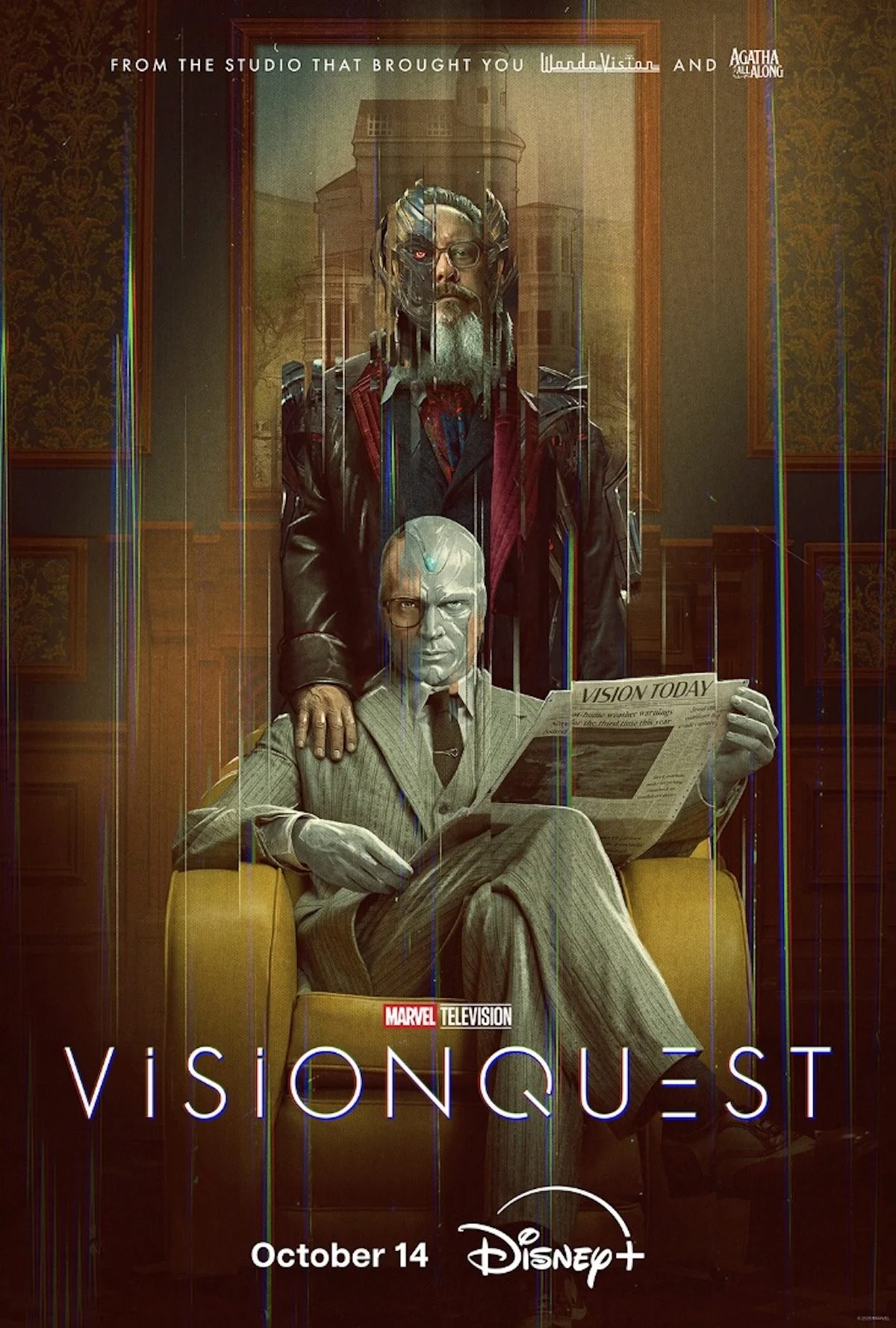
Marvel Studios released the official trailer and promotional poster for the series, eliciting widespread praise across the fandom and critical circles alike. Described as surreal, heartfelt, dangerous, and uniquely funny, the footage indicates that VisionQuest may be one of the strongest post-Infinity Saga television offerings to date.
The official series synopsis released by Marvel reads:
"Vision, rebooted and having escaped from those who sought to weaponize him, has been in hiding. Searching for new meaning, he consults the AI personas embedded in his programming, including F.R.I.D.A.Y., E.D.I.T.H., J.A.R.V.I.S., and the infamous Ultron. His discreet existence ends when a bounty placed on his head thrusts him on the run with Thomas Shepherd, a mysterious boy who may be Vision’s son, reincarnate. As Vision evades capture, he must confront his nature, resist Ultron’s influence, and unravel the enigma that is his young companion if he’s to survive."
Chronology: The Evolution of Wanda and Vision’s Corner of the MCU
To understand the weight of VisionQuest, it is essential to trace the narrative timeline that brought the character to this juncture.
2015 (Avengers: Age of Ultron): Vision is brought to life through the combination of the Mind Stone, Tony Stark and Bruce Banner’s programming, and the malicious consciousness of Ultron. However, Vision ultimately chooses to side with humanity, asserting that life is beautiful precisely because it is finite.
2016–2018 (Captain America: Civil War to Avengers: Infinity War): Vision and Wanda Maximoff attempt to build a quiet life together, which is tragically cut short when Thanos rips the Mind Stone from Vision’s forehead, killing him permanently prior to the Blip.
2021 (WandaVision): Grief-stricken and wielding chaos magic, Wanda unintentionally creates a suburban sitcom reality in Westview, New Jersey. Within this pocket dimension, she conjures a manifestation of Vision from her memories. Concurrently, S.W.O.R.D. reassembles the physical remnants of the original Vision into "White Vision," a weaponized, emotionless drone sent to destroy Wanda’s creation. Following a philosophical duel, the Westview Vision restores White Vision’s lost memories, causing the synthetic hero to fly away to process his newfound identity.
2024 (Agatha All Along): While Agatha Harkness’s coven navigates the Witches’ Road, the thematic reverberations of Wanda’s reality-warping powers and Westview’s aftermath linger over the supernatural side of the MCU.
Late 2026 (VisionQuest): White Vision, now operating independently, goes into hiding. Hunted by unseen forces, he turns inward—consulting the fragmented digital ghosts of his programming—and crosses paths with Thomas Shepherd, setting the stage for a high-stakes cross-country pursuit.
Supporting Data and Production Details
VisionQuest boasts a robust ensemble cast alongside Bettany and Spader. The series features performances from Ruaridh Mollica, Todd Stashwick, T’Nia Miller, Lauren Morais, Orla Brady, Diane Morgan, Polly Frame, Henry Lewis, Jonathan Sayer, Emily Hampshire, and James D’Arcy (reprising his television/cinematic crossover heritage).
Key Production Figures and Metrics:
Platform: Disney+
Premiere Date: October 14, 2026
Showrunner/Creator: Terry Matalas (known for his acclaimed work on Star Trek: Picard Season 3)
Position in Franchise: The final television release before Avengers: Doomsday
The promotional material has leaned heavily into visual dualities. The newly released poster features James Spader and Paul Bettany split between human and robotic forms, teasing a narrative deeply concerned with what it means to possess a soul, whether forged in vibranium or born of flesh.
Official Responses and Creative Direction
The reception to the VisionQuest trailer has been overwhelmingly positive, providing a much-needed morale boost for Marvel Studios’ streaming division. Following a period where critics and fans questioned the overall cohesion and creative direction of the MCU’s Phase 4 and Phase 5 television projects, VisionQuest is being hailed as a return to form.
Early analysis of the trailer highlights the brilliant casting of James Spader. Unlike his voice-only performance as the genocidal robot in Age of Ultron, Spader appears physically in human form within Vision’s mindscape or computational architecture, chewing up the scenery with the sardonic, philosophical menace that made the character a fan-favorite foil to Tony Stark.
Showrunner Terry Matalas has reportedly infused the series with deep-cut Marvel lore. Speculation is already running rampant across fan communities regarding how the show integrates classic Easter eggs—such as potential nods to Captain America lore, the Human Torch, and deep-seated Stark Industries operating systems like F.R.I.D.A.Y., E.D.I.T.H., and J.A.R.V.I.S.
Industry insiders note that Marvel’s decision to position VisionQuest directly ahead of Avengers: Doomsday is a deliberate structural choice. By anchoring the stakes of the wider universe in an intimate, identity-driven character study, Marvel is attempting to replicate the narrative synergy that made its earlier phases so effective.
Implications for the Broader MCU
The release of VisionQuest carries significant weight for the future trajectory of the Multiverse Saga.
1. The Resolution of the Westview Arc
While WandaVision explored grief through the lens of fantasy and sitcom pastiche, and Agatha All Along leaned into dark magic and musical spectacle, VisionQuest brings the trilogy back to its science-fiction roots. It offers closure to the lingering thread of White Vision, resolving the identity crisis sparked in the finale of WandaVision.
2. The Reintroduction of Ultron
Ultron’s return is perhaps the most consequential element of the series. Having been dormant or fractured within various networks since 2015, Ultron’s presence as an internal voice in Vision’s programming represents an ongoing psychological battle. Whether Ultron remains a digital phantom or attempts to construct a physical body to rival his "son" once more will likely alter the cosmic and terrestrial landscape of the MCU. Furthermore, with James Spader’s involvement, fans are speculating whether this version of Ultron will play a role in the upcoming Avengers films.
3. The Reincarnation of Thomas Shepherd
The inclusion of Thomas Shepherd—Wanda and Vision’s magically engineered son, speedster Billy and Tommy’s twin—introduces vital young-hero infrastructure to the MCU. As the universe prepares for a generational shift and massive crossover events like Avengers: Doomsday, establishing characters connected to the Young Avengers or the broader magical/synthetic lineages ensures that the emotional fallout of the Infinity Saga continues to bear fruit.
4. Setting the Stage for Avengers: Doomsday
As the final TV release before the massive team-up film, VisionQuest cannot exist in a vacuum. Its stakes—involving a hunted, powerful synthetic entity, a rogue AI, and a reality-bending young companion—suggest that Vision’s journey will tie directly into the multiversal and existential threats looming over the Avengers.
Conclusion
With its surreal tone, powerhouse performances from Paul Bettany and James Spader, and a deeply personal narrative framework, VisionQuest is shaping up to be a defining moment for Marvel’s streaming output. Audiences will discover whether the series can live up to its sky-high expectations when it premieres on Disney+ on October 14.