
RØDE Unveils Major Firmware 1.4 Update for RØDECaster Video Family: Bringing 4K Capture, NDI HX, and Premiere Pro Integration
Main Facts
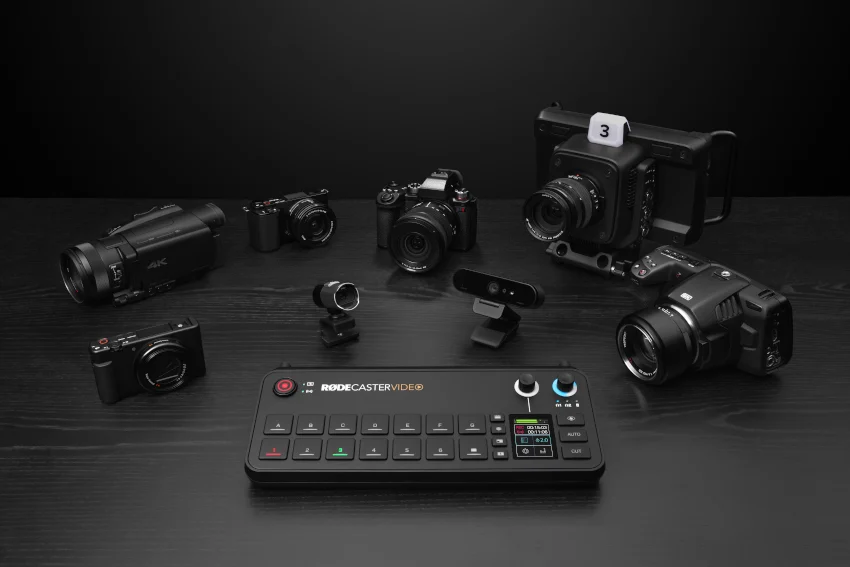
RØDE has announced its most substantial capability expansion to date for the RØDECaster Video ecosystem with the release of firmware version 1.4 (specifically version 1.4.02.1542). Available entirely free of charge, this landmark update fundamentally alters the operational scope of the RØDECaster Video, RØDECaster Video S, and RØDECaster Video Core platforms. By introducing dedicated 4K and Full HD capture modes, the update transitions these devices from conventional live production switchers into robust, multi-camera capture, isolated recording, and network distribution systems.
Key highlights of the firmware 1.4 release include:
- Dedicated 4K Capture Mode: Enables UHD video processing at 3840 x 2160 (UHD30) across multiple HDMI inputs, transforming the hardware into an isolated recording and network distribution hub.
- NDI HX Output Integration: Allows individual camera inputs to be distributed over a local network using low-bandwidth NDI HX with H.264 compression.
- Isolated (ISO) 4K/FHD Recording: Direct recording of independent camera files onto an external SSD using H.264 or H.265 codecs.
- Full HD 60fps Capture Mode: Prioritizes high-frame-rate 1080p60 capture for fast-moving productions, sports, and live events.
- Universal RØDECaster Sync: Extends cross-family synchronization support to the entire RØDECaster Video lineup, integrating seamlessly with RØDECaster Pro II and Duo audio consoles via a single USB-C connection.
- OTIO Timeline Export: Broadens post-production workflows by adding support for Adobe Premiere Pro, building on the previous generation’s DaVinci Resolve EDL capabilities.
- Expanded Audio and Control Features: Includes USB webcam audio capture, Scene Builder keyboard shortcuts, improved monitoring volume controls, and critical performance patches.
Chronology
The evolution of the RØDECaster Video platform has been marked by a steady cadence of firmware refinements since its initial market introduction. Understanding how firmware version 1.4 fits into this trajectory requires looking back at the ecosystem’s development timeline:
- Initial Launch Phase: The RØDECaster Video entered the market as a powerful, compact hybrid production console, winning acclaim for its intuitive interface, HDMI switching, and integrated audio routing capabilities designed primarily around traditional live-streaming and on-the-fly video switching workflows.
- Firmware 1.3 Milestone: RØDE established a foundation for advanced post-production integration by introducing non-linear editing (NLE) timeline export capabilities, notably incorporating initial support for Blackmagic Design’s DaVinci Resolve through Edit Decision List (EDL) exports.
- Early 2026 (Video Core Update): RØDECaster Sync functionality was selectively introduced to the RØDECaster Video Core, allowing it to bridge with audio-centric hardware like the RØDECaster Pro II and Duo.
- March 2026 (Firmware 1.4 Release): RØDE deploys firmware version 1.4 globally. This update acts as a major convergence point, universalizing RØDECaster Sync across the entire video family (Video, Video S, and Video Core) while simultaneously rewriting the device’s processing logic to introduce the brand-new 4K and FHD capture modes.
Supporting Data
The implementation of firmware 1.4 relies on a sophisticated reallocation of hardware processing power. Because real-time UHD video encoding, multi-channel NDI distribution, and independent ISO recording demand immense computing overhead, RØDE has intentionally structured the console around distinct, task-specific operating modes.
Hardware Capacities Across the RØDECaster Video Family
The update scales across the hardware variants with specific input limitations depending on the chosen resolution mode:
- RØDECaster Video (Original): Handles up to four UHD30 inputs in 4K Capture Mode.
- RØDECaster Video S & Video Core: Handle up to three UHD30 inputs in 4K Capture Mode.
- Global Frame Rates: 4K Capture Mode operates at UHD30, while the newly introduced FHD Capture Mode increases the maximum global frame rate to 1080p60.
Codecs, Networking, and Post-Production
- Compression & Bitrate: System-selected codecs (H.264 or H.265) and bitrates apply simultaneously to both internal ISO SSD recordings and network NDI HX outputs.
- Network Protocols: The choice of NDI HX utilizing H.264 rather than full-bandwidth NDI ensures that high-resolution multi-camera feeds can traverse standard local area networks without clogging infrastructure bandwidth.
- Post-Production Interoperability: Open Timeline IO (OTIO) files generated by the system allow editors to seamlessly reconstruct multi-camera shoots within Adobe Premiere Pro, minimizing time spent manually syncing raw footage.
Official Responses and Technical Breakdown
RØDE’s engineering and product development divisions emphasized that firmware 1.4 was designed to solve a fundamental dilemma in modern content creation: the friction between live production switching and high-end multi-camera post-production acquisition.
Prioritizing Throughput Over Live Switching
In official technical briefings accompanying the release, RØDE highlighted that the new 4K and Full HD capture modes intentionally sacrifice certain live-switching features to maximize hardware throughput. When operating in Standard Mode, the RØDECaster Video functions as a fully featured live production switcher complete with graphics overlays, keying, transitions, direct RTMP/SRT streaming, and custom multi-camera scenes.

However, engaging 4K Capture Mode or FHD Capture Mode reallocates processing power strictly toward acquisition and distribution. Consequently, advanced creative switching functions are disabled, leaving simple HDMI switching primarily reserved for monitoring purposes. This division ensures that the device never compromises stability when tasked with writing multiple high-bitrate video streams to an external SSD while simultaneously pushing real-time NDI feeds across a network.
Unifying Audio and Video: RØDECaster Sync
The expansion of RØDECaster Sync across the entire video family represents a major design triumph. By connecting a RØDECaster Video, Video S, or Video Core to a RØDECaster Pro II or RØDECaster Duo via a single USB-C cable, users merge two historically separate production paradigms.
- The audio console (Pro II or Duo) contributes physical and virtual faders, mute and listen controls, SMART Pads, and comprehensive touchscreen management.
- The combined system utilizes a unified nine-channel audio mixer, allowing inputs from either device to be freely routed.
- Furthermore, each NDI output stream can be paired with a custom-tailored audio mix, granting producers granular control over what audio travels to specific network destinations.
Implications
The deployment of firmware 1.4 fundamentally changes how creators, educators, corporate media teams, and live-event producers evaluate the RØDECaster Video ecosystem.
Expanding Beyond the Live Switcher Box
Historically, hardware switchers pigeonholed users into recording a single "program out" feed—meaning whatever mistakes were made during a live switch were baked permanently into the final recording. With the introduction of isolated 4K and 1080p60 recording paired with NDI HX network distribution, the RØDECaster Video transcends its identity as a simple live-streaming appliance. It now acts as a centralized multi-camera acquisition node.
Filmmakers covering live panels, musical performances, or corporate seminars can capture pristine, unswitched camera files for deep editorial reframing, color grading, and correction in post-production. Meanwhile, video village monitors and remote recording stations can pull clean, individual camera feeds over the local network via NDI HX without requiring complex, dedicated capture card hardware for every single camera source.
Bridging Hardware and Editing Suites
The integration of OTIO timeline export for Adobe Premiere Pro—following the earlier inclusion of DaVinci Resolve EDL support—signals RØDE’s deep commitment to closing the gap between production hardware and professional NLE software. By automating the timeline assembly process, the friction of ingesting multi-camera, multi-source recordings is drastically reduced. Editors can jump straight into the creative phase of storytelling rather than spending hours aligning timecodes and grouping clips manually.
A Cost-Effective Evolutionary Step
Perhaps the most significant implication for current owners is that these sweeping operational upgrades require zero hardware expenditure. By unlocking these capabilities entirely via a free firmware update, RØDE has significantly extended the lifecycle and utility of existing hardware investments. Whether deployed as a live streaming switcher, a multi-camera UHD acquisition recorder, or as part of a synchronized hybrid audio-video production studio alongside a RØDECaster Pro II, version 1.4 positions the RØDECaster Video family as one of the most versatile and adaptable toolsets available in modern content creation.
