
Boldly Going Where No Cartoon Has Gone Before: The Enduring, Complex Relationship Between South Park and Star Gene
Main Facts: A Three-Decade Love Affair with Science Fiction’s Royal Family
For nearly thirty years, Comedy Central’s flagship animated satire, South Park, has targeted nearly every facet of modern culture, politics, and media. Creators Trey Parker and Matt Stone have skewered Hollywood blockbusters, internet subcultures, geopolitical conflicts, and contemporary religious movements with equal amounts of irreverence and biting wit. Yet, amidst this chaotic landscape of social commentary, one specific cultural touchstone has remained a recurring obsession: the Star Trek franchise.
From quick, blink-and-you-miss-it background gags to entire narrative arcs anchored by deep-cut science fiction tropes, Star Trek has functioned as a foundational mythology for South Park. According to Trey Parker, the iconic space opera franchise was practically a religion during his formative years. Despite Parker and Stone’s penchant for relentless mockery, their references to Gene Roddenberry’s universe rarely stem from pure contempt. Instead, they represent a genuine, lifelong fandom wrapped tightly in layers of biting, self-aware parody.
The comprehensive Star Trek fan-wiki, Memory Alpha, catalogs dozens of direct and indirect homages featured across South Park’s extensive run. While some of these nods are fleeting background jokes, others serve as critical, load-bearing narrative devices that cleverly subvert the very sci-fi tropes that helped shape the modern television landscape.
Chronology: Five Defining Moments of South Park’s Star Trek Infatuation
1. The Genesis: Season 2’s "City on the Edge of Forever"
The creative collision between the mountain town of South Park and the final frontier began early in the show’s lifespan. Season 2 episode "City on the Edge of Forever" borrowed its title directly from the celebrated Star Trek: The Original Series (TOS) episode written by Harlan Ellison. While the original TOS outing is widely regarded as one of the finest hours in television history—featuring Captain Kirk and Spock traveling back in time to 1930s New York—Parker and Stone adapted the title for a much more claustrophobic premise: Stan, Kyle, Cartman, and Kenny trapped inside a school bus dangling perilously over a cliff while recounting past adventures in a classic clip-show format.
The episode’s most explicit homage to TOS occurs when a nameless child wearing a red shirt and a Starfleet insignia steps off the bus, only to be instantly obliterated by a monstrous creature lurking outside. This was an overt nod to the infamous "redshirt" trope, where disposable security personnel accompanying the main landing party to hostile alien planets inevitably met grisly demises. Paradoxically, while Star Trek protected its core bridge crew by sacrificing unnamed redshirts, South Park applied the exact opposite philosophy to Kenny McCormick, killing off the parka-wearing fourth-grader in almost every single episode until the show’s fifth season.
2. The Mirror Universe: Exploring Morality in "Spookyfish"
Later in Season 2, South Park took on another legendary science fiction trope: the evil parallel dimension. In the episode "Spookyfish," Eric Cartman returns to the school bus stop sporting a neat goatee and behaving with uncharacteristic politeness and warmth. Stan, Kyle, and Kenny quickly deduce that this is not their usual sociopathic classmate, but rather an alternate-universe counterpart where all morality is completely inverted.
This storyline was a direct satire of the Mirror Universe, first introduced in the TOS episode "Mirror, Mirror" and later revisited extensively across Deep Space Nine, Enterprise, and Discovery. In traditional Star Trek fashion, characters from the Mirror Universe are defined by facial hair and sheer malice. South Park, however, subverted the formula by making the alternate Cartman a genuinely pleasant boy, creating a comedic conflict where the main characters actively attempt to banish the original, hateful Cartman to the parallel dimension instead.
3. Deep-Cut Continuity: The Star Trek Nerds in "4th Grade"
When Parker and Stone decided to age the protagonists up from the third to the fourth grade in Season 4, they introduced a pair of obsessive, glasses-wearing schoolmates known colloquially as the "Star Trek Nerds." Desperate to escape the responsibilities of fourth-grade life and return to the simpler times of the third grade, the boys enlist these sci-fi enthusiasts to construct a functional time machine.
This episode stands out as arguably the most explicit deep dive into TOS and The Next Generation continuity in the show’s history. The Star Trek Nerds passionately debate competing theoretical models of cinematic time travel, contrasting the "Mr. Spock Theory" (slingshotting a starship around the sun, as seen in Star Tomorrow) with the "Lieutenant Commander Data Theory" (temporal mechanics driven by magnetic vibration from Time’s Arrow).
Notably, the nerds engage in a fierce argument regarding the total number of produced TOS episodes, with one claiming 72 and the other insisting on 73. Both figures are factually incorrect—the original series ran for precisely 79 episodes. Given Parker and Stone’s encyclopedic knowledge of the franchise, this error was almost certainly an intentional troll designed to provoke pedantic reactions from the very audience segment most likely to spot the discrepancy.
4. The Animated Cameo That Wasn’t: Michael Dorn in "Fun with Veal"
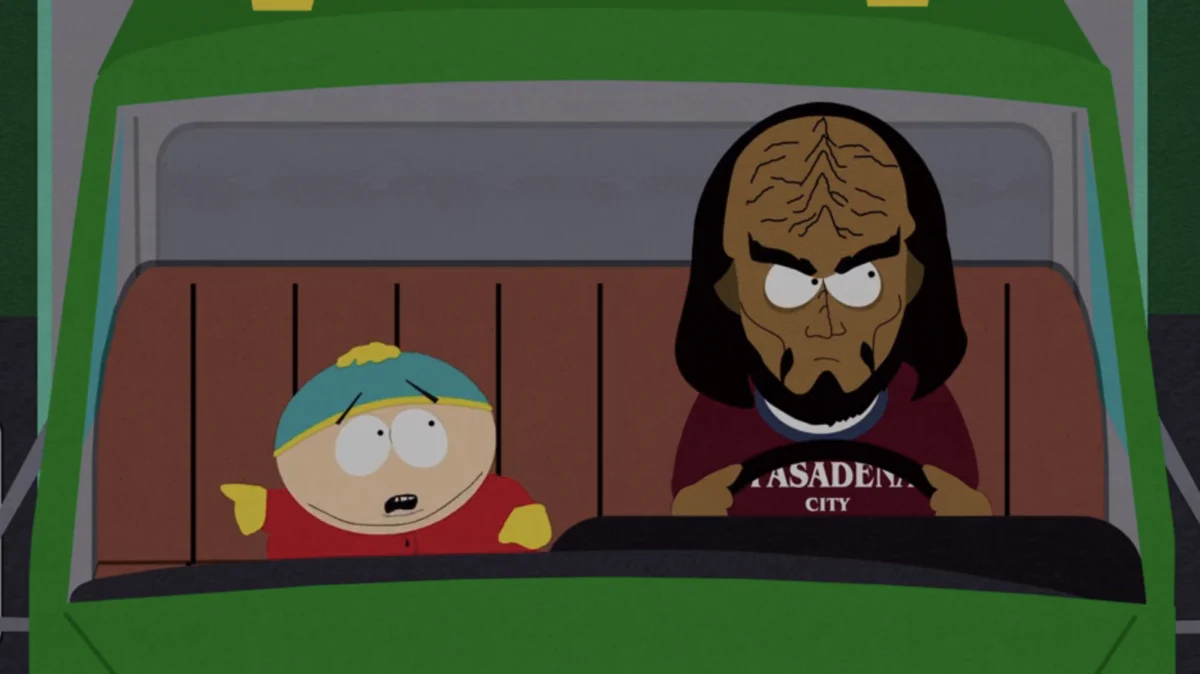
By Season 6, South Park’s engagement with Star Trek graduated from conceptual parody to direct corporate-cultural intersection. In "Fun with Veal," the boys stage a militant rescue operation to save a group of doomed calves from a slaughterhouse, holding hostages and demanding specialized transit. Cartman specifically insists that "the guy who plays Worf" drive their getaway vehicle.
To the delight of sci-fi fans, an animated version of actor Michael Dorn appears on screen, fully adorned in his iconic Klingon forehead prosthetics and uniform. Grudgingly acquiescing to Cartman’s absurd demands, Dorn’s character refuses to commit murder, prompting Cartman to berate him with the immortal line: "Some goddamn Klingon you are!"
Because Parker and Stone historically avoided celebrity voice cameos—with rare exceptions like George Clooney’s barking dog in Season 1—Matt Stone originally voiced the animated rendition of Worf. However, this creative choice yielded an amusing behind-the-scenes revelation years later.
Supporting Data: The Untold Michael Dorn Story
While South Park creators historically enjoyed utilizing internal voice talent, subsequent interviews revealed that securing the real Michael Dorn would not only have been possible, but enthusiastically welcomed by the actor himself.
During a 2015 Reddit "Ask Me Anything" (AMA) session, a fan asked Michael Dorn about his appearance in "Fun with Veal." Dorn responded with a mixture of amusement and genuine frustration:
"I am a HUGE fan of South Park, and I was actually a bit pissed off that they didn’t reach out to me for that episode. I would’ve done it for nothing."
Despite never being officially contacted by the production team, Dorn’s embrace of the parody highlights the mutual respect flowing between the two cultural phenomena. The intersection of Star Trek and South Park demonstrates how high-brow science fiction world-building can be seamlessly fused with low-brow, anarchic satire without losing its core identity.
5. Extreme Homage: "Pre-School" and The Menagerie
One of the darkest visual homages to Star Trek arrived in Season 8’s "Pre-School." While the primary narrative framework of the episode acts as a parody of Martin Scorsese’s psychological thriller Cape Fear—following the boys as they evade a vengeful ex-convict named Trent Boyett—the visual design of preschool teacher Miss Claridge borrows heavily from one of the most famous episodes of Star Trek: Original Series: "The Menagerie."
In Matt Stone and Trey Parker’s official DVD commentary for Season 8, the creators openly acknowledged the visual inspiration. Just like Fleet Captain Christopher Pike in "The Menagerie," Miss Claridge is confined entirely to an advanced, motorized black wheelchair following a horrific accident, with only her severely scarred face and expressive eyes visible. Communication is reduced to a binary system of audio tones: a single beep signifying affirmation and a double beep indicating denial.
True to the stylistic DNA of South Park, however, the homage quickly escalates past its cinematic source material into surreal violence. While Christopher Pike eventually finds peace living out an illusionary existence on Talos IV, Miss Claridge’s mechanical wheelchair suffers a chaotic malfunction after being struck by a stray taser, crashing first into a propane storefront and subsequently triggering an attack by stray neighborhood cats.
Official Responses and Creative Commentary
The enduring presence of Star Trek within South Park is not merely accidental window dressing; it represents a core pillar of the creators’ comedic philosophy. Trey Parker’s candid admission that Star Trek functioned as his childhood "mythology" provides critical context for why the series returns to the well so frequently.
In various retrospective interviews and commentary tracks, Parker and Stone have emphasized that parody requires deep familiarity. To effectively ridicule a franchise, creators must understand its mechanics, pacing, emotional beats, and internal logic. The precision with which South Park targets specific plot points—such as the exact mechanics of temporal mechanics in The Next Generation or the bureaucratic quirks of Starfleet discipline—proves that the writers room operates with a high level of institutional knowledge regarding classic television science fiction.
Furthermore, veteran actors from the Star Trek universe have frequently expressed admiration for how modern satire engages with their legacy. Even when left out of the recording booth like Michael Dorn, the overarching sentiment from the sci-fi community has been one of affectionate acknowledgment.
Implications: How Star Trek Shaped Modern Satire
The intersection of South Park and Star Trek offers a fascinating case study in how foundational media properties influence contemporary counterculture. When Gene Roddenberry launched The Original Series in 1966, he envisioned an optimistic, utopian future where humanity had overcome its base instincts of war, greed, and bigotry.
Conversely, South Park operates on the fundamental assumption that human nature is inherently absurd, petty, and driven by base impulses. By filtering the idealistic tropes of Star Trek through the cynical lens of small-town Colorado children, Parker and Stone created a unique comedic friction.
The Cultural Legacy of Sci-Fi Satire
- Deconstruction of Tropes: By juxtaposing the sterile, professional danger of Starfleet away missions with the casual, absurd mortality of South Park (exemplified by the redshirt-Kenny parallels), the show helped pioneer a modern meta-narrative style where audiences are encouraged to laugh at the artificiality of television conventions.
- Generational Bridge-Building: South Park effectively introduced classic 1960s and 1990s television science fiction concepts to younger demographic cohorts who might otherwise never have engaged with serialized space operas.
- Legitimization of Fandom: By treating Star Trek lore with equal parts deep reverence and utter disrespect, the series validated the obsessive nature of modern geek culture while simultaneously keeping fan communities humble.
Ultimately, South Park’s ongoing conversation with the Star Trek universe underscores a fundamental truth about television history: the most biting satires are almost always born out of a place of deep, foundational affection. Whether mocking Captain Kirk’s historical fistfights, Captain Pike’s beeping wheelchair, or Worf’s stoic warrior code, Trey Parker and Matt Stone have ensured that Starfleet’s legacy remains permanently etched into the annals of animated comedy.
