
Beyond the Blueprint: Screenwriter Matt R. Lohr on the Craft, Chaos, and Legacy of Dan O’Bannon
In the labyrinthine world of screenwriting, writers spend decades chasing chimeras: the perfect formula, the rigid three-act architecture, the mathematically precise inciting incident, and the exact sequence of plot points engineered to transform an ordinary script into cinematic gold. Yet, film history reveals a fascinating paradox. Many of the greatest, most enduring motion pictures of the last half-century were penned by creators who understood that structure is never the final destination. Rather, it is merely the engine room—the essential machinery that allows a story to breathe, convulse, and come alive.
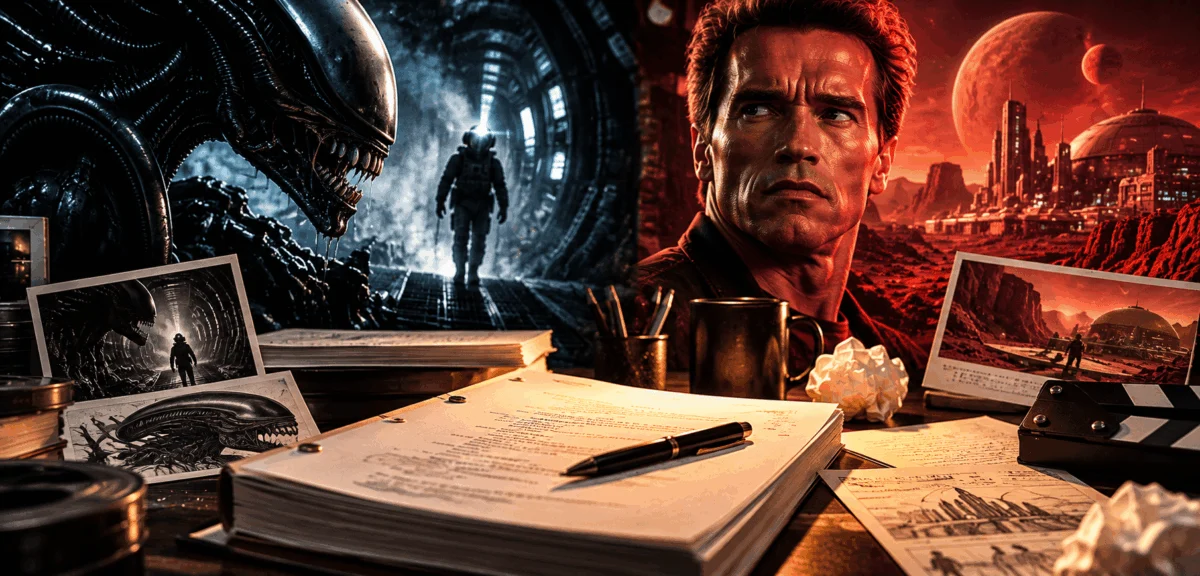
In a comprehensive and illuminating masterclass discussion, award-winning screenwriter, essayist, film critic, and co-author Matt R. Lohr pulls back the curtain on the mechanics of storytelling. As the co-author of The Dan O’Bannon Guide to Screenplay Structure, Lohr shares profound insights gleaned from working directly alongside one of Hollywood’s most visionary and wildly imaginative minds: the late Dan O’Bannon, the creative force behind cinematic masterpieces like Alien, Total Recall, and The Return of the Living Dead.
Main Facts: A Masterclass in Collaborative Legacy
The core of Lohr’s narrative centers on his unlikely partnership with O’Bannon, which began during Lohr’s graduate studies at Chapman University. What started as an academic assignment blossomed into a multi-year mentorship and a posthumous literary stewardship.
Following O’Bannon’s passing in 2009, his widow, Diane O’Bannon, entrusted Lohr with completing and polishing her late husband’s manuscript. The resulting book is not merely a technical manual; it is a synthesis of O’Bannon’s hard-won wisdom, drawing on theoretical frameworks from Aristotle to Syd Field while remaining grounded in the messy, practical realities of professional screenwriting.
The collaboration offers vital takeaways for contemporary storytellers:
- Structure as Scaffolding: Structure is designed to support character and tension, not to shackle creativity.
- The Evolution of Conflict: Great screenplays organically transform the audience’s emotional relationship to the story, shifting genres and stakes naturally (as seen in Alien).
- Dialogue is Performance: Words on a page must be tested against the human breath and vocal cords.
- Storyteller First: Genre elements—monsters, spaceships, and gore—are merely the wrapping paper for universal human narratives.
Chronology: From Chapman University to Pacific Palisades
Lohr’s journey into O’Bannon’s eccentric orbit reads like a classic Hollywood-adjacent anecdote, marked by academic ambition, sudden twists, and a healthy dose of surrealism.
The Graduate Student and the Filmmaker-in-Residence
While pursuing his MFA in screenwriting at Chapman University, Lohr was deeply entrenched in writing his thesis under the guidance of Leonard Schrader, the Academy Award-nominated screenwriter of Kiss of the Spider Woman. At the time, Dan O’Bannon—already a legendary figure in sci-fi and horror—was serving as the school’s filmmaker-in-residence.
When Schrader casually mentioned that O’Bannon was looking for a capable writer to help him organize and flesh out a book on screenwriting, Lohr’s cohort recognized a generational opportunity. Soon, Lohr found himself renting cars, driving from Orange County up to O’Bannon’s home in Pacific Palisades, and stepping into a collaborative crucible.
The Unconventional Introduction
Their very first meeting shattered any expectations of a formal, ivory-tower mentorship. After just a few minutes of polite studio-style small talk, O’Bannon fixed his gaze on Lohr and asked a blunt question: "Have you ever taken psychedelic drugs?"
When Lohr confessed he hadn’t, O’Bannon dryly remarked that he looked like Clark Kent. It was an appropriately mind-bending introduction to a creator whose career was built on subverting expectations and plunging ordinary people into extraordinary, terrifying circumstances.
Completing the Manuscript
Over the next two years, Lohr worked side-by-side with O’Bannon, analyzing classic films, dissecting structural beats, and helping structure the book that would stand as O’Bannon’s definitive pedagogical legacy. Following O’Bannon’s death in 2009, Diane O’Bannon approached Lohr with a formidable task: take the extensive notes, outlines, and partial drafts and shepherd them across the finish line. Lohr spent an additional year organizing, polishing, and safeguarding O’Bannon’s singular voice, ensuring the book captured the provocateur’s authentic perspective.
Supporting Data and Analysis: Dissecting Alien and the Anatomy of Terror
What elevates Lohr’s insights above standard screenwriting advice is the caliber of the work he studied. O’Bannon didn’t have to speculate on what worked; he had engineered films that terrified and enthralled global audiences.
The Genre Shift in Alien
During the conversation, Lohr breaks down the structural brilliance of Alien (1979) as a masterclass in evolving audience expectations. The first half of the film functions almost entirely as hard science fiction. The Nostromo crew are blue-collar space truckers driven by curiosity and corporate obligation. They investigate a mysterious signal, explore an alien vessel, and try to decode an incomprehensible cosmic puzzle.
Then comes the legendary chestburster sequence. Instantly, the DNA of the film mutates. Curiosity evaporates, replaced entirely by primordial terror. The characters no longer care where the creature came from or what its scientific implications are; they want to survive. The narrative successfully pivots from an exploration of the unknown to an unyielding flight from it.
Character Chemistry vs. Modern Spectacle
Lohr points out that this structural sleight-of-hand only works because the audience genuinely believes in the characters before the horror strikes. The crew of the Nostromo feel like hard-working people who have logged years together. Their gripes, banter, and professional exhaustion feel tactile and real.
Lohr contrasts this with Ridley Scott’s later prequel, Prometheus. In Prometheus, the characters often lack natural camaraderie, making it harder for the audience to invest emotionally when things go lethally wrong. Lohr’s takeaway is stark: high-end spectacle can capture an audience’s eye, but authentic character dynamics are what keep them emotionally hooked.
Official Responses and Practical Craft: The Reality of Writing Dialogue
Moving from macro-level structure to micro-level execution, Lohr offers one of the most immediately actionable pieces of advice for any writer sitting in front of a blank document: read your dialogue aloud.
"You’re not writing words that have to live on a page. You’re writing lines that actors have to be able to say."
Lohr emphasizes that text can look poetic, clever, or structurally efficient in screenwriting software yet sound utterly wooden when spoken by a human being. Dialogue must carry rhythm, subtext, intention, and the unpredictable cadence of real human interaction. Great dialogue, Lohr notes, is born of acute listening—absorbing how people actually talk rather than how writers think people talk.
Interestingly, O’Bannon’s guide did not attempt to solve every single aspect of screenwriting. O’Bannon openly acknowledged that certain elements—particularly dialogue and innate artistic flair—reside in the realm of individual talent. Instead, the book focuses heavily on giving writers a diagnostic structural framework. When a script stalls, a writer trained in O’Bannon’s mechanics doesn’t just rewrite blindly; they can diagnose where the dramatic foundation has cracked.
Implications: Originality, IP Obsession, and Independent Cinema
The conversation inevitably turns to the economic realities of contemporary Hollywood, where originality often takes a backseat to familiar Intellectual Property (IP).
The Tyranny of Presale Value
Studio executives are perpetually obsessed with "presale value"—the perceived commercial safety net of an audience already recognizing a brand. This explains the endless pipeline of sequels, reboots, comic-book adaptations, and toy-line cinematic universes. For a writer crafting a wholly original spec script, breaking through the noise can feel insurmountable. A brilliant, risky original concept often struggles for scraps while a derivative, brand-name project receives fast-track financing before its narrative flaws are even resolved.
The Independent Sanctuary and Horror as a Star
However, Lohr notes that independent filmmaking offers a vital sanctuary for original voices, particularly within the horror genre. Horror possesses a unique structural advantage: the genre itself often functions as the primary "star." Audiences frequently patronize horror films not because of a bankable movie star, but out of an appetite for the genre itself.
This built-in audience grants independent filmmakers the freedom to take creative risks—though Lohr issues a strong warning. Built-in genre enthusiasm is not a license to rely on lazy jump scares or tired clichés. The best independent horror uses the elasticity of the genre to smuggle in deep psychological, emotional, and social commentary.
Conclusion: The Ultimate Identity of a Storyteller
Near the conclusion of the interview, Lohr shares what is perhaps his most defining takeaway from his time with Dan O’Bannon. Despite writing some of the most iconic science fiction, action, and horror films of the 20th century, O’Bannon never viewed himself narrowly as a "genre writer." He viewed himself simply as a storyteller.
As Lohr recalls, O’Bannon often summarized his creative philosophy with striking simplicity:
"I’m a storyteller. A lot of my stories just happen to involve monsters and things from outer space."
This ethos cuts through the corporate anxiety of modern Hollywood. Before worrying about algorithm trends, streaming metrics, or commercial formulas, a writer must fall in love with the core of their narrative. Whether shooting a micro-budget creature feature in a cramped basement or drafting a high-concept sci-fi epic, the scale of the production never dictates the seriousness with which a writer should approach the craft.
Structure provides the skeleton, character provides the heartbeat, and imagination provides the skin. But it is a genuine love for the shared human experience of storytelling that brings the whole creation to life. For writers struggling to finish their next draft, Lohr’s masterclass offers a clear directive: stop hunting for magical formulas. Return to the characters, stress-test your structure, speak your dialogue into the room, and tell a story truly worth experiencing.
