
The High-Stakes Battle for ‘Who’s Afraid of Virginia Woolf?’: A Portrait of Creative Chaos
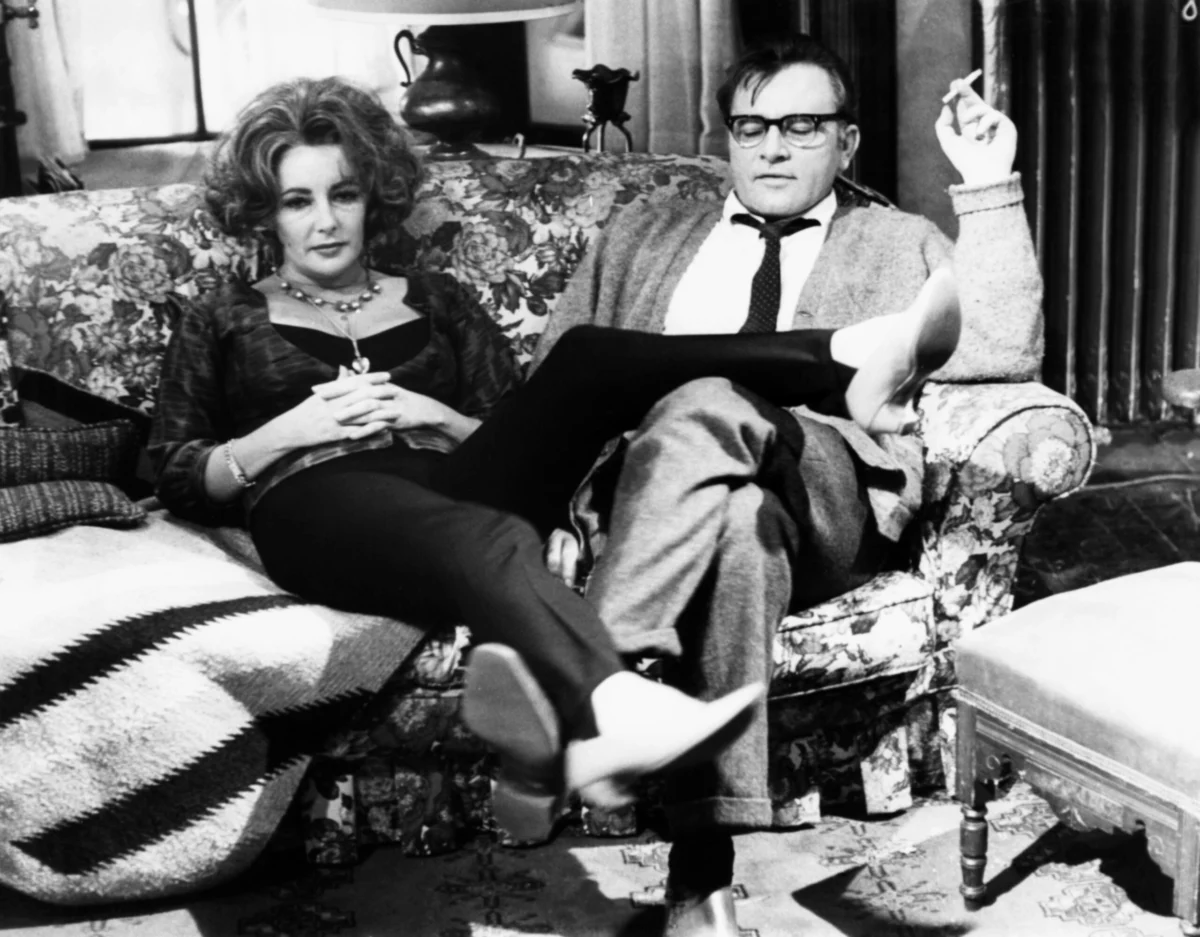
The 1966 film adaptation of Edward Albee’s Who’s Afraid of Virginia Woolf? stands as a monolithic achievement in American cinema—a visceral, black-and-white descent into the psychological purgatory of a marriage in collapse. Yet, behind the critical acclaim and the iconic performances of Elizabeth Taylor and Richard Burton, the production was a battlefield. It was a project defined by existential stakes for everyone involved: a test of mettle for a first-time film director, a career-defining gamble for a seasoned screenwriter turned producer, and a high-wire act for a legendary actress attempting to redefine her craft.
The Stakes of 1966: A High-Pressure Crucible
Every major player in the production carried the weight of their own professional reputation. For Elizabeth Taylor, the role of the middle-aged, venom-tongued Martha was not just a character; it was a crusade to shed the "movie star" veneer and prove her mettle as a serious dramatic actor. The transformation required a physical and emotional vulnerability she had rarely been asked to provide.
For producer Ernest Lehman, moving from the screenwriting chair—having penned classics like North by Northwest and Sweet Smell of Success—to the producer’s office was a volatile transition. His credibility in the new role rested entirely on the success of this adaptation. Meanwhile, director Mike Nichols, fresh off a string of triumphs on Broadway, arrived in Hollywood carrying the heavy label of "boy genius." This project was his feature film directorial debut; it was the moment he would either solidify his legend or prove, as his detractors hoped, that he was utterly out of his depth in the machinery of the studio system.
The climate of the time made their creative choices appear even more radical. The decision to film in black-and-white in 1966 was viewed by studio head Jack Warner as an archaic, prestige-destroying move. Nichols and Lehman found themselves in a perpetual state of trench warfare with Warner, who viewed their artistic sensibilities as a threat to the film’s commercial viability.

A Chronology of Conflict
The tension between the production team and studio leadership reached a fever pitch in early 1966. On January 5, Jack Warner issued a memo demanding the final cut be ready by March 1 to satisfy a tax deadline. The memo cited an agreement with composer Alex North—a Hollywood legend known for his work on A Streetcar Named Desire and Spartacus—to meet this aggressive schedule.
However, the directive was built on a foundation of miscommunication. When Lehman reached out to North, the composer was shocked to learn he was supposedly committed to a deadline for a film for which he had seen no footage and held no creative discussions. North rightfully balked, noting the impossibility of composing a score for such a dense, character-driven work under such constraints.
This triggered a chain reaction of volatile confrontations:
- January 1966: Nichols storms into Warner’s office, threatening to take his grievances to the press if the studio continues to compromise the artistic integrity of the film.
- The Internal Feud: Immediately following his victory over Warner, Nichols turned his aggression on his producer, Ernest Lehman. In a scathing monologue, Nichols accused Lehman of being self-serving and emotionally manipulative.
- The Musical Stalemate: By early February, the relationship between Nichols and North had deteriorated. Despite North’s illustrious career, Nichols demanded to hear themes played on a piano before a note was written, an affront that only deepened the mutual hostility.
- The Final Breaking Point: On February 8, with the deadline looming, Nichols unilaterally fired North without consulting his producer. His subsequent attempt to recruit his friend Leonard Bernstein—after an failed pursuit of André Previn—was the final straw that led to his temporary exile from the Warner Bros. lot.
Psychological Projection and Professional Power Plays
The relationship between Nichols and Lehman is a textbook study of creative friction. In his private journals, Lehman recorded a series of accusations leveled against him by Nichols, which included claims that Lehman prioritized his own image over the film’s quality.

The irony, as noted by observers like Philip Gefter in his book Cocktails With George and Martha, is that Nichols’ criticisms were mirror images of his own behavior. The two men were locked in a cycle of projection, where each accused the other of the very narcissism they were both exhibiting. Despite these "verbal slap downs," the two maintained a veneer of professional civility, often shaking hands or clearing the air after outbursts, only to return to the fray the next day. This dynamic—a mix of deep-seated intellectual respect and personal contempt—became the engine of the film’s frantic, pressurized energy.
Supporting Data: The Composer’s Dilemma
Alex North was not merely a hired hand; he was a titan of mid-century film scoring. By 1966, he had earned nine Academy Award nominations. His perspective on the conflict highlights the growing divide between the "Old Hollywood" guard and the new wave of directors represented by Nichols.
According to editor Robert O’Steen, the conflict was less about music and more about control. North’s desire for artistic autonomy clashed with Nichols’ desire for total, singular creative vision. O’Steen famously remarked that he warned Nichols against fighting Warner over the composer, urging him not to push the studio into a corner. Nichols, however, was undeterred. His insistence on his own vision—at the expense of established industry protocols—was the defining characteristic of his tenure on the film.
Official Responses and Studio Dynamics
The studio, under the iron fist of Jack Warner, viewed the creative process as a logistical problem to be solved through deadlines and efficiency. For Warner, the film was a product; for Nichols, it was a piece of theatre on celluloid. This fundamental philosophical divide explains why the production felt like a series of constant, escalating crises.

Lehman, caught in the middle, acted as the buffer between the director’s volatile genius and the studio’s bottom-line anxieties. His journals reveal a man who was deeply aware of the "sneaky and dishonest" nature of his work, yet he remained committed to the project’s success, often documenting the indignities of his collaboration with Nichols as if keeping an account for posterity.
Implications: The Legacy of the Struggle
The legacy of Who’s Afraid of Virginia Woolf? is often discussed in terms of its impact on the Motion Picture Association’s rating system and its seismic shift in the portrayal of domestic trauma. However, the true implication of its production history lies in the cost of that success.
The film proved that "difficult" collaborations—marked by ego, power plays, and near-firings—could result in masterpieces. It marked a turning point in the industry where the "director as auteur" began to supersede the "studio as manufacturer." While Nichols was briefly kicked off the film, his eventual return and the film’s subsequent critical and commercial triumph validated his approach.
The struggle between Nichols, Lehman, and the studio was not just a series of petty grievances; it was a microcosm of the evolution of American cinema. By pushing for a modern, minimal score and resisting the standard Hollywood polish, Nichols and his team effectively broke the mold. They proved that if a film is to hold a mirror up to the darkness of human nature, the process of creating it must sometimes embrace that same darkness. The story of Virginia Woolf remains a haunting reminder that, in the high-stakes game of filmmaking, the most profound art is often born from the most unsustainable pressure.
