
In Conversation: Unmasking the Icon in American Pachuco: The Legend of Luis Valdez
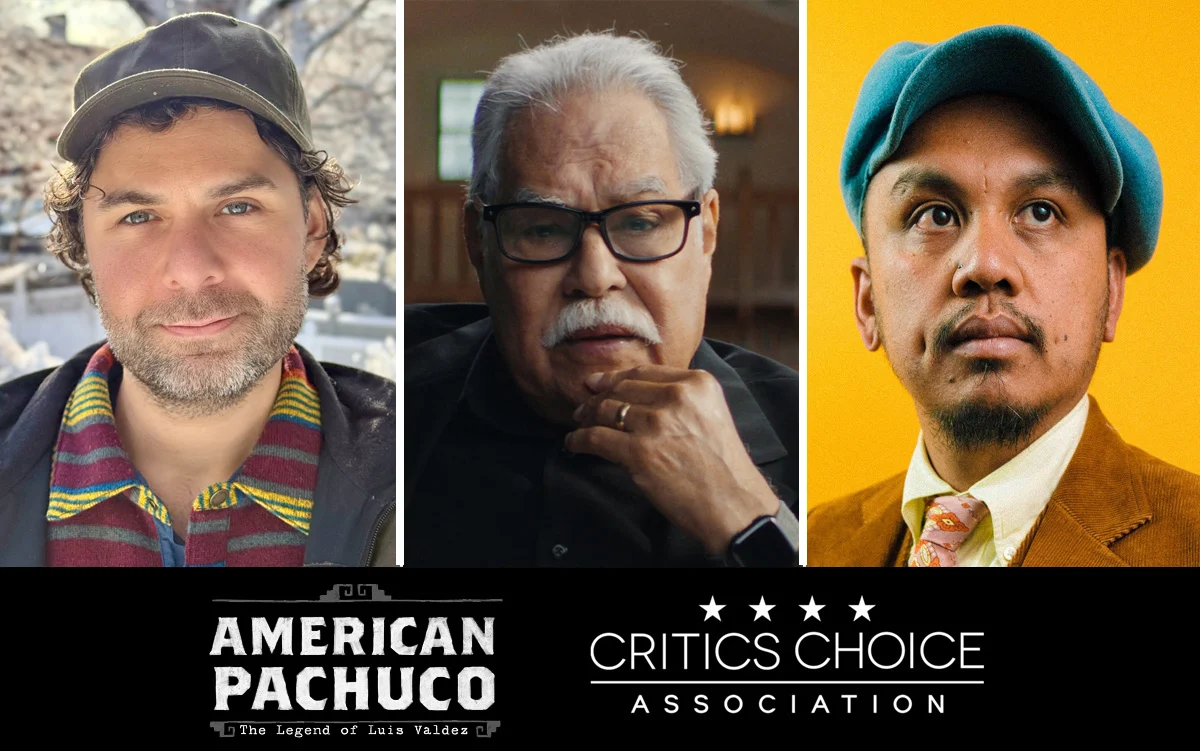
The landscape of American cultural history has long been defined by those who dared to bring marginalized narratives into the spotlight. Among the most influential of these figures is Luis Valdez, the visionary playwright, director, and activist often heralded as the father of Chicano theater. This year, his monumental life and career receive the definitive cinematic treatment in American Pachuco: The Legend of Luis Valdez.
Following a triumphant festival run—which included securing both the U.S. Documentary Audience Award and the Festival Favorite Award at the 2026 Sundance Film Festival—the documentary successfully completed a sprawling 40-city theatrical tour. Now, the film is poised to reach a national audience, with its premiere set for PBS’s American Masters on October 6.
In a recent exclusive roundtable hosted by Critics Choice Association (CCA) member Tim Cogshell, the film’s subjects and creators—Luis Valdez himself, director David Alvarado, and producer Everett Katigbak—discussed the arduous process of capturing a legacy that spans decades of political resistance, artistic innovation, and cultural reclamation.
The Genesis of an Icon: Chronology of a Revolution
To understand the weight of American Pachuco, one must understand the trajectory of Luis Valdez’s career. Valdez did not merely write plays; he fundamentally altered the American theatrical landscape.
- The 1960s (The Birth of El Teatro Campesino): Emerging from the United Farm Workers movement, Valdez founded El Teatro Campesino in 1965. His early works, or actos, were performed on flatbed trucks in the fields, providing a voice for laborers during the Delano Grape Strike. This period established the core of his philosophy: art as a tool for social mobilization.
- The 1970s and 80s (The Crossover): Valdez broke barriers by taking Chicano narratives to the mainstream. His play Zoot Suit (1978) became the first Chicano-written play to reach Broadway, and his 1987 biopic La Bamba became a cultural phenomenon, proving that stories rooted in Mexican-American identity held universal appeal.
- The 2020s (The Archival Rescue): As the documentary details, the preservation of Valdez’s history was in jeopardy. A central triumph of the production was the rescue and restoration of over 80,000 feet of original film footage documenting El Teatro Campesino. This archival work forms the visual backbone of American Pachuco, providing an intimate, raw look at the movement’s infancy.
Artistic Innovation: Crafting the Narrative
During the CCA conversation, director David Alvarado addressed the unconventional storytelling techniques employed in the documentary. Most notably, the team made the daring decision to incorporate a fictional narrator to guide the audience through the labyrinthine history of Chicano theater.
"We didn’t want a standard ‘talking head’ retrospective," Alvarado explained. "We wanted to capture the spirit of the Pachuco—the archetypal figure that Valdez himself elevated to iconic status in Zoot Suit. The narrator acts as a bridge between the historical archives and the modern spectator, maintaining the theatricality that Valdez championed."
The narration, performed by the legendary Edward James Olmos, provides a gravitas that anchors the film’s ambitious scope. Olmos, who starred in the original film adaptation of Zoot Suit, serves as both a peer and an observer, offering a perspective that is deeply personal and historically informed.
Supporting Data: The Scale of the Achievement
The production of American Pachuco was a feat of historical preservation as much as filmmaking. According to producer Everett Katigbak, the team faced significant hurdles in organizing the chaotic, decaying archives of El Teatro Campesino.
"We were dealing with 80,000 feet of film that had been sitting in storage for decades," Katigbak noted during the interview. "The process of digitizing and restoring this footage was essentially a forensic project. We weren’t just making a movie; we were recovering a missing chapter of American history."
The film’s success at Sundance—measured not only by the two prestigious awards but by the intense audience engagement during its 40-city tour—highlights a growing hunger for films that celebrate the contributions of Chicano artists to the broader American canon. The transition to PBS’s American Masters marks a significant milestone, ensuring that the legacy of Valdez will be archived for educational and historical study in perpetuity.
Official Responses and Perspectives
For Luis Valdez, the documentary is less a biography and more a reflection on the collective struggle of his community. When asked about his thoughts on being the subject of such an exhaustive project, Valdez emphasized the collaborative nature of his life’s work.
"It’s not just about me," Valdez remarked. "It’s about the people in the fields. It’s about the actors who stood on flatbed trucks in the scorching sun. When you look at the footage we recovered, you don’t see one man’s vision; you see the birth of a consciousness. The film succeeds because it honors that collective spirit."
Director David Alvarado added that the film was specifically designed to challenge "industry skepticism." He noted that for years, the narrative of Chicano theater was relegated to the periphery of American cinema history. American Pachuco serves as a rebuttal to that erasure, asserting that these stories are not "niche"—they are American stories that happen to be told through a Chicano lens.
Implications: A New Standard for Cultural Documentation
The implications of American Pachuco: The Legend of Luis Valdez extend far beyond the film industry. By bringing this story to a national television audience, the project sets a new standard for how we treat the "living archives" of minority artists.
1. The Importance of Archival Preservation
The film proves that private archives—often at risk of being lost or destroyed—are vital cultural assets. The success of the rescue mission undertaken by Alvarado and Katigbak serves as a call to action for other cultural institutions to prioritize the digitization and preservation of independent activist media.
2. Redefining the Biopic
By blending documentary footage, fictional narration, and historical reenactments, the film pushes the boundaries of the genre. It suggests that when dealing with an artist as theatrical as Valdez, a traditional, dry documentary would have failed to capture his essence. The film’s success provides a blueprint for future biographers looking to capture the spirit of an artist rather than just the timeline of their life.
3. Expanding the American Canon
Perhaps most importantly, the film reinforces the idea that the American Dream is multifaceted. By centering on a figure who defied both political resistance and the gatekeepers of Hollywood, American Pachuco challenges the audience to broaden their understanding of what constitutes a "legendary" American life.
Conclusion: A Must-Watch Event
As American Pachuco: The Legend of Luis Valdez prepares for its PBS broadcast on October 6, it stands as a testament to the power of perseverance. It is a film about the transition from the fields to the screen, from the picket line to the stage, and from the margins to the center of the American cultural consciousness.
For those interested in the intersections of art, activism, and history, this documentary is essential viewing. It is a vibrant, chaotic, and deeply moving tribute to a man who, in his own words, taught a generation that "the truth is never neutral." As the closing credits roll, viewers are left with the undeniable impression that the story of Luis Valdez is far from over—it is now part of the permanent fabric of the American experience.
To watch the full CCA "In Conversation" roundtable with Luis Valdez, David Alvarado, and Everett Katigbak, visit the official Critics Choice Association website or watch the segment on the CCA YouTube channel.
