
The Perpetual Return: Why Michael Patrick King and Lisa Kudrow Are Finally Closing the Curtain on ‘The Comeback’
In the annals of television history, few shows have mirrored their own meta-narratives with the uncanny precision of HBO’s The Comeback. Created by Michael Patrick King and starring Lisa Kudrow, the series was never intended to be a recurring decadal event. Yet, as the show concludes its third and final season—a release that arrived this past March—it has cemented its legacy as a cultural artifact that periodically resurfaces to hold a mirror up to an industry in flux.
The Accidental Trilogy: A Ten-Year Cycle
The title of the series, The Comeback, was initially a tongue-in-cheek reference to the desperate, grasping nature of D-list fame. However, the show itself has become the ultimate comeback kid. First launched in 2005, the series was swiftly canceled before finding a second life in 2014, and ultimately, its third act in 2024/2025.
"It’s more meta than we tried to be," Lisa Kudrow admitted during a candid appearance on Variety’s Awards Circuit Podcast. Michael Patrick King, the creative architect behind the series, echoed the sentiment, noting the unintentional branding that developed over the years. "The second season we thought was going to come back right after the first, and that did not happen. Here, it became our brand to be this thing that comes back every decade."
Now, with the third installment behind them, the creators are firm in their decision to walk away. For Kudrow, the conclusion feels not like a cancellation, but a deliberate architectural choice. "It’s a perfect piece," she explains. "It’s a trilogy, and that’s perfect; it’s completely full circle."
Chronology of an Industry Chronicler
To understand why The Comeback is ending now, one must look at what it was built to document. The series has always functioned as a time capsule of the shifting landscape of Hollywood.
- 2005: The Reality TV Inflection Point. When the show premiered, reality television was viewed by the creative establishment as an "extinction event" for scripted television. Valerie Cherish, the series’ protagonist—a veteran sitcom star struggling to maintain relevance—was the perfect vessel to explore this anxiety.
- 2014: The Digital Transition. By the time the show returned for its second season, the industry had moved into the digital age, where the line between personal life and public performance had blurred entirely.
- 2024/2025: The Age of Artificial Intelligence. The final season tackles what King describes as the next existential threat: AI. "We’re always having potential extinction events, which create enormous fear and comedy," King says. "We thought reality TV was going to end narrative TV, and now it’s just a different wing of the house. This season, it’s AI that is the extinction event."
The Threat of the Algorithm
The final season of The Comeback finds Valerie Cherish, ever the optimist and ever the victim of her own ambition, agreeing to star in a new sitcom. The twist? She discovers the script is being generated primarily by artificial intelligence.
The narrative choice is sharp and pointed. King reveals that he consulted with real-life writers who are currently grappling with the encroachment of generative AI in writers’ rooms. In the show, the legendary pilot director Jimmy Burrows delivers a monologue on the complexities of the writing craft—a speech that King notes has resonated deeply with working writers in Hollywood.

"We learned very early that it wasn’t a joke," King says of the rapid advancement of AI. "It’s not what it was two years ago when people were doing bad monologues at awards shows and joking that ‘ChatGPT wrote this.’ It’s past that. We get the sense there is technology that no one has even seen yet that is so far past where we are now. That’s why we have a whole final series, because the threat is very real."
Behind the Scenes: The "Raw Footage" That Almost Was
During their Variety interview, the duo reflected on the origins of the series, revealing that the show was almost titled Raw Footage.
"When we started our research, we got raw footage from The Osbournes bootleg tapes," King explains. "We kept that color bar in the first season because everything started with that. We didn’t want it to look polished; we wanted it to look off, to look like an assembly created by an editor, not a final cut."
The title change was, in retrospect, a stroke of genius. As King jokingly admits, "I don’t think Raw Footage comes back." The transition to the name The Comeback allowed for a broader, more iconic identity that could sustain a decade-long wait between seasons.
Personal Milestones and the Weight of Variety
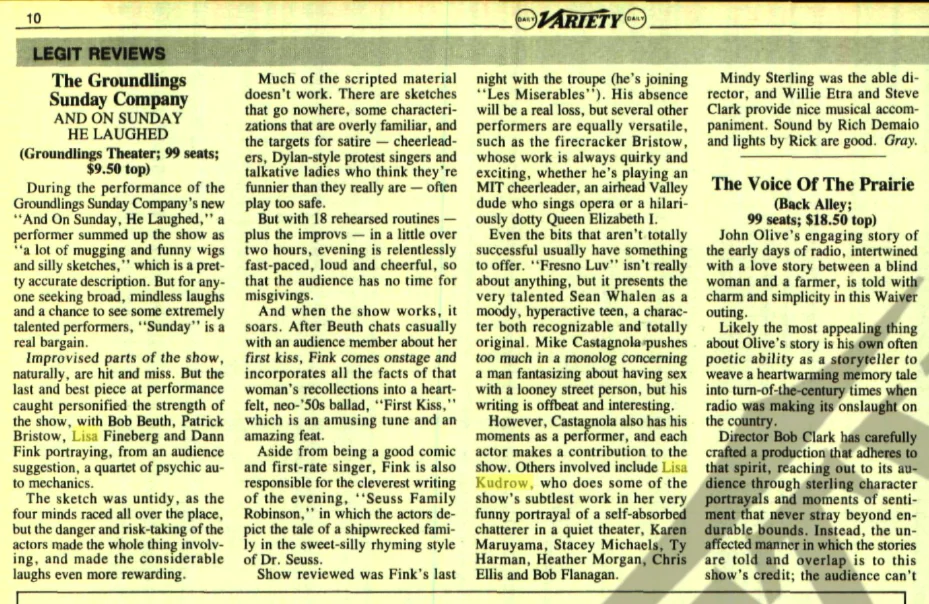
The conversation also served as a moment of professional reflection. Both King and Kudrow traced their careers back to their first mentions in Variety, highlighting how much the industry—and their place in it—has evolved.
For Michael Patrick King, the first mention was November 14, 1984, regarding his play Today’s Special. "It was a family comedy done in Woodstock, New York," King recalled. "That little mention in Variety felt like a dream coming true. It’s a tiny blur, but it had a giant impact."
Lisa Kudrow’s debut in the trade came on March 14, 1989, for a review of her work with The Groundlings. The critic lauded her for "some of the show’s subtlest work in her very funny portrayal of a self-absorbed chatterer in a quiet theater." The irony of that early praise—spotting her knack for playing self-absorbed characters long before she defined the archetype of Valerie Cherish—is not lost on the audience.

Implications: A Lasting Legacy
As the curtain falls on The Comeback, the implications for the industry are clear. The show serves as a testament to the resilience of human storytelling in the face of rapid technological disruption. By choosing to end the series, King and Kudrow are preserving the integrity of their "trilogy," ensuring that the show remains a high-water mark for meta-comedy.
When asked about the future, King offers advice that echoes the philosophy of the series itself: "I tell writers all the time that there’s only one path, and it’s yours. Don’t think you have to have somebody else’s path. Don’t compare yourself to anybody else."
Kudrow adds a final piece of wisdom regarding the acting profession that could apply to anyone in a creative field: "Do what you do, and be your version of who that character is. The rest is none of your business. That’s your only job, and it’s really simple, so you don’t have to take it personally."
With The Comeback now officially complete, it leaves behind a legacy of laughter, discomfort, and an unflinching look at the vanity of the entertainment industry. Whether or not it truly stays gone, the "trilogy" remains a definitive exploration of what it means to be a human performer in an increasingly digital world.
For more insights from the industry’s top creatives, listen to the full episode of the Variety Awards Circuit Podcast. You can subscribe via Apple Podcasts, Spotify, or your preferred podcast platform.
