
Growing Up Stop-Motion: How Travis Knight and Laika Conquered Their 16-Year Passion Project ‘Wildwood’
Main Facts: The Ascent of an Animated Epic
As the animated feature race heats up for the awards season, Laika’s ambitious dark fantasy adventure Wildwood stands firmly as the critical and commercial frontrunner. Directed by Travis Knight—who also serves as CEO of the acclaimed Portland-based stop-motion studio—the film represents a monumental 16-year journey from page to screen. Based on the celebrated young adult novel by Colin Meloy (frontman of the indie folk-rock band The Decemberists) and illustrated by Carson Ellis, Wildwood dives deep into themes of love, grief, and raw magic.
Set against a mythical, dense version of Portland, Oregon, the narrative follows plucky 13-year-old Prue (voiced by Peyton Elizabeth Lee) and her nerdy classmate Curtis (Jacob Tremblay) as they are thrust into the mysterious, forbidden Impassable Wilderness to rescue Prue’s kidnapped infant brother.
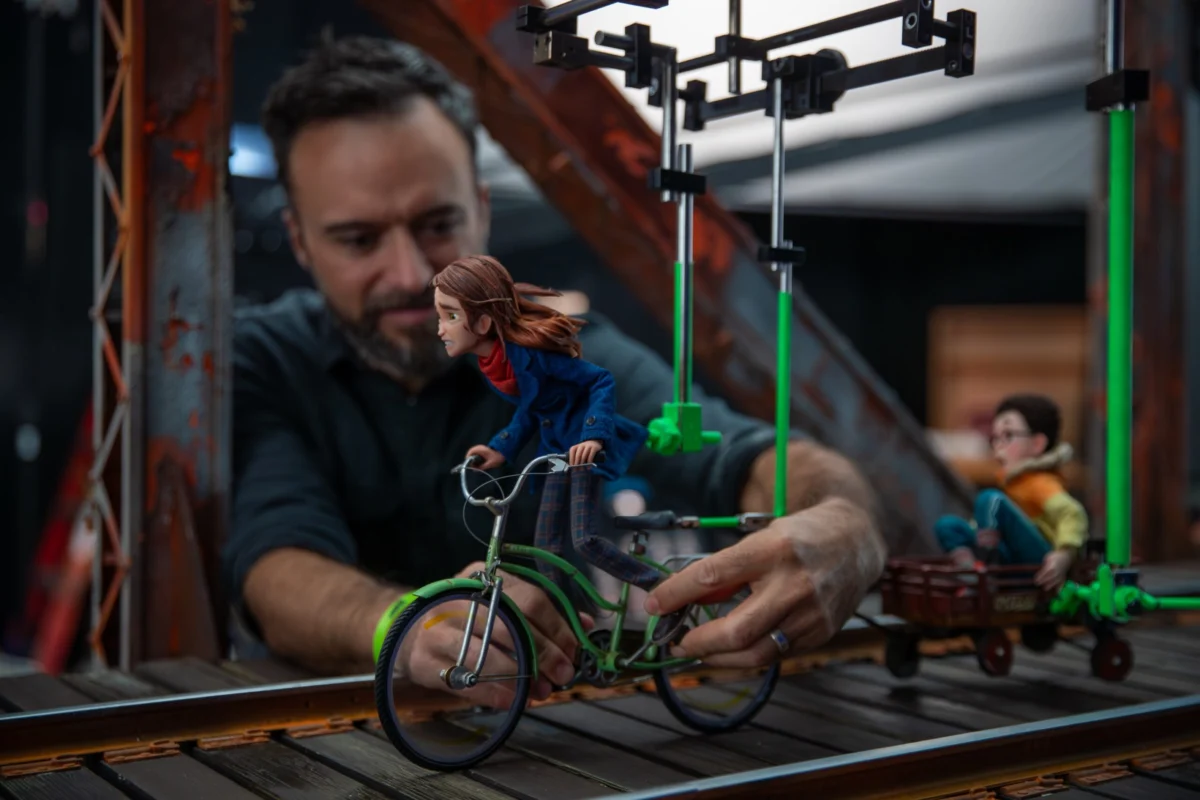
Yet, according to Knight, the true story of Wildwood is as much about the physical and technical evolution of his studio as it is about the fable itself. To successfully translate Meloy’s complex, violent, and emotionally resonant world into stop-motion animation, Knight admits that both he and his crew had to cinematically grow up. The production pushed the boundaries of the medium, utilizing live-action cinematography techniques pioneered by legendary director of photography Caleb Deschanel (The Right Stuff, The Black Stallion) to craft an unprecedentedly naturalistic visual language.

Chronology: A 16-Year Odyssey Through Pandemics and Growing Pains
The path to bringing Wildwood to the silver screen was fraught with unprecedented logistical and creative hurdles, unfolding over nearly two decades of trial, error, and technical progression.
The Foundation Years (Early 2010s)
Shortly after the release of Laika’s debut feature Coraline in 2009, Travis Knight discovered Colin Meloy’s novel. A fellow Portlander, Knight instantly connected with the book’s idiosyncratic voice, which drew heavy inspiration from classic fantasy cornerstones like J.R.R. Tolkien’s The Lord of the Rings, C.S. Lewis’s The Chronicles of Narnia, and L. Frank Baum’s The Wonderful Wizard of Oz. However, Knight quickly experienced a humbling realization: Laika did not yet possess the technical maturity or artistic infrastructure to adapt the material faithfully.
The Rites of Passage (2012–2019)
To become worthy of Wildwood, Laika embarked on a deliberate rite of passage, producing a string of critically acclaimed, Oscar-nominated stop-motion masterpieces: ParaNorman (2012), The Boxtrolls (2014), Kubo and the Two Strings (2016), and Missing Link (2019). With each successive film, the studio implemented calculated technological leaps, expanding its digital and physical toolbox. Knight directed Kubo and the Two Strings before stepping away temporarily to direct the live-action Transformers spin-off Bumblebee (2018)—an experience that fundamentally transformed his relationship with the camera and injected a live-action cinematic grammar into his stop-motion sensibilities.

The Pandemic Disruption (2020–2021)
Just as pre-production and primary fabrication on Wildwood ramped up, the global COVID-19 pandemic struck. The studio was forced into isolation, halting collaborative physical workflows. Animators, puppet makers, and set designers had to invent entirely new remote-working methodologies. These growing pains tested the resilience of the Laika team, forcing them to re-evaluate how an art form rooted in physical, tactile manipulation could survive a fragmented, digital-first environment.
Production and the BFI London Film Festival Premiere (2022–2026)
When the studio finally reunited, physical production commenced on what Knight describes as the most painful yet rewarding endeavor of his career. Following years of grueling frame-by-frame fabrication, lighting adjustments, and composite work, the film made its heavily anticipated debut at the 70th BFI London Film Festival in October 2026, where it instantly captured the imagination of critics and positioned itself as a juggernaut for the Academy Awards.
Supporting Data: Behind the Numbers of Wildwood’s Production
Stop-motion animation is notoriously labor-intensive, requiring meticulous physical creation for every element that appears on screen. Wildwood, however, elevated these challenges to historic proportions.

- 16 Years in Development: The length of time from Travis Knight initially reading Colin Meloy’s novel to the film’s international premiere.
- Five Preceding Features: The slate of Oscar-nominated films (Coraline, ParaNorman, The Boxtrolls, Kubo and the Two Strings, and Missing Link) that served as Laika’s technical training ground.
- 411 Shots in the Climax: The scope of the film’s third-act centerpiece, the Battle for the Plinth.
- 3,000 Combatants: The sheer density of digital and physical background characters populating the largest-scale battle sequence ever executed in stop-motion history.
- 10 to 12 Exposures per Frame: The hyper-complex multi-pass shooting style required during high-action, effects-heavy scenes involving fire, smoke, and dynamic lighting streaming across puppet costumes.
- One Animator, One Bird: The astonishing workload undertaken by master animator Dobrin Yanev, who single-handedly animated almost the entirety of Prue’s harrowing aerial dogfight atop the giant golden eagle, the General.
Official Responses: Travis Knight on the Agony and Ecstasy of Creation
Reflecting on the grueling production process in interviews with industry outlets like Gold Derby, Travis Knight pulled back the curtain on the creative philosophy driving Laika.
"I had the horrible realization early on that I had no idea how to make this movie," Knight confessed, reflecting on the studio’s early hubris. "Because we’d only done Coraline at that point, and the film asked more of us than we were capable of giving. So we had to grow, we had to get better, we had to be worthy of the material."
Knight emphasized the absolute control—and absolute burden—inherent to the stop-motion medium: "Every single thing that you see in a stop-motion film has to be designed and built and manipulated by an artist’s hand. Every single thing you see is a creative choice. You don’t get anything for free. It’s just a complete, blank canvas."

On recruiting veteran live-action cinematographer Caleb Deschanel to bridge the gap between traditional craft and sweeping cinematic scale, Knight noted how valuable Deschanel’s fresh perspective proved to be: "Even though Caleb knew basically nothing about stop-motion, it worked to the movie’s benefit. He came with all these wild ideas on how we could do it, including shooting outside, which would have been impossible, but he also challenged the team’s conceptions of what we could do."
Furthermore, Knight addressed the thematic weight of the story, particularly its willingness to engage with darkness, injury, and consequence: "At some point, these characters get hurt and can die. Violence has a cost, and we wanted to make sure that we portrayed that accurately in the movie. So if a girl gets a laceration on her cheek, you have to choose that exact frame where that happens, and it’s going to affect every shot that follows. If a girl tears her jacket when a coyote is attacking her, you have to decide years in advance when that jacket gets ripped."
Implications: Setting a New High-Water Mark for Stop-Motion Animation
The critical acclaim and frontrunner status of Wildwood carry significant implications for the future of the animation industry at large. In an era dominated by computer-generated imagery (CGI) and hyper-efficient digital pipelines, Laika’s steadfast commitment to physical craftsmanship serves as both an anomaly and a beacon of artistic integrity.

By refusing to shy away from the innate physical limitations of stop-motion—gravity, inertia, and tactile wear-and-tear—and instead collaborating with legendary live-action cinematographers like Caleb Deschanel, Laika has proven that stop-motion can achieve the grand, sweeping scale of epic live-action blockbusters without sacrificing its handmade soul.
As Wildwood dominates the awards conversation, it redefines what audiences and industry professionals expect from animated storytelling. It demonstrates that dark fantasy, emotional gravity, and uncompromising artistic vision can merge to create enduring cinematic art. For Travis Knight and the artists at Laika, Wildwood is not merely a successful film release; it is the definitive proof that an entire studio grew up, mastered its craft, and permanently altered the landscape of modern animation.
