
The Final Frontier: Ellen Burstyn’s Poetic Path to EGOT Glory
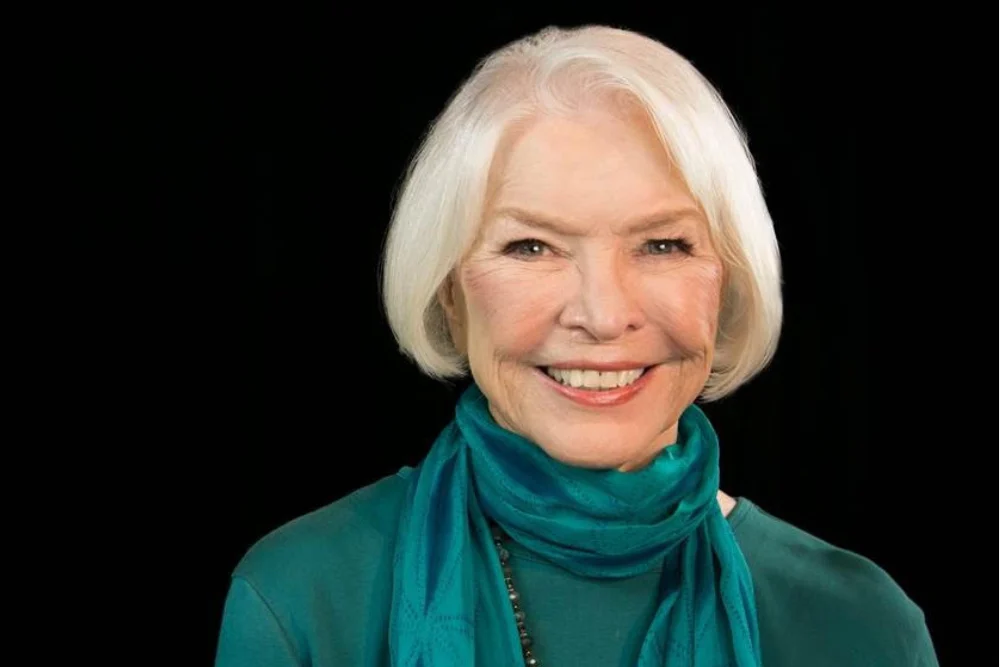
At 93 years old, most legends would be content to rest on the laurels of a career that spans seven decades. But Ellen Burstyn is not most people. As she navigates the digital landscape of a Zoom call, the screen shifts from a comfortable living room to a study that serves as a physical archive of Hollywood history. With the assistance of her aide, Caitlin, Burstyn provides a rare, intimate tour of a wall that most cinephiles only dream of seeing: a collection of statuettes representing the highest honors in acting.
"There’s the Emmy, the Tony, the Golden Lion, the Oscar, and the other Emmy," she says with a gentle, humble cadence. Above them sit rows of nominations, certificates, and plaques—a testament to a lifetime spent in the service of the craft. Yet, as she points to the gaps on her shelf, it becomes clear that for one of the greatest actors of her generation, the work is never truly finished. She is currently chasing the final piece of the entertainment industry’s most prestigious puzzle: the EGOT.
The Architecture of an Icon: A Chronological Retrospective
To understand the weight of Burstyn’s current pursuit, one must look back at the historical milestones that have defined her career. Her ascent was meteoric and foundational to the New Hollywood era of the 1970s.
In 1975, Burstyn achieved a rare feat of artistic dominance by winning both an Academy Award for her searing performance in Alice Doesn’t Live Here Anymore and a Tony Award for her work in the stage play Same Time, Next Year. These accolades solidified her status as a powerhouse capable of commanding both the intimate lens of the camera and the vast, unforgiving space of the Broadway stage.
The decades that followed saw her transition into the television landscape with effortless grace. She secured her first Emmy in 2009 for her guest role in Law & Order: Special Victims Unit, followed by a second in 2013 for her performance in the political drama Political Animals. Most recently, in September, her contribution to the global cinematic canon was honored with the Golden Lion for Lifetime Achievement at the Venice Film Festival—a poignant moment underscored by her appearance in Maggie Gyllenhaal’s short film Flesh Impact, where she embodied the complexity of Marilyn Monroe.
Now, as she approaches her 94th birthday in December, Burstyn finds herself on the cusp of history. If she secures a Grammy for her audiobook Poetry Says It Better: Poems to Help You Wake Up, she will become the oldest person ever to achieve EGOT status, surpassing the legendary John Gielgud, who accomplished the feat at 87. She would join an exclusive pantheon of women—Helen Hayes, Rita Moreno, Audrey Hepburn, Whoopi Goldberg, Jennifer Hudson, and Viola Davis—who have reached this pinnacle of cultural recognition.
Poetry as a Lifeline: The Source of the Nomination
The path to her potential Grammy win is as unexpected as it is profound. Poetry Says It Better, released this past April by HarperCollins, is not merely a product; it is a spiritual map of Burstyn’s life. The collection features poems that have served as anchors through nine decades of joy and turbulence, including works by Edna St. Vincent Millay, Mary Oliver, and Rumi.
Burstyn’s commitment to the project was absolute. She spent five hours and nine minutes in the recording booth, lending her voice to the audiobook. Her efforts have been met with critical acclaim, including a Kirkus Star and an Earphones Award. The Recording Academy’s recognition of the work as a contender for Best Audiobook, Narration, and Storytelling Recording is a validation of her belief that poetry is a living, breathing entity.
"I really enjoy reciting poetry and reading it, and I hope people will read the book," she says. "But I also hope they will listen to the recording that comes with the book—because I think poetry should be heard."
During our conversation, she offered a demonstration of the power these words hold for her. Without prompting, she recited William Ernest Henley’s "Invictus" from start to finish, staring directly into the camera lens with unwavering focus. The poem, which she first encountered in high school, served as a beacon during her darkest moments. "I read that, and I was just so reassured somehow that the stuff I was going through in my life at the time wasn’t going to be forever," she reflects. "That went into my heart, and gave me such confidence that my life was going to change."
The Philosophy of the Craft
Burstyn’s journey has never been about collecting hardware; it has been about the relentless pursuit of artistic truth. Her early career was defined by a natural ability that she quickly realized required the rigor of formal training. After moving from Hollywood to New York to study under Lee Strasberg, she became a devotee of the Method, eventually rising to become the co-president of the Actors Studio.
When asked about her advice to the next generation of performers, her answer is a distillation of her life’s work: "A creative act comes from the heart."
However, even with a shelf full of the world’s most coveted awards, Burstyn maintains a critical perspective on her own trajectory. Her response when asked if she looks at her awards with pride is surprisingly candid. "I could have done better," she admits. "There are things I didn’t do that I should have done, and things that Lee Strasberg encouraged me to do that I wish I had done. So I don’t feel like a success. Yes, I won awards, and yes, I’ve enjoyed my work. But I wish I had gone into the great plays of the theater and played those more."
This humility is perhaps what makes her so enduring. While the world sees an icon, she sees an artist who still has unfinished business.
Implications: The Weight of Legacy and the "Exorcist" Question
As Burstyn eyes the EGOT, she remains deeply engaged with the industry, though she is not shy about voicing her fatigue with its obsession with repetition. When the subject of the upcoming The Exorcist: Martyrs, directed by Mike Flanagan, arises—a project following in the footsteps of the 1973 classic that made her a household name—her reaction is one of weary dismissal. "Isn’t there enough already of the ‘Exorcist’ thing?" she asks. "It’s enough already."
It is a reminder that while Burstyn is a cornerstone of Hollywood history, she is also a woman who values originality over franchise-building. Her current focus on poetry and her push for the EGOT represent a pivot toward the introspective, the personal, and the enduring power of the human voice.
The irony of the EGOT pursuit is that it was not her idea initially. It was her granddaughter who pointed out the proximity of the milestone. "She said, ‘You know, you’re only one away from an EGOT. You should go for it, Grandma,’" Burstyn recalls with a laugh. "I don’t know how you ‘go for it.’ But it is thrilling. I understand only six women have ever gotten an EGOT. That’s quite a special event, so I’m all for it."
Conclusion: A Living Masterpiece
As the interview concludes, Burstyn reflects on the quiet nature of her record-breaking life. In 2020, during the height of the pandemic, she spoke about her love for breaking records as she aged, a sentiment that has not wavered. Whether or not the Grammy arrives to complete the EGOT, her place in the firmament of American culture is already secured.
The shelf in her study may be the reason we are talking, but the woman standing in front of it is the reason we are listening. Ellen Burstyn has spent her life turning her heart into art, and in doing so, she has invited us all to wake up, to listen to the poetry, and to recognize that the most significant chapters of a life are often the ones that are still being written. Whether she claims that final letter or not, she has already achieved the ultimate prize: a career defined by integrity, a voice that commands attention, and a spirit that refuses to stand still.
