
Beyond the Final Frontier: William Shatner at 95 on Science, Survival, and Sixty Years of Star Trek
NEW YORK — Meeting a living legend is rarely a quiet affair, but an encounter with William Shatner in the bustling, chaotic corridors of the Javits Center during New York Comic Con subverts expectations entirely. There are, undoubtedly, more glamorous locations for an interview than a rickety fold-up chair tucked into a high-traffic press alley, a digital voice recorder balanced precariously on one’s knees.
Yet, as Shatner peers down at the compact device with genuine, unpretentious concern—“Are you sure that’s going to record enough?”—any preconceived notions of Hollywood aloofness dissolve. At 95 years old, a towering titan of science fiction is more worried about the journalist’s audio quality than his own demanding schedule.
Shatner is being pulled in a dozen directions simultaneously. Amid the sensory overload of thousands of costumed fans, ringing booth alarms, and blinding camera flashes, there are autographs to sign, photographs to pose for, and, shortly, a grand-scale arena stage awaiting him. There, alongside actor and comedian Ben Stiller, he will command a massive audience to celebrate six decades of Star Trek.
Yet, sitting across from a reporter in a cramped corridor, the nonagenarian actor is completely present. Engaging, humorous, and remarkably relaxed amidst the convention’s corporate circus, Shatner defies the archetype of the weary veteran running on auto-pilot. He has answered questions about Captain James T. Kirk for the better part of sixty years, yet he approaches the conversation not with defensive exhaustion, but with the boundless curiosity of a rookie explorer.
Main Facts: A Legacy Etched in Culture
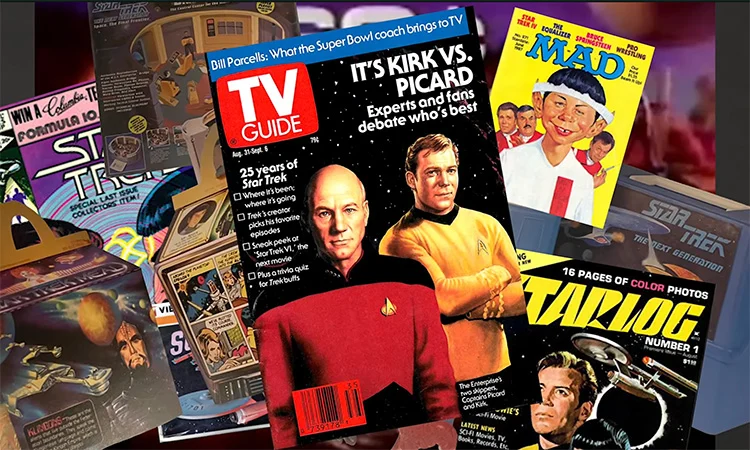
The occasion for Shatner’s convention circuit appearance is the release of The Sixty-Year Mission, a new feature-length documentary exploring the cultural phenomenon of a franchise that began inauspiciously in 1966 and refused to die. As Executive Producer, Shatner finds himself reflecting on a legacy that has spanned generations, media formats, and societal shifts.
Despite the monumental stature of Star Trek today—a multi-billion-dollar empire encompassing television series, feature films, global conventions, literature, and merchandise—Shatner maintains that its ascent was entirely uncalculated. When asked if there was a definitive lightning-bolt moment when he realized the show had crossed the threshold from television program to cultural institution, his answer is immediate and absolute.

“That never happened,” Shatner tells me.
Instead of an explosive breakout, the franchise’s expansion was a slow-burning evolution, largely fueled by syndication long after the original NBC series was cancelled. “It was these little victories that culminated into what became enormous, but it became enormous so slowly,” he explains, offering an analogy uniquely his own: “It’s like the temperature of putting a frog in a pot, and the water warms up slowly. That’s what happened here. I hate to liken myself to a frog, but hey…!”
Chronology: From 1966 to the 23rd Century and Beyond
- 1966: Star Trek: The Original Series premieres on NBC, starring William Shatner as Captain James T. Kirk alongside Leonard Nimoy as Mr. Spock.
- 1969: NBC cancels the series after three seasons and 79 episodes, seemingly consigning the sci-fi experiment to television obscurity.
- 1970s–1980s: Through local television syndication, the series cult following explodes. This grassroots revival prompts Paramount to launch Star Trek: The Motion Picture (1979) and a subsequent, highly successful film franchise.
- 1990s–2020s: The franchise expands into multiple television spin-offs (The Next Generation, Deep Space Nine, Voyager, Discovery, Strange New Worlds). Meanwhile, Shatner transitions into author, director, and documentarian.
- Present Day: Shatner executive-produces The Sixty-Year Mission, a cinematic retrospective celebrating the 60th anniversary of the franchise, cementing its place as one of the most enduring mythos in entertainment history.
Supporting Data: The Anatomy of an Unplanned Empire
To understand the longevity of Star Trek, historians often point to its progressive casting, allegorical storytelling, and visionary optimism. However, the data surrounding its fanbase reveals an engine of perpetual motion:
- Longevity: Spanning six decades, the franchise has produced over 900 television episodes across more than 10 distinct series and 13 feature films.
- Global Reach: Comic-con appearances by legacy cast members consistently draw tens of thousands of attendees, with New York Comic Con hosting multi-generational crowds spanning demographics from baby boomers to Gen Z.
- Cultural Saturation: According to entertainment analytics, Star Trek references remain among the most widely recognized pop culture touchstones globally, outlasting competing 1960s television properties by a significant margin.
Official Responses and Perspectives
When conversation inevitably circles back to why humanity remains fixated on a starship crew from the 1960s, Shatner’s perspective undergoes a dramatic gear change. He eschews cozy nostalgia in favor of a sweeping, macro-level examination of human civilization.
“Well, that’s the question that we ask, and I’m not sure that there’s an answer, except the obvious one, which is, as you and I speak, there is a possibility, a very distinct possibility, that mankind has pushed itself into a corner that could be existential,” Shatner reflects.
Rather than resting comfortably in the fictional universe of the 23rd century, Shatner pivots directly to real-world threats: ecological collapse, environmental degradation, and geopolitical aggression. Yet, in the same breath, he balances these dark realities with a fierce optimism regarding human ingenuity. He highlights emerging scientific breakthroughs—advancements in medicine, atmospheric carbon-capture technologies, and biological organisms engineered to consume plastic waste.

“We’re so close to heavenly aspects as against devilish, and we’re on the lip, and which way we fall is dependent on what we do right now,” he states. “The fact that Star Trek offers the existence 400 years from now suggests that we will have made the correct action and saved ourselves by our intellect and not by our other condition of humanity, which is aggression.”
Implications: When Reality Surpasses Fiction
Perhaps the most striking aspect of spending time with Shatner is his perspective on the genre that made him a household name. Long before he ever slipped into a Starfleet tunic, Shatner was an avid reader of science fiction—particularly stories penned by scientists, doctors, and academics who extrapolated laboratory theories into speculative futures.
Today, however, Shatner questions whether real-world science has begun to outpace imaginative fiction.
“I think nowadays, what’s happening in the lab is so exotic that it beggars what science fiction is,” he muses, diving enthusiastically into discussions of quantum physics, subatomic particles, and phenomena occurring light-years apart. To him, proven scientific reality has become so inherently bizarre that human imagination struggles to invent scenarios stranger than the truth.
When asked about his own relationship with the franchise—what Star Trek means to him personally, as opposed to the millions of fans who use it as a comfort watch—his response strips away all Hollywood artifice.
“What is my Star Trek? Well, my Star Trek is Star Trek. I don’t watch it very much. I don’t watch myself, and I don’t watch the other iterations of Star Trek,” he admits. “The answer to your question is my Star Trek is reality.”

Conclusion: The Final Act
Later that afternoon, the fold-up chair and the digital recorder are replaced by the glare of theatrical spotlights and an amphitheater filled to capacity. Stepping onto the stage alongside Ben Stiller, Shatner immediately commands the room, eliciting uproarious laughter from both the audience and his famous co-host.
Even Stiller, a master of comedy accustomed to ruling massive rooms, is kept on his toes by Shatner’s razor-sharp timing and unpredictable conversational pivots. It is a microcosm of the actor’s enduring appeal: whether in a quiet backstage corridor or under the blazing lights of a convention main stage, the fundamental traits remain unchanged.
The wit is intact. The curiosity burns brightly. The unpredictability is absolute.
And as The Sixty-Year Mission arrives in cinemas, reminding audiences of the fictional futures charted decades ago, William Shatner remains firmly focused on the horizon—proving that at 95 years old, the most fascinating frontier is still the one we have yet to cross.
The Sixty-Year Mission is out now in cinemas.
