
Inside the Surreal World of Netflix’s ‘In Your Dreams’: How Directors Erik Benson and Alex Woo Built an Animated Love Letter to Childhood Cinema
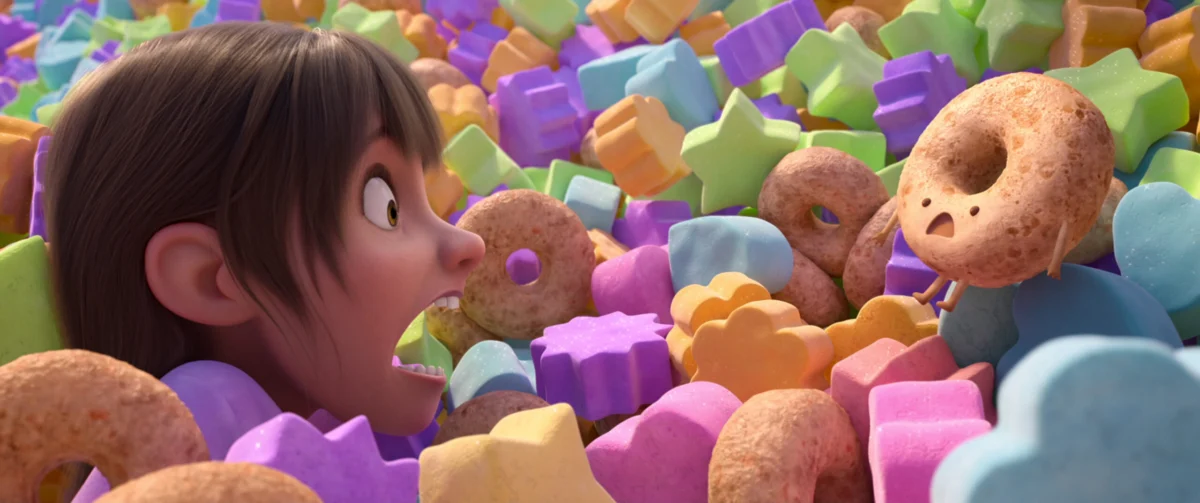
Just as certain scenarios only ever happen in the realm of dreams—such as suddenly realizing you have a final exam on a class you never attended, or desperately fleeing a suburban town overrun by zombies—some cinematic concepts can truly only be brought to life through the boundless medium of animation.
In Your Dreams, Netflix’s visually dazzling new animated feature film co-directed by Erik Benson and Alex Woo, leans heavily into this philosophy, filling its runtime with a delightful, chaotic abundance of both.
At the center of the narrative are estranged siblings Stevie (voiced by Jolie Hoang-Rappaport) and Elliot (voiced by Elias Janssen). When the duo accidentally stumbles upon an ancient, mysterious book detailing the legendary Sandman (Omid Djalili)—the elusive master of dreams who supposedly holds the power to rewrite reality—they realize that mastering the nocturnal realm might be their only chance to change their waking lives. More importantly, they hope to use the Sandman’s magic to prevent the impending divorce of their parents, played by Simu Liu and Cristin Milioti. Consequently, falling asleep stops being a mundane nightly routine and transforms into a high-stakes, mission-critical adventure.
Main Facts: A High-Stakes Journey Through the Subconscious
In Your Dreams is structured as a comedy-adventure blending family emotional stakes with a wildly imaginative, shape-shifting aesthetic.
- The Creative Team: Directed by Erik Benson and Alex Woo, the film is produced for Netflix.
- The Voice Cast: Features Jolie Hoang-Rappaport as 12-year-old Stevie, Elias Janssen as 8-year-old Elliot, alongside Omid Djalili, Simu Liu, and Cristin Milioti.
- The Premise: Two siblings embark on a quest through the absurd landscapes of their own subconscious. Navigating a gauntlet that includes a snarky stuffed giraffe, zombie breakfast foods, and the formidable queen of nightmares, they seek the Sandman to grant their ultimate wish: a fixed, perfect family.
- Availability: In Your Dreams is currently streaming globally on Netflix.
Chronology: From Concept to Screen and the Evolution of a Visual Grammar
Building a coherent universe out of the inherently illogical nature of dreams required meticulous structural planning. The production team spent years establishing the visual rules that govern the transition from wakefulness to sleep.

For the younger brother Elliot, drifting off to sleep is effortless, triggered simply by the comforting siren song of a turtle-shaped white noise machine. Stevie, however, struggles with the transition, requiring a deliberate, conscious effort to quiet her mind. The animation team honors this psychological barrier by creating a warm, glowing sequence of slipping into sleep. Utilizing a physics-defying floating camera, the shot circles fluidly around Stevie as she drifts upward, breaking past the boundaries of the "real world" and plunging down into the vibrant, surreal dreamscape.
These transitional sequences quickly became some of the most crucial elements of the film, as well as director Alex Woo’s favorite moments in the entire production.
"Every film has its own grammar and language, and you have to set up certain rules and pay them off," Woo explained in an interview with IndieWire. "The rules of how dreams work and how you go in and out of dreams, all that stuff needs to be established because you can’t take it for granted. [The transitions] were some of my favorite shots in the whole movie. They’re just purely cinematic."
Throughout production, Woo and his team continually finessed the film’s tone, pushing the visual boundaries right up until the final editing lock. Because animation allows for hyper-precise adjustments down to the individual frame and pixel—a luxury live-action filmmaking rarely affords—key pillars of the narrative were actually added late in the process.
One such late addition was Stevie’s witty voiceover guide, which opens the movie and immediately establishes her distinct comedic voice. "We all had that sit-up moment when [the voiceover] comes in and you do that freeze frame. You talk to the audience," Woo noted. "Suddenly, people are like, Oh, this is not just a straightforward animated movie. There’s layers to this."

Supporting Data and Influences: A Cinematic Remix
A significant part of the visual language of In Your Dreams stems from Alex Woo’s deep-seated nostalgia for the cinematic touchstones of his youth. Growing up splitting his time between different cultural hubs, Woo absorbed a diverse mix of Western blockbusters and Eastern animation styles.
"I was definitely a Spielberg kid. I mean, Elliot is named after Elliot from E.T. I was a big fan of Hook, I was a big fan of The Goonies and Labyrinth," Woo recalled. "I was also a big Miyazaki kid, because I grew up half my life in Hong Kong, so Asian animation was a big part of my childhood."
This rich tapestry of influences is baked directly into the DNA of In Your Dreams. The movie features its own stylized, animated take on the classic Spielbergian "zolly" (zoom-lens dolly) shot. At the same time, characters occasionally trigger power-up sequences that look straight out of Dragon Ball Z, or morph through antic transformation sequences reminiscent of Sailor Moon.
Even the inhabitants of Stevie’s dream "Breakfast Town"—initially introduced as adorable, fuzzy creatures bearing a striking resemblance to the susuwatari (soot sprites) from Hayao Miyazaki’s My Neighbor Totoro—undergo a drastic shift. As the dream narrative takes a darker, more perilous turn, these creatures morph into entities much closer to the high-stakes, subterranean peril found in The Goonies.
"Art’s all remix, right?" Woo observed. "I thought a movie about the dream world was the perfect venue to pull all of these references and movies that I loved and put them in there because you can do so many types of worlds in a dream movie. You have so much latitude, aesthetically and creatively. So it was kind of the perfect movie for me to create a sort of love letter to all these films that I grew up with."

Official Responses: Striking the Balance Between Thrill and Trauma
As with any creative "remix" blending comedy, family trauma, and surreal horror, finding the right emotional equilibrium was paramount. Woo and his team engaged in extensive internal testing to calibrate the intensity of the nightmares Stevie and Elliot encounter on their quest.
Rather than sanitizing the dream world to make it entirely safe for younger audiences, Woo leaned into the bittersweet nostalgia of childhood fear.
"I didn’t want to soft pedal anything because, when I was a kid, I really liked kind of being scared at the movies. There’s something thrilling about it, but of course, there’s a line beyond which it becomes traumatizing. But you just don’t know where that line is until you test it out," Woo explained. "We had early iterations of the film where we really pushed the intensity of the nightmares because I wanted to see how far we could go with it."
By utilizing animation as a safety net—allowing creators to push a concept past the edge of comfort and then artfully dial it back before final rendering—the team successfully cultivated a tone that feels simultaneously dangerous and deeply comforting.
Implications: What In Your Dreams Means for Netflix Animation
The release of In Your Dreams arrives at a pivotal time for Netflix’s original animated feature division. As streaming platforms increasingly compete for family audiences against legacy studios like Disney, Pixar, and DreamWorks, Netflix has carved out a distinct niche by backing auteur-driven, aesthetically adventurous projects that lean into artistic risk-taking.

By permitting directors like Erik Benson and Alex Woo to construct dense, reference-heavy visual worlds that combine Western cinematic tropes with Eastern animation traditions, Netflix continues to prove that streaming platforms can be fertile ground for original, non-franchise IP. In Your Dreams demonstrates that audiences—both children and adults—are hungry for animation that respects their intelligence, embraces visual complexity, and refuses to talk down to them about real-world emotional struggles like familial fracture and anxiety.
As In Your Dreams streams to global audiences, its success signals a bright future for stories that blur the lines between waking life and the limitless expanse of the imagination.
