
RØDE Unlocks Pro-Grade Flexibility: Firmware 1.4 Transforms the RØDECaster Video Series
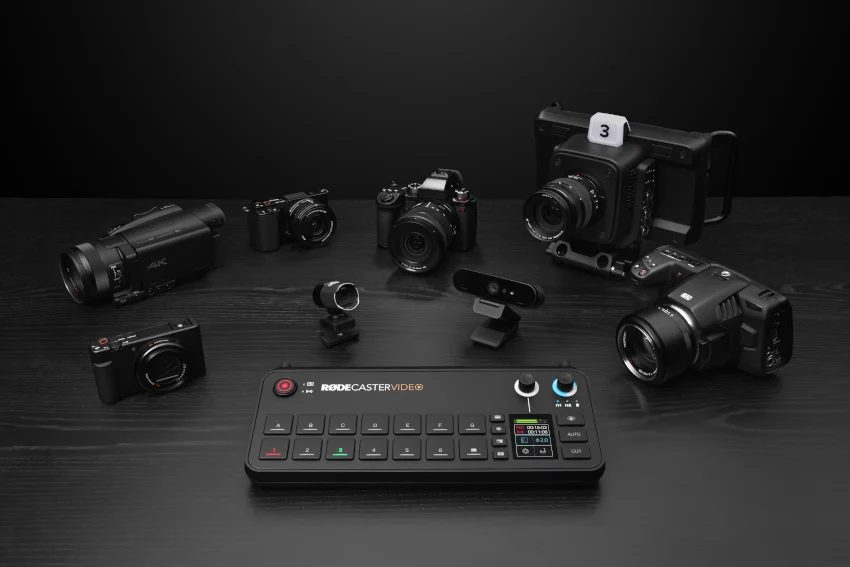
In a move that significantly redefines the utility of its video production hardware, RØDE has released a massive, free firmware update for its RØDECaster Video family. Firmware version 1.4 (build 1.4.02.1542) is not merely a collection of minor bug fixes; it is a fundamental architectural expansion that transitions the RØDECaster Video, Video S, and Video Core units from standard live switchers into high-performance multi-camera capture and network distribution hubs. By introducing dedicated 4K and Full HD capture modes, RØDE has effectively doubled the value proposition of these devices for professional videographers, streamers, and studio engineers.
Main Facts: A Paradigm Shift in Production Architecture
The cornerstone of the 1.4 update is the introduction of dedicated Capture Modes. Historically, the RØDECaster Video series was recognized as an all-in-one live production switcher capable of handling transitions, graphics, and direct streaming. While those capabilities remain intact, the new firmware allows users to pivot the hardware’s internal resources toward high-fidelity acquisition.
The New Operating Modes
- 4K Capture Mode: This mode empowers the hardware to function as a UHD (3840 x 2160) acquisition and distribution system. It accepts multiple UHD30 camera feeds via HDMI. The flagship RØDECaster Video supports up to four inputs, while the Video S and Video Core variants handle three. Crucially, each of these feeds can be independently output via NDI HX (H.264), allowing for seamless integration into network-based production environments like OBS or vMix without the need for additional capture cards.
- FHD Capture Mode: Designed for scenarios where fluidity and frame rate are prioritized over raw resolution, this mode maintains a steady 1080p60 workflow. This is an ideal solution for live sports, high-speed demonstrations, or corporate events where motion clarity is the primary concern.
By decoupling the "switching" logic from the "capture" logic, RØDE has circumvented the hardware limitations that typically plague all-in-one devices when trying to process too many high-resolution streams simultaneously. In these capture modes, processing-heavy features like complex keying, real-time transitions, and graphics overlays are disabled to ensure rock-solid throughput for isolated recording and network distribution.
Chronology: Building Toward a Unified Ecosystem
RØDE’s journey toward this update has been one of iterative refinement. Since the launch of the RØDECaster Video series, the company has consistently sought to bridge the gap between pro-audio and pro-video workflows.
- Early 2026: The RØDECaster Video Core received initial support for "RØDECaster Sync," marking the first step in integrating video switching with the RØDECaster Pro II and Duo audio consoles.
- Mid-2026: Users began requesting more granular control over post-production workflows, leading to the introduction of EDL export for DaVinci Resolve in firmware 1.3.
- Current (Late 2026/2027): With the release of version 1.4, RØDE has finalized the integration of the RØDECaster Sync feature across the entire video range, including the standard Video and Video S models. This creates a modular "studio-in-a-box" where a single USB-C cable creates a unified command center for both audio and video, sharing faders, SMART pads, and interface controls between the two hardware units.
This chronological progression demonstrates a clear intent: RØDE is not just selling individual pieces of hardware; they are building a proprietary, interconnected ecosystem that rivals much more expensive professional broadcast equipment.
Supporting Data: Technical Specifications and Performance
The technical implications of firmware 1.4 are substantial, particularly regarding data handling and network efficiency.
NDI HX and H.264/H.265 Efficiency
By opting for NDI HX (High Efficiency) over full-bandwidth NDI, RØDE has made a pragmatic decision for the average user. Full-bandwidth NDI can saturate 1Gbps network connections rapidly when multiple 4K streams are involved. By utilizing NDI HX with H.264 compression, RØDE ensures that production teams can transport multiple 4K camera feeds over standard local area networks without the massive overhead typically associated with uncompressed video.
4K ISO Recording
Perhaps the most requested feature for independent filmmakers is the ability to record "ISO" (isolated) tracks. Firmware 1.4 allows each HDMI input to be recorded as a discrete, high-quality 4K file directly to an external SSD. This is a game-changer for post-production. Instead of being "baked in" to a final, switched master file, editors now have access to raw camera angles. This allows for:
- Color Grading Consistency: Adjusting color and exposure individually for each camera angle.
- Reframing: Using the 4K resolution to punch in and create "fake" close-ups during the edit.
- Error Correction: Cutting away from a camera that may have gone out of focus or suffered a lighting mishap.
Official Responses and Strategic Vision
While RØDE typically lets its engineering speak for itself, the release of the 1.4 firmware clearly articulates a strategy of "resource allocation." The company acknowledges that a single processor cannot perform real-time 4K switching, heavy graphics rendering, and multi-channel ISO recording simultaneously at high frame rates.

By forcing a choice between "Standard Mode" (for live switching) and "Capture Mode" (for acquisition), RØDE is providing users with a "mode-based" workflow. This is a mature engineering approach. Rather than having a device that performs everything at a "mediocre" level, they have created a device that performs specific tasks at a "pro" level depending on the current configuration.
Furthermore, the addition of OTIO timeline export for Adobe Premiere Pro is a direct response to feedback from professional editors. By moving beyond simple EDLs to the more robust Open Timeline IO (OTIO) format, RØDE is acknowledging that their hardware is being used in professional creative suites, not just by hobbyist streamers.
Implications: The Future of Modular Production
The implications of this update are far-reaching for several key industries:
1. The Prosumer/Corporate Studio
For businesses that produce internal training, podcasts, or corporate communications, the RØDECaster Video series now represents the most cost-effective way to achieve a "multi-camera ISO" setup. Previously, this would have required a dedicated capture card array or expensive hardware switchers like the Blackmagic ATEM series. Now, a single unit can handle the audio mixing, camera switching, and isolated recording, all while talking to a RØDECaster Pro II for audio control.
2. The Indie Filmmaker
The ability to use the RØDECaster Video as a centralized acquisition hub is profound. A filmmaker can now set up three or four cameras, feed them into the RØDE unit, and record all of them to a single SSD while simultaneously sending the feeds to a computer for remote monitoring. It simplifies the "cabling mess" of a multi-cam shoot and provides a clean, organized folder structure for the editor once the shoot wraps.
3. The Live Event Streamer
The inclusion of UVC webcam audio capture and expanded NDI functionality means that streamers can now integrate varied sources—webcams, high-end cinema cameras, and audio consoles—into a single, cohesive network stream. The "press-and-hold" mute for monitoring and the new keyboard shortcuts for Scene Builder are small but significant quality-of-life improvements that speak to RØDE’s attention to the actual user experience in high-pressure live environments.
Conclusion
With firmware 1.4, RØDE has successfully defended its position as an innovator in the creator hardware space. By prioritizing modularity, the company has extended the lifespan of its current hardware, giving existing owners a significant performance upgrade without asking for an additional investment.
The RØDECaster Video series is no longer just a "switcher." It has evolved into a sophisticated acquisition tool that respects the needs of the post-production workflow as much as the live broadcast. As the lines between streaming and traditional filmmaking continue to blur, RØDE’s latest update provides the flexibility, reliability, and technical muscle required to navigate this changing landscape. Whether you are a solo creator or part of a larger production house, the 1.4 firmware turns the RØDECaster Video into a versatile workhorse that is undeniably essential for any multi-camera setup.
