
Unlocking the Monolith: The Criterion Collection Debuts Definitive 4K Box Set, The Complete Kubrick
By The Film Stage Editorial Desk
Published in partnership with the Criterion Collection
Main Facts: The Definitive Masterpiece of Home Video Archiving
To label Stanley Kubrick a filmmaker is to drastically understate his footprint on human culture. He was Hollywood’s resident genius, an international man of mystery, a master chess player who approached narrative geometry with ruthless precision, and yet, to his dying day, he remained a simple Bronx-born family man with an insatiable curiosity and an unconditional adoration for his relatives and pets. Across thirteen feature films spanning just under half a century, Kubrick’s most enduring gift may be his total obliteration of boundaries.
He was a formalist of myriad disciplines—a deeply intellectual artist whose most powerful, lingering images surged directly from the unconscious. He was simultaneously a mighty humanist and an acerbic misanthrope, a consummate auteur and a blockbuster showman whose work is equally revered by working artists, theoretical scientists, rigorous film scholars, midnight-movie fiends, and the general public. To this day, no single label can contain him. To appreciate Kubrick is to stand in awe of the revelation that radical formal experimentation, towering intellectual curiosity, and mass-cultural appeal do not need to be enemies. Genre is never a lower form in his hands; story structure never stifles spontaneity and mystery. Here was a man who did it all, leaving behind the lingering, haunting sensation that he had barely even gotten started.
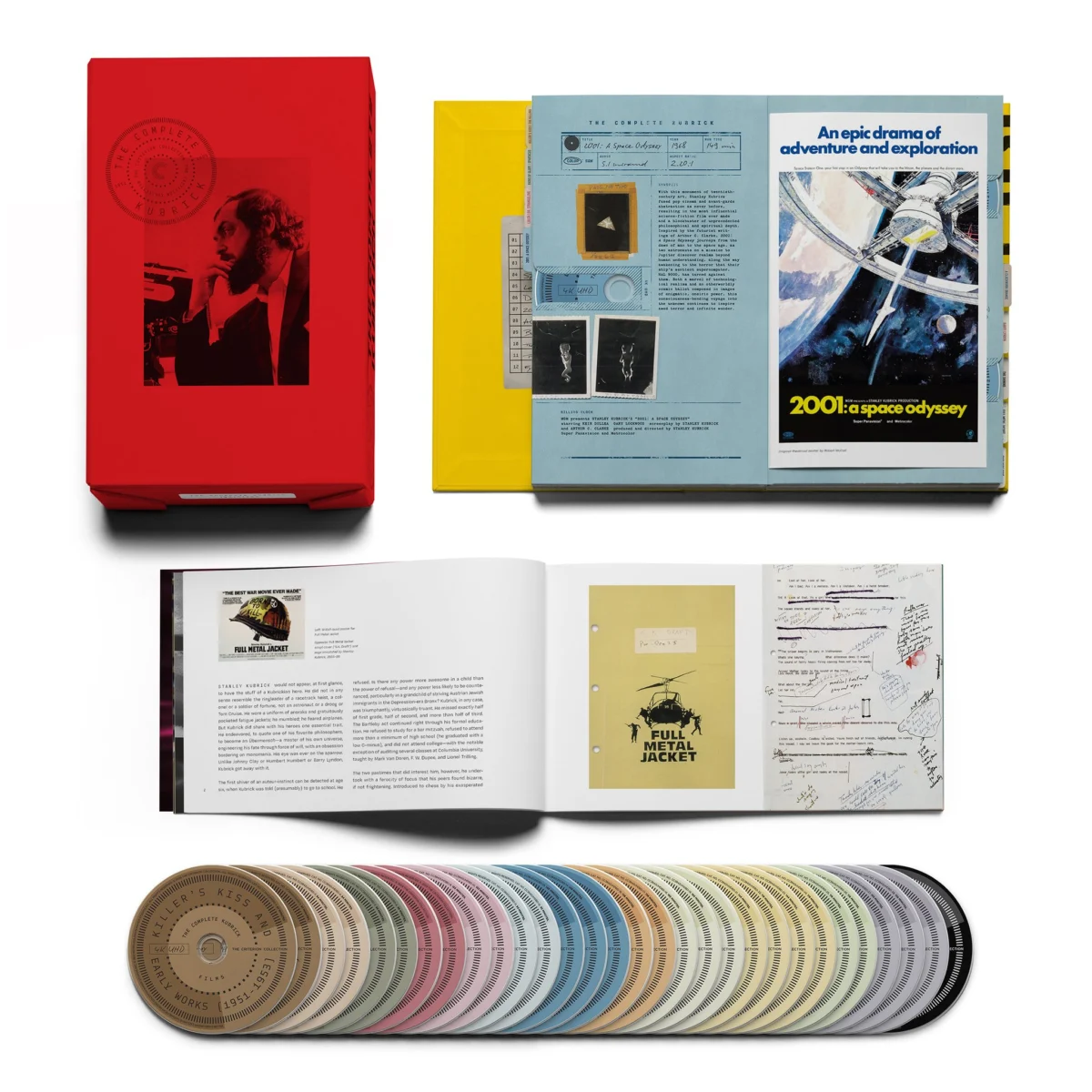
Now, in what constitutes a monumental milestone for physical media and cinephilia at large, The Criterion Collection has released The Complete Kubrick, a definitive 4K Ultra HD box set. Available now via the Criterion Collection, this comprehensive release gathers every single one of the master’s completed films for the very first time. From his rare early documentary shorts to trailblazing studio features with MGM and Warner Bros., the entire catalogue has been stunningly restored, accompanied by a staggering wealth of supplements, commentaries, and archival materials. Across thirteen meticulously curated discs, audiences are invited to revisit a peerless body of work equipped with bonus features ranging from vintage LaserDisc commentaries to brand-new, cutting-edge analyses—including a fascinating exploration of how HAL-9000 predicted modern Large Language Model "hallucinations," released just in time to pair with Luca Guadagnino’s 2001-conversant feature, Artificial.

In celebration of this landmark release, and in hopes of igniting a much-needed Kubrick renaissance for a moviegoing public starved of true boldness and cinematic invention, we are rolling out a sprawling, multi-part editorial season dedicated to the filmmaker’s oeuvre. We will journey through Criterion’s monumental box set era by era, disc by disc, interspersed with exclusive interviews and rare archival discoveries.
Chronology: A Cinematic Journey Through Thirteen Masterpieces
To contextualize the scale of Criterion’s new 13-disc collection, it is vital to trace the historical and creative trajectory of Kubrick’s filmography—a timeline defined by relentless evolution, technical innovation, and uncompromising artistic autonomy.
Phase One: The Genesis and Early Breakthroughs
- The Early Documentary Shorts & Feature Debuts: Long before he commanded Hollywood soundstages, Kubrick honed his gaze on the streets of New York as a photojournalist for Look magazine. His early shorts (Day of the Fight, Flying Padre, The Seafarers) laid the observational groundwork for his narrative beginnings: the independently financed, fiercely debated war picture Fear and Desire (1953) and the lean, nocturnal noir Killer’s Kiss (1955).
- The Noir Pivot and War Epics: With The Killing (1956), Kubrick announced himself as a master of narrative architecture, utilizing a fractured timeline that heavily influenced modern crime cinema. He followed this with the devastating anti-war masterpiece Paths of Glory (1957) and his studio-hired Hollywood epic Spartacus (1960), a crucible of production trials that ultimately cemented his lifelong demand for total creative control.
Phase Two: Satire, Saturation, and the Cosmos
- The Satirical Trilogy: Relocating to the United Kingdom, Kubrick entered a legendary run of black comedy and social critique. Lolita (1962) adapted Vladimir Nabokov’s untamable novel with razor-sharp irony, while Dr. Strangelove or: How I Learned to Stop Worrying and Love the Bomb (1964) captured the existential dread of the Cold War with peerless comedic genius.
- The Sci-Fi Paradigm Shift: With 2001: A Space Odyssey (1968), Kubrick fundamentally altered the vocabulary of visual effects and philosophical storytelling, creating an immersive cosmic trip that remains entirely singular.
Phase Three: Genre Deconstruction and Period Perfection
- The 1970s Masterworks: Kubrick challenged audience morality with the hyper-stylized ultra-violence of A Clockwork Orange (1971), then pivoted completely to achieve painterly perfection with the 18th-century period tragedy Barry Lyndon (1975), shooting entirely with NASA-developed high-speed lenses under natural candlelight.
- The Modern Horror Apex: The Shining (1980) took the conventions of the horror genre and subjected them to microscopic psychological analysis, pioneering the use of the Steadicam to map out a labyrinth of domestic terror and isolation.
Phase Four: The Twilight Vision
- Late Career Masterpieces: Turning his lens to the brutal realities of armed conflict, Full Metal Jacket (1987) explored the dehumanization of military indoctrination in two distinct acts. Finally, his mesmerizing final film, Eyes Wide Shut (1999)—completed just before his passing—unspooled as a nocturnal psychosexual odyssey exploring jealousy, power, and intimacy in the modern bourgeoisie.
Supporting Data: Inside The Complete Kubrick 4K Box Set
The sheer logistical and technical weight of The Complete Kubrick sets a new benchmark for boutique home video publishing.
- Format: 13-Disc 4K Ultra HD / Blu-ray hybrid box set.
- Content Coverage: 100% of Kubrick’s completed directorial filmography, spanning from his 1951 directorial debut short Day of the Fight to his 1999 swan song, Eyes Wide Shut.
- Restoration Standards: All feature films have undergone state-of-the-art 4K restorations utilizing original camera negatives, magnetic audio elements, and archival prints, supervised and approved by historical collaborators and preservationists.
- Supplementary Archive: Includes legacy commentaries dating back to the pioneering era of the LaserDisc format, alongside hours of newly produced documentaries, visual essays, and technical breakdowns examining Kubrick’s meticulous methodologies in lens selection, aspect ratios, editing, and sound design.
Official Responses and Insights from the Archives
As part of our season-long celebration, we sat down with the key architects behind the curation of Criterion’s definitive release to discuss the immense responsibility of housing Kubrick’s legacy in a single package.

Michael Chaiken on Assembling The Complete Kubrick
In our exclusive feature, producer and archival researcher Michael Chaiken sheds light on the philosophy guiding the box set’s creation. Addressing the driving ethos of the project, Chaiken notes:
“He wanted the films to survive.”
That simple, yet heavy directive formed the backbone of Criterion’s restoration efforts. Ensuring that Kubrick’s precise framing, color grading, and acoustic design survived the transition into the modern digital era required navigating deeply guarded studio vaults and consulting with the director’s estate to guarantee total fidelity to his singular artistic intent.
Nigel Galt on Editing Eyes Wide Shut
In another major interview, veteran dialogue and sound editor Nigel Galt offers an intimate look at the grueling, highly specialized post-production process on Kubrick’s final feature. Reflecting on the sanctity of the director’s editing choices, Galt emphasizes:

“That cut is Stanley’s cut.”
Dispelling decades of tabloid myths and studio interference rumors surrounding Eyes Wide Shut, Galt details the absolute authority and clarity of vision Kubrick maintained until the very final frame of his life, ensuring that the film released to theaters—and now preserved on 4K—represents his uncompromised, final artistic statement.
Implications: A Kubrick Renaissance for Modern Cinema
The release of The Complete Kubrick arrives at a critical juncture in contemporary film culture. As mainstream cinema increasingly leans toward algorithmic homogeneity, franchise fatigue, and risk-averse commercial formulas, the return of Stanley Kubrick’s complete body of work in pristine 4K acts as a bracing reminder of what uncompromising cinematic authorship looks like.
For a new generation of filmgoers discovering his work for the first time, this box set serves as an exhaustive masterclass in visual storytelling. For lifelong cinephiles, it offers an emotional and intellectual pilgrimage back to the outer limits of cinematic form. Whether you are filling in the gaps of your Kubrickology or returning to familiar masterpieces for a tenth time, The Complete Kubrick is not merely a home video release—it is a cultural monument.

Stay tuned to The Film Stage as we roll out our weekly deep-dives into the box set, beginning with Part I covering Kubrick’s early documentary shorts, Fear and Desire, and Killer’s Kiss.
The Complete Kubrick is now available directly through The Criterion Collection.
