
Beyond the Mud: How DC’s "Clayface" Expands the Super-Hero Genre Into Body Horror—And 5 Films to Watch Next

Main Facts
The expansion of the DC Universe (DCU) has officially entered uncharted and unsettling territory. With the theatrical release of Clayface, directed by James Watkins, DC Studios has boldly sidestepped traditional comic-book formulas in favor of a visceral, unflinching dive into body horror.
The film stars Tom Rhys Harries as Matt Hagen, a rising star in the Gotham City film industry whose life is violently upended after a catastrophic encounter with a local gangster’s girlfriend. Left with a severely mutilated face, Hagen’s promising ascent transforms into a tragic descent. In a desperate bid to reclaim his identity, career, and former glory, Hagen undergoes an experimental medical procedure pioneered by Dr. Caitlyn Corr (Naomi Ackie). However, the treatment carries a devastating side effect: it leaves his cellular structure unstable, slowly rendering his face and body as malleable as clay.
Rather than relying purely on costumed heroics, CGI-heavy superhero brawls, or multiverse stakes, Clayface anchors its narrative in the proud, macabre tradition of body horror. It explores the psychological and physical deterioration of an individual losing their humanity, soul, and physical form. For audiences seeking more of this unique intersection between comic book lore and skin-crawling genre filmmaking, here are five essential companion films that explore transformation, identity, and monstrous reinvention.

Chronology of the Transformation: From Golden Age Comics to Modern Horror
To fully understand the cinematic evolution of Clayface, it is vital to look back at how the character has mutated across media.
- 1940: The character of Clayface made his debut in Detective Comics #40 as Basil Karlo, a golden-age horror actor driven mad when a classic monster movie he starred in was remade without him. Notably, his name was an homage to iconic horror legend Boris Karloff. Over the decades, subsequent versions of the character—most notably Matt Hagen—were introduced, bringing shape-shifting mud powers to the mythos.
- 1992: Batman: The Animated Series cemented the tragedy of Matt Hagen in the two-part episode "Feat of Clay" (featuring Ron Perlman as the voice of Hagen). In this iteration, Hagen was a down-on-his-luck actor permanently scarred in a car accident, who became addicted to a restorative cream called Renuyu.
- 2026: James Watkins’ Clayface borrows heavily from the tragic DNA of "Feat of Clay" while shifting the origin closer to a street-level crime drama mixed with Cronenbergian terror. By replacing the car accident with a brutal, knife-wielding gang assault, the film sets up an intimate, horrific playground where modern practical and digital effects collide.
Supporting Data: Genre Influences and Cinematic Parallels
The atmospheric and thematic construction of Clayface draws from a rich lineage of cinema that prioritized physical transformation, societal ostracization, and the high cost of vanity. Critics and filmmakers alike have pointed to several key pillars of horror and sci-fi that map directly onto Watkins’ directorial vision.
1. Darkman (1990)
Directed by Sam Raimi—who originally sought to direct a Batman or The Shadow adaptation before creating his own superhero—Darkman remains the closest spiritual ancestor to Clayface.

- The Premise: Liam Neeson stars as Dr. Peyton Westlake, a scientist developing synthetic skin for burn victims. After being brutalized and left for dead by gangsters, Westlake uses his imperfect skin-printing technology to seek bloody vengeance while trying to reclaim his relationship with his girlfriend (Frances McDormand).
- The Parallels: Both Darkman and Clayface feature protagonists driven to monstrous extremes by underworld violence. While Darkman relies on advanced, short-lived synthetic masks, Hagen’s entire physique becomes a living, shifting canvas. Furthermore, the tragic, ultimately unfulfilled romance between Matt and Dr. Caitlyn Corr mirrors Peyton and Julie’s doomed love story.
2. The Fly (1986)
Director James Watkins has openly cited David Cronenberg’s masterpiece as a foundational influence on Clayface, praising its seamless blend of horror, humor, and heartbreak on Letterboxd.
- The Premise: Jeff Goldblum stars as eccentric scientist Seth Brundle, whose teleportation experiment goes horribly wrong when a housefly enters the chamber with him, resulting in a gradual, genetic fusion of man and insect.
- The Parallels: Renowned for Chris Walas and Stephan Dupuis’s Oscar-winning practical makeup effects, The Fly explores the agonizing loss of humanity as a loved one (played by Geena Davis) watches helplessly. This dynamic is directly translated into the tragic professional-turned-romantic relationship between Hagen and Dr. Corr in Clayface.
3. Batman Returns (1992)
While Tim Burton’s sequel features the Caped Crusader (Michael Keaton), the true gravity of the film rests on its tragic, deformed outcasts: Selina Kyle (Catwoman) and Oswald Cobblepot (The Penguin).
- The Premise: After being pushed out a window by her corrupt boss, mousy secretary Selina Kyle is transformed into a feline fatale, developing a dual existence that she can only navigate while wearing black leather.
- The Parallels: Matt Hagen’s trajectory in Clayface mirrors Selina’s transformation in Batman Returns. Both characters are discarded, left for dead, and reborn into monstrously empowered forms. They are also trapped by "split" identities—unable to feel comfortable in their natural skin, leading them into destructive, unstable romances that are doomed from the start.
4. The Invisible Man (1933)
James Whale’s classic Universal Monster movie, adapted from H.G. Wells’ science fiction novel, provides the visual and atmospheric template for Clayface.
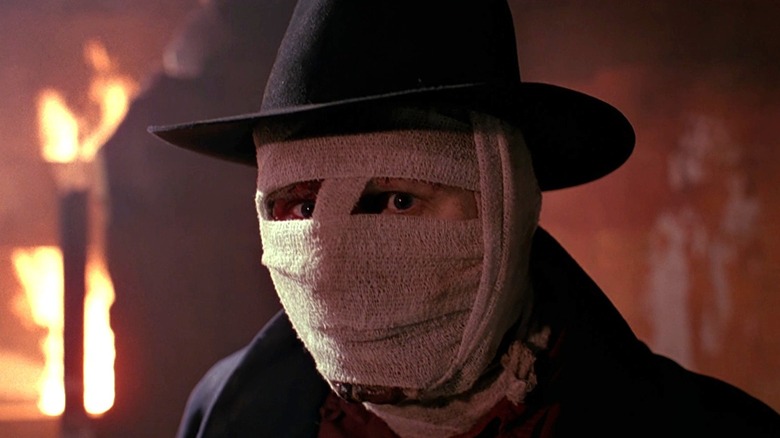
- The Premise: Claude Rains stars as Dr. Jack Griffin, a scientist who discovers a serum of invisibility, only for the formula to drive him violently insane as he terrorizes the English countryside.
- The Parallels: Griffin’s iconic appearance—a face wrapped entirely in white bandages and hidden behind dark sunglasses—is visually echoed in the early-act imagery of Matt Hagen recovering from his facial mutilation. Moreover, the terrifying paranoia of Whale’s film permeates the final act of Clayface, where Dr. Corr walks the streets of Gotham, glancing over her shoulder, wondering if the stranger next to her could secretly be Matt.
5. The Substance (2024)
Coralie Fargeat’s provocative, neon-soaked sci-fi body horror film shares the most modern thematic DNA with Clayface.
- The Premise: Demi Moore stars as Elizabeth Sparkle, an aging celebrity who turns to a mysterious black-market cellular drug called "The Substance" to manifest a younger, flawless alter ego (Margaret Qualley).
- The Parallels: Both films examine the brutal societal expectations placed on physical appearance, particularly within the entertainment industry. While Elizabeth’s reliance on the Substance mimics a destructive drug addiction that leads to a grotesque third-act metamorphosis, Clayface channels that same level of R-rated, gore-soaked transformation through Hagen’s shifting, unstable mud-like biology.
Official Responses and Creative Vision
DC Studios and director James Watkins have defended the calculated risk of steering a major comic book property into hard-R horror territory. In promotional interviews, Watkins emphasized that the psychological terror of losing one’s face—and by extension, one’s identity—offered a far more compelling narrative anchor than traditional superhero spectacle.
Industry analysts have noted that Clayface represents a broader strategic shift for Warner Bros. and DC Studios under the co-leadership of James Gunn and Peter Safran. By treating distinct characters as genre experiments—ranging from psychological crime thrillers to creature features—the studio is attempting superhero fatigue mitigation through tonal diversity.

Early test screenings and reviews have praised the studio’s willingness to lean into practical creature design, dark psychological themes, and genuine tragedy, positioning Clayface not just as a successful Batman villain spinoff, but as a watershed moment for comic book adaptations on screen.
Implications for the Future of the DC Universe
The critical and financial gamble of Clayface carries profound implications for the trajectory of the broader DC Universe. For years, major cinematic universes have struggled with homogenized tones, where high-stakes world-ending CGI battles overshadow intimate character studies.
By proving that a recognizable comic book villain can successfully anchor a pure body horror film, DC Studios has established a valuable precedent:
- Genre Fluidity: Future standalone or limited projects within the DCU can safely explore genres outside the traditional action-adventure framework, including psychological thrillers, cosmic horror, and noir detective stories.
- Director-Driven Visions: Giving filmmakers like James Watkins the creative freedom to lean into R-rated practical effects and emotionally bleak narratives signals to top-tier talent that DC is a welcoming home for auteur-driven genre cinema.
- Audience Appetite: The positive reception of Clayface suggests that modern audiences are hungry for mature, character-driven subversions of superhero tropes, proving that monsters can sometimes be far more compelling than heroes.
