Redefining a Literary Icon: How Jack Thorne and David McKenna Reimagined ‘Lord of the Flies’ for a New Generation
Main Facts: A Triumph of Creative Synergy at the 2026 IndieWire Honors
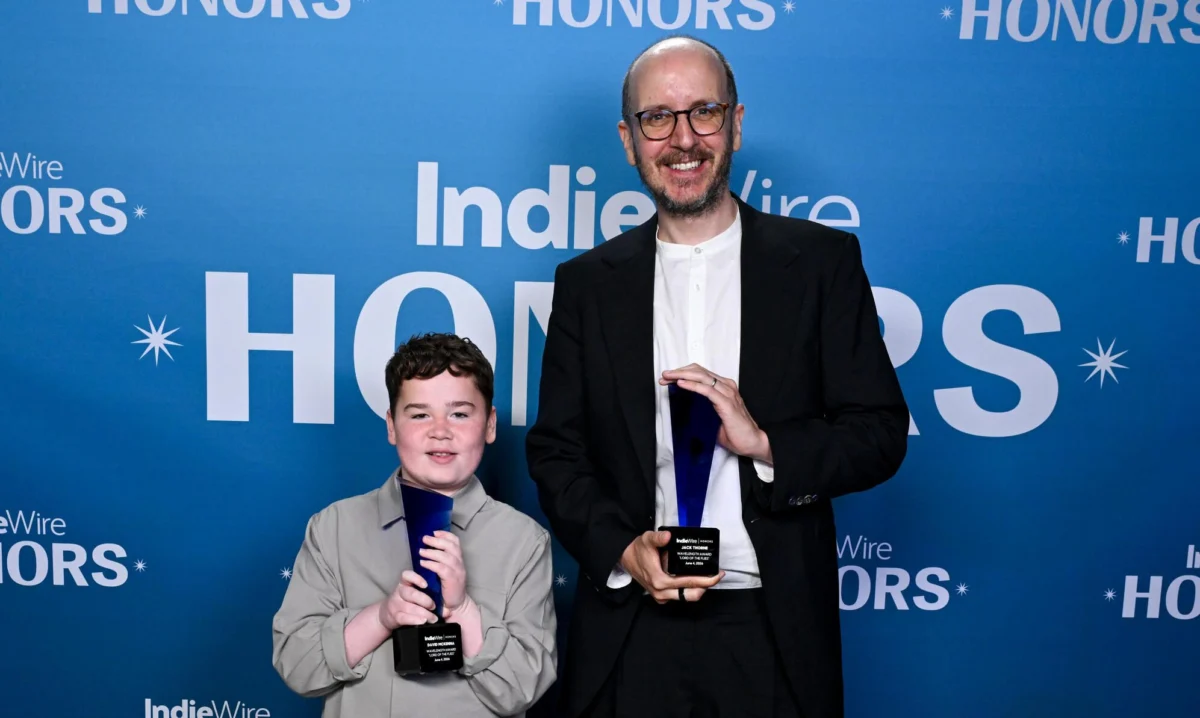
At the 2026 IndieWire Honors, an annual celebration recognizing the most innovative and impactful achievements in contemporary cinema and television, the prestigious Wavelength Award was presented to JackThorne, the creator and writer of Netflix’s highly acclaimed limited series adaptation of Lord of the Flies, alongside breakout star DavidMcKenna. The Wavelength Award, which honors outstanding creative synergy, artistic risk-taking, and collaborative excellence, was bestowed upon the duo for their revolutionary reinterpretation of one of literature’s most tragic figures: Piggy, who in this modern adaptation is finally given his proper name, Nicky.
Netflix’s bold, prestige adaptation of William Golding’s classic 1954 novel has captured global attention for its visceral exploration of human nature, societal collapse, and the fragility of civilization. While Golding’s text famously concludes in a devastating descent into savagery, darkness, and moral ruin, the atmosphere at the IndieWire Honors was one of profound optimism.
During his acceptance speech, Jack Thorne affectionately dubbed the production team and cast "Team David," credit-pointing McKenna as the emotional anchor and creative catalyst who completely redefined the production’s understanding of the narrative. Rather than portraying Nicky as a passive, tragic victim—the traditional reading of Piggy in previous cinematic iterations—McKenna infused the character with a fierce, eccentric optimism, described as a "little old Irish granny" who remains the moral compass of the stranded schoolboys.
Chronology: The Journey from Page to Screen
The path to this critically acclaimed adaptation began several years prior, when Netflix secured the television rights to Golding’s estate with the intention of developing a definitive, character-driven limited series. Jack Thorne, renowned for his empathetic and nuanced writing on projects such as Wonder, His Dark Materials, and Skins, was brought on board to pen the scripts. Thorne partnered with visionary director Marc Munden (Utopia, The Third Day), establishing a creative alliance dedicated to ground-level realism and emotional authenticity.
In late 2024 and early 2025, the production embarked on an exhaustive casting call across the United Kingdom and Ireland. Seeking to populate the deserted island with authentic, raw talent rather than polished child actors, Thorne, Munden, and casting directors auditioned more than 1,000 young hopefuls for the core roles of Ralph, Jack, Piggy, Simon, and the "littluns."
The breakthrough came when they met David McKenna. McKenna did not approach the character of Piggy with the expected defeatism or vulnerability of an outcast. Instead, his audition presented a resilient, humorous, and deeply empathetic young boy who viewed the island not just as a prison, but as a space where a better, more cooperative society could be built.
Production and On-Set Collaboration
Filming took place on location, where Munden and Thorne fostered an environment of creative freedom, encouraging the young ensemble to improvise and form genuine bonds. It was during this grueling shoot that McKenna’s interpretation of Nicky reshaped the scripts.
Thorne actively rewrote dialogue to match McKenna’s unique cadence and comedic timing, culminating in a performance that balanced existential dread with moments of sublime joy. The production wrapped in late 2025, leading to a highly anticipated Netflix release in early 2026 that quickly drew praise from critics and educators alike for its daring departures from and faithful adherence to the spirit of Golding’s prose.
Supporting Data and Creative Choices: Deconstructing "Nicky"
To understand the impact of McKenna’s performance, one must look at the specific creative deviations Thorne’s adaptation made from Golding’s original text. Historically, the character of Piggy has been defined by his physical ailments—his asthma (or "ass-mar"), his severe myopia requiring thick glasses, and his weight—which render him an immediate target for the predatory Jack and his choir-turned-hunters. In previous film adaptations, such as Peter Brook’s stark 1963 black-and-white film and Harry Hook’s 1990 Americanized version, Piggy was portrayed primarily as an intellectual but physically helpless victim.
Creative Element
Original Novel (William Golding, 1954)
Netflix Limited Series (Jack Thorne, 2026)
Character Name
Exclusively referred to by the derogatory nickname "Piggy"
Given his proper name, "Nicky"
Primary Archetype
The tragic, rational intellectual; a passive victim of bullying
The optimistic, resilient hero; an active moral compass
Deep brotherhood; teaches Simon "Hooray for Captain Spaulding"
Thorne and McKenna dismantled this dynamic by shifting Nicky’s internal drive. Rather than cowering, Nicky acts as a maternal, scolding force on the island—hence McKenna’s self-description of the character as a "little old Irish granny." Nicky is a boy who is hyper-aware of his own physical vulnerabilities but refuses to let them dictate his utility or his dignity.
This is illustrated through his unexpected cultural eccentricities. In the series, Nicky is a passionate fan of Groucho Marx. In a pivotal, heartwarming scene designed to establish a sense of normalcy amidst growing isolation, Nicky teaches the sensitive choir boy Simon, played by Ike Talbut, the lyrics to "Hooray for Captain Spaulding" from the 1928 Marx Brothers musical Animal Crackers. This creative choice serves multiple narrative purposes:
It highlights Nicky’s role as an entertainer and a source of morale.
It establishes a profound, brotherly bond between Nicky and Simon, making their eventual, tragic fates even more devastating for the audience.
It provides a stark contrast to the tribal, rhythmic chants of Jack’s hunting faction, juxtaposing civilized, vaudevillian joy against primal, chaotic noise.
Official Responses and Acceptance Speeches
The chemistry and mutual respect between the veteran screenwriter and the young actor were on full display during the IndieWire Honors ceremony.
Jack Thorne’s Praise for the Young Cast
While accepting the Wavelength Award, Jack Thorne emphasized that the success of the adaptation belonged entirely to the young actors, advocating for a directorial philosophy of trust and non-interference:
"In truth, for me, it’s a ‘get out of the way and let the kids swing’ award. Marc Munden, our director, all the other remarkable cast, they’d all say the same thing, which is, ‘David McKenna rocks.’ We met David, who didn’t see Nicky as a victim at all, but as a—to quote him—‘little old Irish granny.’ As the optimistic hero who sees possibilities for better. David is remarkable. He can sing you a mean ‘Don’t Cry For Me Argentina,’ he can make you laugh, and he can make you believe that joy is just around the corner. Who better to take you into a tragedy?"
David McKenna’s Emotional Tribute
Taking the microphone, David McKenna expressed deep gratitude, pointing out that his passion for acting was heavily influenced by Thorne’s previous work on the screenplay for the 2017 hit film Wonder, an adaptation of R.J. Palacio’s novel about a boy with facial differences navigating school life:
"I grew up watching your film Wonder, and the fact that I’m stood here with you saying those remarkable words is just a dream, so thank you. This is for everyone."
To the delight of the audience, McKenna proved Thorne’s praise accurate by singing a few flawless, impromptu bars of "Don’t Cry For Me Argentina" from Andrew Lloyd Webber’s Evita, showcasing the charismatic, theatrical spirit he brought to the set of the island drama.
McKenna also took time to acknowledge the collaborative nature of the production, thanking director Marc Munden, executive producer Joel Wilson, his father, his talent agent, and his fellow cast members. He emphasized that the intense filming conditions forged an unbreakable bond among the boys, stating they had "become brothers" during the shoot, and accepted the award on behalf of the entire ensemble.
Implications: A New Template for Adapting Classic Literature
The success of Thorne’s Lord of the Flies and the recognition of McKenna’s performance at the 2026 IndieWire Honors carry significant implications for the entertainment industry, particularly regarding how classic, high-school curriculum literature is adapted for modern streaming audiences.
Rethinking the "Victim" Narrative
For decades, literary adaptations have struggled with modernizing mid-century texts without losing their core thematic weight. By renaming Piggy to Nicky and giving him agency, humor, and a distinct personality beyond his physical limitations, Thorne and McKenna have established a new template. They proved that a character can still meet a tragic end without being defined solely by their victimhood throughout the narrative. Nicky’s death in the series is not the inevitable crushing of a weakling, but the tragic silencing of an active, vibrant voice of reason and hope, which amplifies the emotional impact of the climax.
The Power of Youth-Led Ensembles
Furthermore, the production’s casting methodology and Thorne’s "get out of the way" writing philosophy challenge the industry’s tendency to over-rehearse or over-sanitize young performances. By allowing McKenna and his co-stars to bring their own cultural backgrounds, musical talents, and humor to the screen, Netflix has delivered an adaptation that feels urgent, contemporary, and deeply human.
As streaming platforms continue to search for prestige intellectual property that appeals across generational divides, the critical and industry acclaim for Lord of the Flies suggests that the key to unlocking classic texts lies in trusting the instincts of the young actors hired to bring them to life. David McKenna’s triumph as Nicky ensures that future adaptations of Golding’s work will forever be viewed through a more empathetic, dynamic lens.