
Apple Redefines the Professional Desktop: The M6 and M5 Silicon Revolution
Apple has once again disrupted the professional computing landscape, pushing its desktop lineup—the Mac mini and Mac Studio—further into the realm of high-end cinematic and data-intensive production. With the introduction of the groundbreaking 2nm M6 chip and the expansive power of the M5 Ultra, Apple is signaling a shift in its strategy: the company is no longer just competing with traditional workstations; it is creating a new category of "AI-first" production machines.
By integrating CPU, GPU, and dedicated Neural Accelerators into a unified architecture, these new systems are designed to handle the massive data throughput required by modern filmmakers, 3D artists, and AI engineers. This evolution marks a transition where raw clock speeds are secondary to the efficiency of the entire pipeline.
The Core Transformation: A Shift in Silicon Strategy
At the heart of these announcements lies the transition to the 2nm process for the M6 chip, a milestone in semiconductor manufacturing that allows for unprecedented transistor density. This leap enables Apple to pack more performance into smaller form factors, effectively blurring the lines between a compact home office machine and a studio-grade render node.
For creative professionals, the narrative has shifted from "faster rendering" to "faster workflow fluidity." Apple is focusing heavily on hardware-accelerated media engines that handle H.264, HEVC, ProRes, and AV1 decoding locally, reducing the reliance on cloud-based processing and enabling real-time editing of uncompressed 8K footage.
Chronology: The Rollout of the New Desktop Lineup
Apple’s strategy for the rollout reflects a tiered approach, addressing both the individual creator and the massive enterprise production facility.
- August 25: Apple officially opened pre-orders for the entire lineup, generating significant buzz among post-production houses and independent studios.
- September 22: The official launch date for the standard M6 Mac mini and the M5 Max/Ultra Mac Studio models.
- Late October: Apple has scheduled the availability of the ultra-high-end 512GB unified memory configuration for the Mac Studio, marking the final piece of the hardware puzzle for high-end VFX environments.
Mac Mini: The 2nm M6 Performance Jump
The Mac mini has long been an underdog, but the introduction of the M6 chip transforms it into a legitimate production powerhouse.
The Power of 2nm
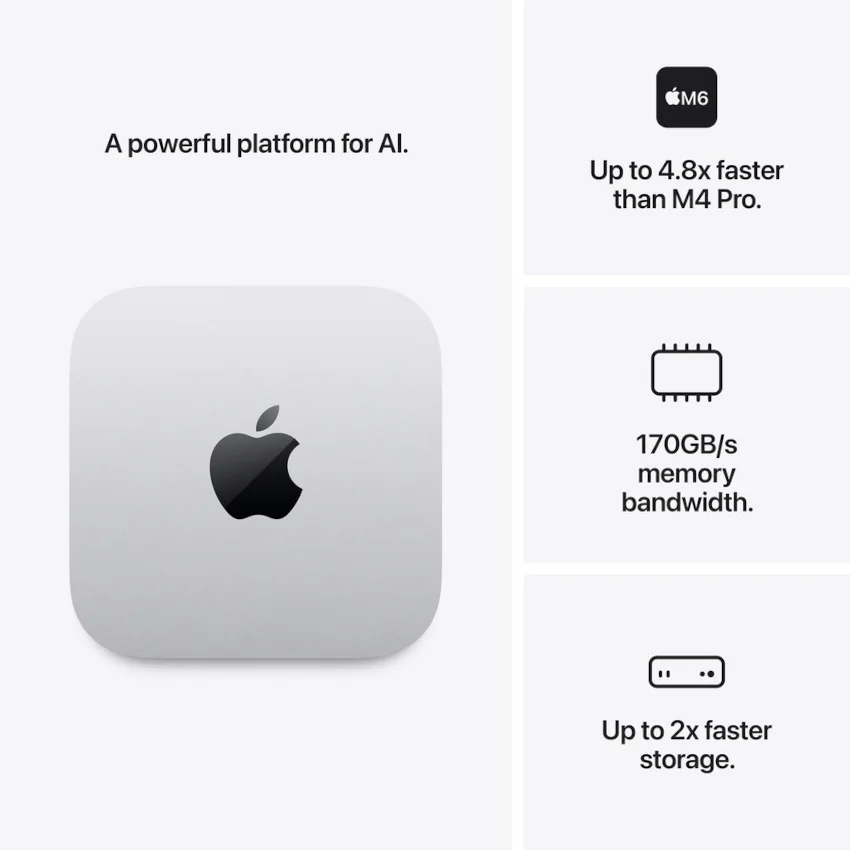
Built on a 2nm architecture, the M6 features a 12-core CPU and a 12-core GPU. Crucially, Apple has integrated Neural Accelerators into every single GPU core. The result is a performance boost that is difficult to ignore:

- 40% faster CPU performance compared to the M4.
- 2x faster graphics performance.
- 4x faster AI inference capabilities.
With a dual 16-core Neural Engine and a memory bandwidth of 170GB/s, the base M6 model is capable of managing complex video projects that previously required much larger hardware. The standard 16GB of unified memory is a welcome baseline, with options for up to 32GB, ensuring that editors can work with multiple compressed formats without hitting performance bottlenecks.
The M5 Pro Alternative
For users who require more headroom, Apple has added an M5 Pro configuration to the Mac mini chassis. Boasting an 18-core CPU and 20-core GPU, this version supports up to 64GB of unified memory and a substantial 307GB/s bandwidth. This configuration is clearly aimed at 3D artists and VFX professionals who need to manage high-polygon counts and complex particle simulations within a small desktop footprint.
Mac Studio: The Heavyweight Contender
While the Mac mini offers impressive efficiency, the Mac Studio is designed for the heavy lifting of professional film production. With the introduction of the M5 Max and M5 Ultra, the Studio effectively replaces the need for massive, tower-based workstations in many workflows.
M5 Max and Ray Tracing
The M5 Max configuration, featuring an 18-core CPU and up to a 40-core GPU, introduces third-generation hardware-accelerated ray tracing. This is a game-changer for motion graphics artists using tools like Cinema 4D or Blender. The enhanced shader cores, combined with 128GB of unified memory, allow for complex lighting and rendering tasks that would previously have required a multi-GPU server setup.
The M5 Ultra: Quad-Die Dominance
The M5 Ultra is the pinnacle of Apple’s current silicon capabilities. Using "UltraFusion" technology, Apple has created the industry’s first quad-die architecture. The specifications are staggering:
- 36-Core CPU & 80-Core GPU.
- 512GB Unified Memory.
- 1.2TB/s Memory Bandwidth.
For a colorist working in DaVinci Resolve, the ability to grade uncompressed 8K footage in real-time is no longer a luxury—it is the standard. Furthermore, the Media Engine can handle up to 33 streams of 8K ProRes 422 simultaneously, a feat that simplifies the workflow for multi-camera shoots and complex VFX compositing.
Implications for Production and Connectivity
The hardware upgrades extend beyond the silicon. With the introduction of Thunderbolt 5, Apple is providing 120Gb/s of bandwidth, which is essential for the high-speed storage arrays required in modern 8K workflows.

Genlock and Sync
One of the most exciting additions is the introduction of genlock over USB-C. This feature allows for frame-accurate synchronization between professional camera systems—such as the iPhone 17 Pro—and the display. This is a vital development for virtual production and live-action cinematography, where precise timing between hardware is non-negotiable.
The Distributed AI Revolution
Perhaps the most forward-thinking announcement is the ability to cluster multiple Mac Studio units over Thunderbolt 5 and RDMA (Remote Direct Memory Access). By networking these systems, studios can create a localized AI processing cluster. Apple’s internal testing shows that a four-system cluster can deliver 3x faster AI inference, effectively allowing firms to train and iterate models on their own hardware rather than relying on the latency of cloud-based training environments.
Pricing and Market Positioning
Apple has maintained its premium pricing, reflecting the high-end utility of these machines:
- Mac mini (M6): Starts at $899.
- Mac Studio (M5 Max): Starts at $2,499.
- Mac Studio (M5 Ultra): Starts at $5,499.
While the price point for the M5 Ultra is significant, when compared to the total cost of ownership for a full-scale VFX workstation, the power-to-price ratio remains highly competitive. The inclusion of Wi-Fi 7 and Bluetooth 6 ensures that these machines are ready for the next decade of connectivity standards.
Conclusion: The New Standard for Local Workflows
The move to 2nm architecture with the M6 and the quad-die M5 Ultra represents a pivot point for Apple. The company is betting that professionals want more than just speed; they want a unified environment where AI acceleration, media throughput, and memory bandwidth work in concert.
For the filmmaker or the motion graphics designer, these machines remove the "waiting time" from the creative process. Whether it is the Mac mini handling a fast-paced edit on location or a cluster of Mac Studios rendering a full-length feature film in a studio, Apple’s latest hardware suite is built to keep the production pipeline entirely local.
As the industry continues to move toward higher resolutions and more complex AI-assisted workflows, Apple has positioned itself not just as a hardware manufacturer, but as the architect of the modern production environment. The era of the "compact workstation" has truly arrived, and it is significantly more powerful than anyone could have anticipated a few years ago.
