
Beyond the Frame: Inside the Unpredictable, Resilient Career of Filmmaker Miranda Sajdak
Main Facts
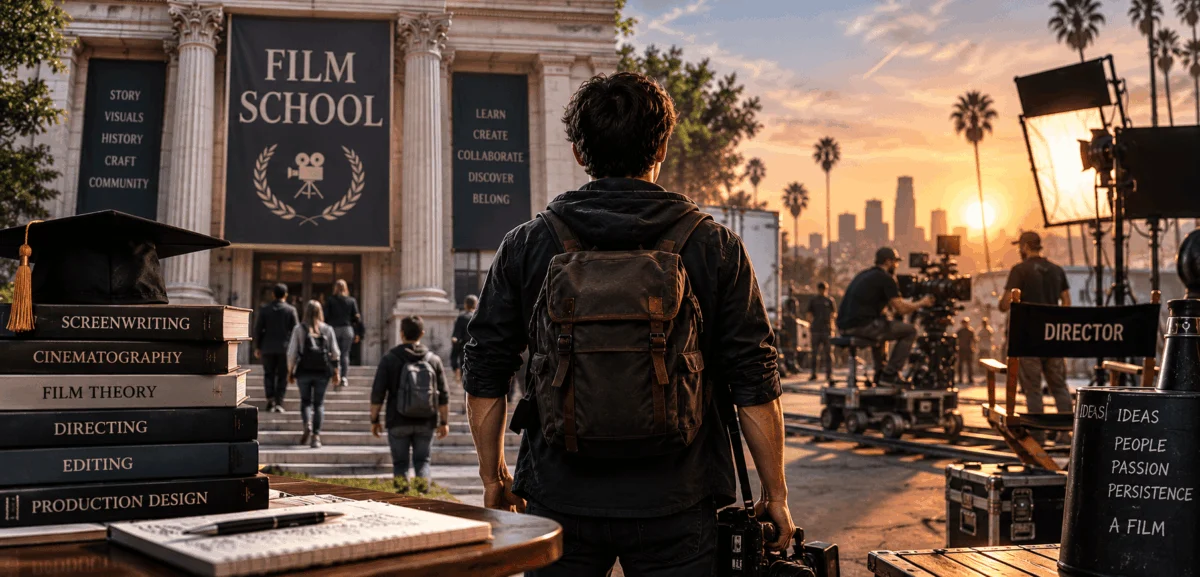
The entertainment industry is rife with unwritten rules, but perhaps none provoke more anxiety for aspiring filmmakers than a foundational crossroads: Is film school actually necessary?
According to seasoned writer, producer, and director Miranda Sajdak, there is no single blueprint for success in the cinematic arts. Her career—spanning blockbuster studio productions, independent features, television writers’ rooms, entrepreneurial ventures, and her own directorial projects—demonstrates that the path to a sustainable filmmaking career is rarely linear.
Sajdak’s journey offers a masterclass in the realities of the entertainment business. From navigating elite academic environments like Columbia University to cutting her teeth as a production assistant (PA) on high-profile Hollywood blockbusters like The Bourne Ultimatum and Cloverfield, and later managing the chaotic logistics of indie filmmaking (including finding a last-minute pregnant horse during a winter shoot in upstate New York), her experiences dismantle romanticized notions of the industry. Instead, they highlight the essential traits required to survive and thrive in Hollywood: radical resourcefulness, deep professional humility, genuine relationship-building, and the entrepreneurial grit to carve out one’s own path.
Chronology: From Childhood Epiphany to Industry Veteran
The Spark
Miranda Sajdak’s fascination with cinema began in childhood. The pivotal moment arrived when her mother took her to see Penny Marshall’s 1992 sports comedy-drama, A League of Their Own. Watching women take center stage in a rich, multi-dimensional narrative struck a visceral chord. Walking out of the theater, Sajdak knew definitively that filmmaking was not merely an interest, but her life’s calling.
Academic Foundation
That early determination eventually led her to Columbia University’s renowned film program. Far beyond textbooks and theoretical lectures, film school provided Sajdak with critical access: an immediate network of peers, hands-on experience on graduate student sets, a practical understanding of strict on-set etiquette, and mentorship from professors who helped distill the overwhelming universe of cinema into focused, actionable study.
The Studio Trenches
Armed with her education, Sajdak transitioned into physical production, cutting her teeth in the demanding world of studio filmmaking. Working as a production assistant, she contributed to major motion pictures including The Bourne Ultimatum and Cloverfield. These high-pressure environments exposed her to the inner workings of unionized, multi-million-dollar studio setups, offering a stark contrast to the indie world she would later navigate.
Television and Collaboration
Seeking to expand her narrative toolkit, Sajdak transitioned into television, working as a writers’ assistant on shows such as Huge and China, IL. This chapter redefined her understanding of authorship, transforming her perception of writing from a solitary art form into a deeply collaborative commercial enterprise.
Entrepreneurship and The "Script Chicks"
Realizing that passion projects rarely pay immediate bills, Sajdak partnered with producer Sandra Leviton to launch Script Chicks. Leveraging their extensive background in development, the duo built a business providing professional screenplay coverage. This entrepreneurial pivot served as a financial lifeline, keeping the lights on while affording them the creative autonomy to write, direct, and produce independently.
Returning to the Director’s Chair
After years of supporting other creators, developing properties, and navigating studio notes, Sajdak realized she had drifted away from the primary ambition that inspired her childhood cinema trip: directing. Refusing to wait for idealized industry conditions, she penned a new short script, assembled a trusted circle of brutally honest peer reviewers, launched a crowdfunding campaign, and returned firmly to directing action-driven work.
Supporting Data & Industry Realities: The Anatomy of Filmmaking
Sajdak’s career maps out the distinct structural differences between the various sectors of the entertainment industry, providing concrete insights for emerging talent.
Studio vs. Independent Production
While both environments share a singular core objective—telling a compelling story—the operational scale alters everything:
- Union Studio Productions: Characterized by massive budgets, heavily specialized departments, large crews, and relative breathing room for individual setups. The hierarchy is rigid, and roles are clearly defined.
- Independent Productions: Lean, agile, and often chaotic. Directors and producers frequently find themselves troubleshooting inter-departmental issues on the fly. While grueling, Sajdak notes that this hands-on environment grants filmmakers an intimate, practical understanding of every single gear turning behind the camera.
The Myth of the Unsolvable Crisis
Indie filmmaking frequently tests human endurance through sheer absurdity. Sajdak recounts producing a winter feature in upstate New York where the narrative’s emotional climax hinged on a teenage girl assisting a horse giving birth. The production had secured a location on a pregnant horse farm, guaranteeing a smooth shoot—until nature refused to align with the call sheet. The horse was simply not going to foal during their allotted production window.
With no modern mobile internet available to instantly source solutions, Sajdak turned to a landline and the Yellow Pages, cold-calling regional horse farms. Within an hour, she identified two viable leads, relocated the crew, and captured the sequence. It remains, for Sajdak, the ultimate definition of producing: no manual can prepare a producer for a non-compliant animal; success relies entirely on immediate, pragmatic problem-solving.
The Realities of Writing for Hire and Television
Television taught Sajdak a lesson that every aspiring screenwriter must eventually swallow: ego is the enemy of longevity. In a collaborative medium involving network executives, studio mandates, character eliminations, and structural overhauls, writing is rarely precious. Sajdak’s golden rule for writers entering the room is stark and liberating: "There will be rewrites. There will be a lot of rewrites." Writers who treat every sentence as sacred text inevitably struggle in professional writers’ rooms.
Official Perspectives & Industry Insights
Reflecting on the perpetual debate surrounding film school, Sajdak offers a balanced, non-dogmatic viewpoint. While formal education accelerated her entry into the industry, she stresses that it is not a mandatory prerequisite.
"What matters is understanding where you want to go and determining which path gives you the skills, relationships, and experience necessary to get there," Sajdak notes.
Many successful industry professionals bypass formal programs entirely, mastering cameras, theory, and protocol independently or through the "school of hard knocks" on working sets.
On the subject of professional survival, Sajdak emphasizes that networking is frequently misunderstood. It is rarely about collecting business cards at high-profile cocktail parties or film festival mixers. True networking, according to Sajdak, is rooted in demonstrated competence and reliability under pressure:
- When peers and superiors witness your professionalism, composure during a crisis, and work ethic, your name naturally enters the conversation when new opportunities arise.
Furthermore, Sajdak champions financial pragmatism. A viable career in entertainment rarely resembles a straight vertical climb. It is a mosaic of side hustles, script-reading gigs, PA work, producing for others to fund your own visions, and launching supplementary businesses. Survival in the arts requires treating your career as an evolving portfolio of skills rather than a single, rigid trajectory.
Implications for the Future of Independent Cinema
Sajdak’s journey carries profound implications for the next generation of content creators entering an increasingly fragmented media landscape.
As traditional studio gatekeeping shifts and digital distribution democratizes access to audiences, the traditional models of breaking into Hollywood are undergoing a seismic transformation. Sajdak’s career proves that waiting for permission—waiting for the perfect budget, the ideal studio greenlight, or seamless institutional support—is often a career killer.
By building parallel revenue streams (such as Script Chicks), embracing the unglamorous mechanics of production assisting, and maintaining creative resilience in the face of logistical chaos (or uncooperative livestock), modern filmmakers can maintain creative agency.
Ultimately, Sajdak’s trajectory serves as an empowering reminder: the specific doorway you use to enter the industry—whether it’s an elite MFA program, a PA gig on a blockbuster action film, a television writers’ assistant desk, or a camera in a bedroom—matters far less than the grit, adaptability, and resourcefulness you display once you are inside.
