
Beyond the Prompt: Autodesk Flow Studio Redefines Generative AI for Filmmakers with New 3D Editor and Canvas Workflow

Main Facts: The Evolution of Autodesk Flow Studio
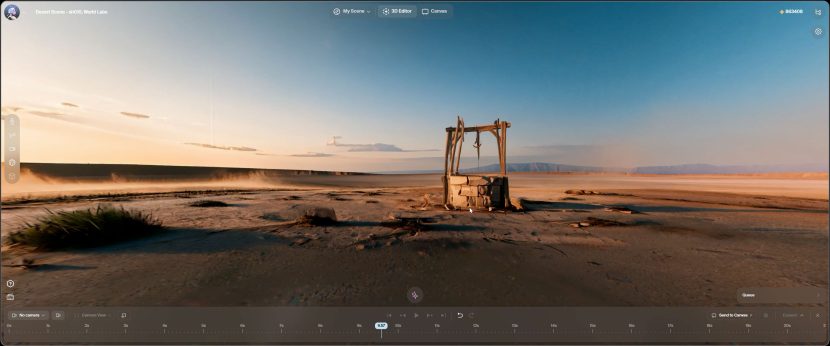
Autodesk is redefining the landscape of generative video production with a major update to Autodesk Flow Studio, moving the technology far beyond simple, prompt-driven video generation. At the heart of this release is a powerful new hybrid system: the 3D Editor + Canvas workflow. This platform bridges the gap between interactive, spatial 3D scene construction and the rich, cinematic visual output of state-of-the-art generative 2D video models.
Rather than promising a Hollywood-ready film generated entirely from a single block of descriptive text, Flow Studio introduces granular, directable control to AI filmmaking. By allowing directors, animators, and visual effects (VFX) artists to position cameras, block actor movements, shape exact performances, and manage spatial geometry directly in three dimensions, Autodesk is tackling the notoriously unpredictable "last 20 percent" of generative content creation.
The cloud-based platform caters to a wide spectrum of creators, scaling seamlessly from nimble indie teams of three to five people up to expansive, major studio pipelines. By integrating technologies like World Labs’ Marble for Gaussian splat-based environments alongside advanced motion-capture and reference-driven performance tools, Flow Studio positions itself not as a replacement for human creativity, but as an advanced directorial instrument.
Chronology: From Wonder Dynamics to Autodesk’s Next-Gen Directing Platform
To understand how Autodesk Flow Studio arrived at this milestone, it is helpful to trace the technological trajectory that brought its core architects to this point.

The Foundation: Early Generative AI and Automation
- The Rise of Text-to-Video: Early iterations of generative video models relied heavily on text prompts. While capable of producing striking imagery, these models lacked precise control, making targeted edits nearly impossible without completely regenerating the asset.
- The Wonder Dynamics Era: Co-founded by Nikola Todorovic, Wonder Dynamics pioneered automated CG character integration into live-action footage. The original platform successfully synthesized roughly 25 distinct machine learning, computer vision, and generative systems, proving that complex technical pipelines could be automated behind the scenes to empower artists.
Integration and the Birth of Flow Studio
- Acquisition and Integration: Following Wonder Dynamics’ integration into Autodesk, Todorovic and his team set out to solve a broader industry challenge: moving away from isolated AI tools and building a unified, production-ready ecosystem.
- The Current Release: Autodesk introduces the 3D Editor + Canvas workspace. This release represents a pivotal shift, transitioning generative AI from a novelty experiment that produces static, unpredictable clips into a fully directable, multi-layered editorial pipeline.
Supporting Data: Technical Architecture, Capabilities, and Pipelines
The technological framework underpinning Flow Studio is designed to balance heavy computational lifting with real-time, interactive artist control.
The 3D Editor and Spatial Workflows
The platform’s 3D Editor allows creators to assemble shots using a robust mix of digital assets:
- Characters and Animation: Performers can be mapped using motion-capture data or video references.
- Camera Tracks: Users can keyframe camera movements directly or combine tracks from multiple reference sources.
- Spatially Coherent Environments: Leveraging cutting-edge spatial technologies like World Labs’ Marble, the system utilizes Gaussian splat-based worlds for rapid blocking, layout planning, and precise camera design.
The Canvas and Generative Finishing
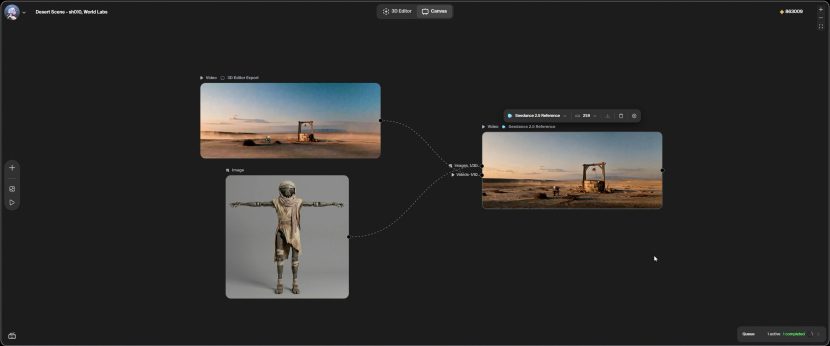
Once the foundational 3D scene establishes the staging, composition, performance, and camera trajectory, artists can move into Canvas—Flow Studio’s node-based 2D environment.
- Leveraging AI Strengths: Generative 2D models are utilized for what they do best: complex lighting integration, atmospheric effects, physics simulations, and cinematic color grading.
- Flexibility: Users are not locked into a single method. Creators can stay entirely within Canvas for fast turnarounds or dive into the 3D Editor whenever a shot demands millimeter-exact spatial direction.
Performance Metrics and Infrastructure
- Cloud-Based Interactivity: The 3D Editor is engineered to maintain high interactivity over the cloud.
- Processing Times: While 3D workspace manipulation happens smoothly, Canvas generation times vary based on the selected generative model, shot length, and output resolution. World generation via spatial tools currently operates on a scale of several minutes per environment.
- Adoption Trajectory: According to Autodesk leadership, the software is following a classic tech adoption curve: starting in social media content and experimental loops, passing through commercials, music videos, and independent films, and ultimately scaling toward major studio pipelines.
Official Responses and Expert Insights: Nikola Todorovic on the Future of Directing
In a recent interview on the fxpodcast, Nikola Todorovic—co-founder of Wonder Dynamics and now a key driving force at Autodesk—shed light on the philosophy guiding Flow Studio’s development.

Solving the "80/20 Rule" of Generative AI
Todorovic points out a core frustration familiar to anyone who has worked with early generative tools: the "80/20 rule."
"Prompting and AI can produce the first 80 percent of an image remarkably quickly. The difficulty begins when a director asks for a precise revision: move an object, alter the performance or refine a camera path without losing everything that already works."
By coupling 3D spatial direction with 2D generative outputs, Flow Studio gives artists the leverage needed to alter that final 20 percent without throwing away the rest of the shot. This directability directly counters the rising industry criticism of generic "AI slop," where creators are forced to accept a model’s statistically safest, most homogeneous interpretation.
Performance Before Prompting
Addressing how performances are generated, Todorovic remains skeptical of text-only prompts or audio-only inputs for creating nuanced acting:
"Audio-driven animation can work, but it often creates generalized gestures and expressions."
Consequently, Flow Studio prioritizes captured human performances. By allowing real video and audio reference from a recorded actor to drive the character mesh, the system preserves human timing, subtle micro-expressions, and intentionality before generative models polish the final appearance. While audio-only generation is supported during final touches, Autodesk is actively expanding how source-performance audio carries through the broader workflow.
Implications: Changing the Economics and Craft of Filmmaking
The release of Autodesk Flow Studio’s updated workflow signals profound shifts for the entertainment industry, altering everything from technical pipelines to creative accessibility.
Democratizing Complex VFX
Traditional Computer Graphics (CG) pipelines require artists to construct exhaustive digital environments—often building far more than what the camera will ever capture—just to account for potential last-minute directorial changes. Flow Studio flips this paradigm. By letting AI handle background technical complexity, storytellers can concentrate their energy entirely on what makes it into the final frame.
Todorovic emphasizes that this technology is not about eliminating human creativity through automation:
"This is not about replacing filmmaking with a prompt. Filmmakers have always relied on specialists without personally solving every physical equation involved. The opportunity is to give more storytellers access to complex techniques without requiring mastery of every layer of the underlying mathematics."
Reshaping Industry Tiers
By democratizing high-end tracking, spatial world-building, and performance integration, Flow Studio bridges the gap between resource-heavy studio departments and independent creators. A small team of three to five individuals can now execute shots that previously required dedicated departments for pre-visualization, layout, matchmoving, and compositing.
A New Standard for Generative Video
Ultimately, Autodesk Flow Studio marks the maturation of generative video. The medium is shedding its identity as a novelty party trick that spits out random, unmanageable clips. Instead, it is evolving into a legitimate cinematic instrument—one where artificial intelligence acts as the brush, but the filmmaker firmly holds the handle.
