
Bringing the Anarchy: How DNEG Bridged the Gap Between Live-Action and Looney Tunes in Coyote vs. Acme
Main Facts
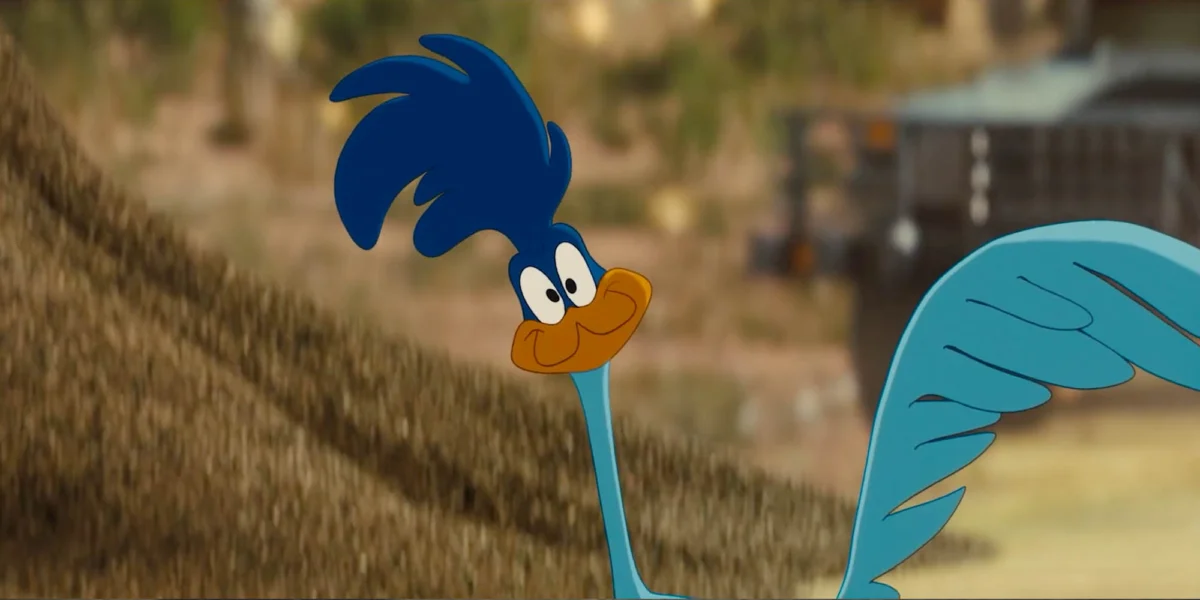
The art of translating two-dimensional, hyper-kinetic animation into a tangible, photographed world has long been one of the motion picture industry’s most elusive holy grails. Few cinematic experiments have captured the public imagination quite like Robert Zemeckis’s Who Framed Roger Rabbit, a landmark achievement that proved animated icons could inhabit physical space. Decades later, DNEG’s visual effects and animation teams took on an even more distinct stylistic challenge with Coyote vs. Acme: preserving the specific, anarchic, and razor-sharp comedy of the classic Looney Tunes universe within a photorealistic live-action environment.
Directed by Dave Green (Teenage Mutant Ninja Turtles: Out of the Shadows) and guided by Production VFX Supervisor George Murphy (The Matrix Revolutions, Maleficent), the production required an unprecedented marriage of classic feature animation principles and cutting-edge digital effects. In an exclusive interview on the fxpodcast, Visual Effects Supervisor Alexander Seaman and Animation Director Keith Roberts detailed the meticulous craft, technical innovations, and creative compromises required to bring Wile E. Coyote out of the desert backdrop and into a world populated by real actors, practical stunts, and physical sets.
Rather than relying on standard, off-the-shelf computer-generated (CG) pipelines, DNEG had to systematically deconstruct and rebuild conventional digital workflows. The goal was never to make Wile E. Coyote look like a real animal, nor was it to simply paste a flat cartoon cell over a live-action plate. Instead, the team sought to create a three-dimensional character possessing physical weight and volume while strictly honoring the iconic graphic silhouettes, sharp timing, and timeless visual grammar established decades prior by legendary animators like Chuck Jones.
Chronology
Phase 1: Inception and the "Sketchvis" Foundation
The journey of bringing Coyote vs. Acme to the screen began with a deep-seated reverence for the source material. Seaman, who humorously recalls dressing up as Roger Rabbit for a childhood birthday party, jumped at the opportunity to work on the film. Roberts joined the production from its earliest developmental stages, attracted by a project that promised to stretch both halves of DNEG’s technological and artistic capabilities.
From the outset, the production recognized that traditional 3D animation methods—which naturally favor flowing curves, smooth momentum, and overlapping motion—would inevitably dilute the sparse, punchy comedic timing intrinsic to Chuck Jones’s style. To combat this, the team instituted an intensive pre-production and layout process known as "sketchvis."
Almost every shot in the film originated as a hand-drawn sketch directly over live-action plates. While the sketchvis team fluctuated in size, much of the foundational visual blocking was driven by a core group of just four artists (peaking at around ten). This method allowed Director Dave Green to rapidly evaluate multiple alternative gags within a single week. By sketching over the plates first, artists could explore performances freely without being encumbered by complex 3D rigs, lens distortions, or camera limitations. Once Green approved a specific comedic beat, the animation team reverse-engineered the drawings, frequently forcing substantial adjustments to digital rigs and virtual camera setups to match the spontaneous, hand-drawn aesthetic.

Phase 2: On-Set Collaboration and Puppeteering
Translating a cartoon character into a live-action scene requires more than digital magic; it demands genuine interaction between human actors and their animated counterparts. On set, seasoned puppeteer Dave Barclay played a pivotal role by operating a physical, tangible proxy of Wile E. Coyote.
Barclay’s puppet gave the cast a real focal point—someone to look at, react to, and time their dialogue against. A subtle twitch of the puppet’s head could punctuate a comedic beat or prompt an authentic facial reaction from an actor. Because Wile E. Coyote communicates almost entirely through expressive body language and silent reactions, these physical exchanges were vital for establishing the rhythm of a scene.
The puppet itself was ingeniously modular. Built with removable ears, nose, and arms, Barclay could strip the prop down to little more than a pair of glowing eyes for certain compositions, minimizing visual obstruction on the background while still providing actors with an accurate eyeline reference. While some scenes relied on simpler eyeline markers after initial rehearsals, many of the final takes incorporated Barclay’s direct physical interplay. In post-production, Seaman’s team digitally erased the puppeteer and the armature, retaining only the organic timing that made the human-to-cartoon chemistry click.
Phase 3: The Technical Pipeline — Rigging, Toon Shaders, and Houdini Outlines
Once plate photography and animation blocking were locked, the workflow transitioned into DNEG’s specialized rendering pipeline. Standard photoreal rigs were discarded in favor of systems capable of extreme, non-destructive deformation.
To achieve the signature look of a classic Warner Bros. short, DNEG developed custom toon shaders utilizing Clarisse. Initial passes were rendered relatively flat to ensure the fundamental poses and silhouette reads remained uncompromised by complex lighting schemes.
One of the most complex technical hurdles involved generating dynamic outlines. Built using Houdini based on the outlines of the shading network, these lines were not static. They dynamically adjusted based on movement, position on the character’s anatomy, and distance from the camera lens. For instance, a line tracing Wile E.’s paw could not simply thicken uniformly as the paw moved closer to the camera; artists had to ensure consistent weight across characters at comparable depths to preserve the hand-drawn illusion through shifting scales and perspectives.

Phase 4: Integration, Lighting, and Environmental Blend
Integrating a heavily stylized cartoon character into a photographic world meant managing conflicting visual physics. A prime example is the classic falling piano gag. The piano’s impact needed the abrupt, violent, and instantaneous timing of a traditional cartoon, yet the automobile it crushed had to exhibit believable, real-world weight and structural destruction.
The sequence combined a practical special effects stunt with digital augmentation and custom retiming. The team tested various iterations—including whether a hyper-realistic piano performing the same action would retain its humor—ultimately concluding that exaggerating the physics around the animated gag yielded the strongest comedic result.
Lighting the character also demanded deliberate restraint. Seaman instructed artists to steer away from complex global illumination and hyper-detailed surface shading, favoring simpler key lighting and flatter aesthetics. Much of Wile E.’s fine-tuning—such as catching the precise highlight along his nose—was managed directly in Nuke using rotoscoping shapes and localized lighting tweaks, ensuring the character popped from the live-action plate without looking out of place.
Environmental settings presented their own unique trials. The desert backdrops required the warm, nostalgic familiarity of classic theatrical shorts rendered through a photorealistic lens. As Seaman noted, "It needed to be realistic, but you could never actually go to that place." Utilizing Unreal Engine for early visualization allowed Director Dave Green to block out camera moves and staging before handing the assets over to Roberts’s team for gag refinement. The virtual environments remained intentionally flexible, adapting to the evolving animation quite late in the production cycle.
Supporting Data
- Team Scale: The sketchvis department core consisted of approximately four artists, scaling up to ten during peak production phases.
- Software Ecosystem:
- Unreal Engine: Utilized for pre-visualization, spatial blocking, and early camera choreography.
- Clarisse: Used to develop and run custom toon shaders for the character pipeline.
- Houdini: Deployed to generate and dynamically manage character outlines based on camera distance and anatomical positioning.
- Nuke: Employed for compositing, localized lighting accents, and roto-shape adjustments.
- Reference Material: Heavily influenced by the economic posing, spare animation quality, and precise timing of legendary director Chuck Jones, alongside the pioneering live-action blending techniques of Who Framed Roger Rabbit.
Official Responses
Reflecting on the unique challenges of the production during their fxpodcast appearance, Visual Effects Supervisor Alexander Seaman and Animation Director Keith Roberts emphasized the fine margins inherent in crossing stylistic divides.
"Their comedy was all about clean timing and about the spare quality of the animation," Keith Roberts explained, underscoring the necessity of resisting the urge to over-animate CG models simply because modern software makes complex movement effortless.

Addressing the complexities of lensing and character perspective, Seaman highlighted the delicate balance required when merging animated subjects with live-action plates: "There is a very narrow margin between a recognisable character and a version that simply looks wrong. A lens that works beautifully for the actors may distort the cartoon beyond that point." To solve this, the rendering camera for Wile E. Coyote frequently utilized a different focal length than the live-action photography, giving artists critical control over the character’s expression and silhouette without breaking spatial continuity.
Discussing the massive logistical hurdle of blending a stylized character into expansive virtual landscapes, Seaman added insight into the fluid nature of the production pipeline: "It needed to be realistic, but you could never actually go to that place." Allowing massive virtual sets to remain malleable around evolving character gags, he noted, proved to be one of the most intellectually and technically rewarding challenges of the entire project.
Implications
The methodologies forged during the production of Coyote vs. Acme carry significant implications for the future of hybrid filmmaking and visual effects pipelines. For years, the prevailing industry trend has leaned relentlessly toward photorealism—treating every digital asset, whether a dragon, a spaceship, or a cartoon character, as an exercise in simulating real-world physics, subsurface scattering, and ray-traced light transport.
DNEG’s work on the film demonstrates that treating stylized IP with algorithmic deference to reality strips away its essential artistic identity. By deliberately stepping backward into hand-drawn sketchvis methods, building non-standard deformational rigs, and developing responsive, camera-aware toon shaders, the studio established a blueprint for how classic 2D animation vocabulary can successfully survive translation into three-dimensional space.
Furthermore, the project validates the collaborative power of physical on-set proxies like Dave Barclay’s modular puppet. By prioritizing human-to-puppet interaction during principal photography, the production ensured that the digital character never felt like an afterthought stamped onto a finished plate during post-production.
Ultimately, Coyote vs. Acme serves as a masterclass in creative restraint. It proves that the most sophisticated visual effects are not always those that strive to trick the eye into believing the impossible is real, but those that successfully honor the stylized, anarchic joy of art that never pretended to be real in the first place.
