
Chasing the Wind: How Director Mary Mazzio and the ‘Mighty Mary’ Crew Revived a 1990s Sailing Milestone
For nearly two centuries, the America’s Cup has stood as the pinnacle of international sailing—predating the modern Olympic Games by decades and the FIFA World Cup by nearly a century. Operating under a unique, centuries-old tradition, the competition functions less like a modern corporate sporting league and more like a high-stakes maritime duel. A challenging yacht club formally issues a challenge to the defending holder of the trophy, establishing a direct line of athletic combat on the open water. Technically, any yacht club in the world can step forward.
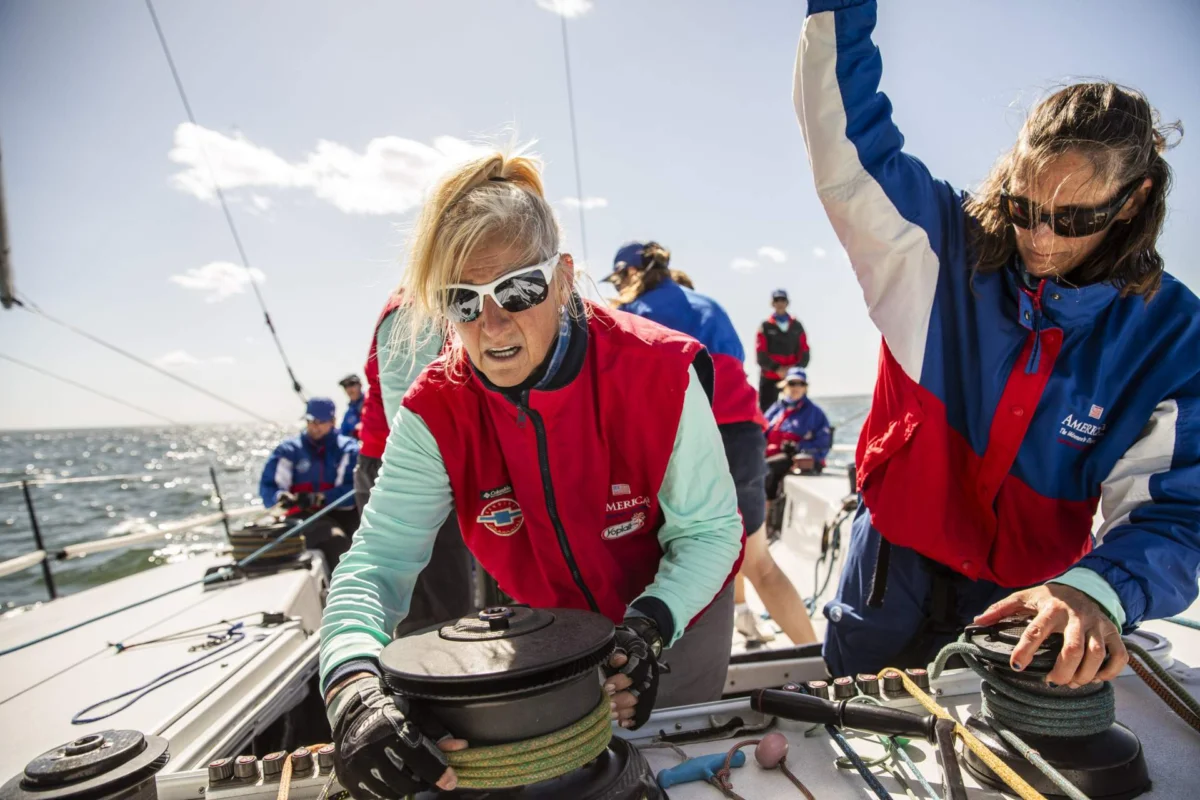
Yet, for the first 140 years of its storied history, this ultimate test of maritime endurance was an exclusive boys’ club. It was not until the 1990s that women began breaking the glass ceiling to participate actively as crew members in America’s Cup competitions. The watershed moment arrived in 1995, when billionaire industrialist Bill Koch financed the first-ever entirely women-crewed team to enter the fray. Aboard the racing yacht christened Mighty Mary, these trailblazing athletes achieved far more than the male-dominated establishment—and frankly, more than anyone outside their own rigorous training camp—ever expected.
Now, a new feature-length documentary, Mighty Mary, directed by Mary Mazzio, dives deep into the high-octane drama of that 1995 campaign. Rather than relying solely on nostalgic reflection, the film matches the unrelenting intensity of its subjects, utilizing innovative cinematic techniques to pull audiences straight into the heart of the storm.
The Genesis of a Maritime Revolution: The 1995 America’s Cup
To understand the magnitude of the Mighty Mary campaign, one must understand the sheer scale of America’s Cup racing in the mid-1990s. These vessels were not recreational weekend sailboats; they were massive, highly sophisticated, engineering marvels weighing upwards of 55,000 pounds. Maneuvering them required superhuman levels of strength, coordination, and split-second tactical brilliance.
When Bill Koch backed the all-women syndicate for the 1995 San Diego races, the sailing world reacted with a mixture of skepticism, condescension, and outright hostility. The team was subjected to intense media scrutiny and localized news coverage as they built their crew, established brutal training regimes, and prepared to face off against elite, veteran male syndicates.
Director Mary Mazzio and her production team had access to an expansive archive of historical material. This included original race footage, local television broadcasts, and the frantic media firestorm that surrounded the boat’s inception. But Mazzio knew that archival footage alone would not capture the visceral, bone-crushing reality of what these women endured.

To bridge the gap between past and present, the documentary team engineered a remarkable cinematic experiment: they reunited the original Mighty Mary crew 30 years later, placing them aboard modern 65-foot racing yachts to recreate their historic races.
Chronology of a Revival: Recreating the Past on the Water
The production of Mighty Mary bridges three decades of athletic evolution. The narrative structure flows fluidly between the 1995 Louis Vuitton Cup trials and present-day recreations shot off the coast of Oyster Bay, New York.
Phase One: The 1995 Trials
The film explores the grueling selection processes, the interpersonal dynamics of a pioneering female crew, and the institutional resistance they faced. Through extensive, newly recorded interviews, the documentary also brings back the male sailors who competed against Mighty Mary back in the 1990s. Looking back across a 30-year lens, these men offer surprisingly candid, introspective admissions regarding the prevailing machismo of the era.
Phase Two: The Modern Recreations
To capture the raw physical exertion of the sport, Mazzio orchestrated on-the-water recreations featuring the original crew members. Utilizing split-screen formatting, the documentary juxtaposes pixelated 1990s footage directly alongside crisp, modern cinematography.
Cinematographer Peter Levy, alongside a dedicated camera team and Mazzio herself—who captured intimate, visceral angles using Super 8 cameras from inside the hulls—managed to drop viewers directly into the chaos. The screen bursts with life: original sailors shouting commands, leaping across decks, hauling heavy lines, and executing lightning-fast physical maneuvers.
“Seeing that old muscle memory, the racing memory, was incredible,” Mazzio told IndieWire. “We lined the boats up and did racing starts. People are screaming. It’s like you’re back in it. And for me, I still compete as an athlete, and maybe you don’t have the physicality anymore, but the [competitiveness] is ingrained; it’s Pavlovian. It was incredible to see how these women rallied. They came off the boat, like, ‘We can still do this.’”

Supporting Data and Production Insights: Testing the Limits
Mazzio’s filmmaking style is defined by rigorous testing and an unwavering commitment to audience engagement. For all of her documentary projects, Mazzio takes early cuts of her films directly to focus groups composed of teenagers and young adults—demographics notorious for unvarnished honesty.
During the production of Mighty Mary, the director hosted test screenings that included young demographics far removed from the world of competitive sailing.
“We had almost no athletes [in the test screenings] except for two lacrosse bros, and I was like, ‘I’m gonna lose these brothers in about five minutes,’” Mazzio joked.
Rather than alienating them, however, the film’s relentless pacing held their attention. The feedback gleaned from these sessions directly shaped the film’s final rhythm, prompting the editing team to meticulously track physical indicators of boredom—such as coughing, knee-bouncing, and shifting in seats—to determine where sequences needed acceleration.
“As painful as that process is, it yields an extraordinary set of things: moments to speed things up or slow things down, places where they’re like, ‘This has too much of a PBS feel,’” Mazzio explained. “If you can capture a young person’s attention for 90 minutes, that’s amazing. Our films have a lot of music. They have sequences with super fast cuts. That’s intentional, and that’s from the focus groups.”
This deliberate structuring is designed to strip away the sanitized veneer often associated with historical documentaries about women in sports. Mazzio wanted to showcase the unfiltered grit of high-level athletics.

“When you see films about women, you don’t necessarily see certain aspects. The sweat, the profanity, the sheer ‘I can’t do another deadlift’ physicality of going for it and pushing yourself and exploring the outer limits of what you can do. To me, that’s exciting territory,” she noted.
Official Perspectives: Voices from the Helm
The documentary’s core strength lies in its firsthand testimonies, led by figures like Dawn Riley, the original team captain of the Mighty Mary. Riley’s career did not end with the 1995 Cup; she went on to shatter further glass ceilings by managing an entire America’s Cup syndicate, cementing her legacy as a titan of the sport.
For Mazzio, the inclusion of Riley and her teammates served a dual purpose: honoring their historical contributions while providing a masterclass in athletic perseverance.
Comparing the multi-ton sailing vessels to elite motorsports, Mazzio offered a vivid analogy: “These are beasts of machinery. If you think of F1, it would be like stepping back into a racing vehicle.”
The comparison extends to the psychological makeup of the competitors. Whether it is a Formula 1 driver or an elite America’s Cup grinder like Olympian Amy Baltzell—who features prominently in the film—the fundamental drive to win remains universal, cutting cleanly across boundaries of gender.
Broader Implications: Inspiring the Next Generation
Ultimately, Mighty Mary positions itself as more than just a sports retrospective; it is a piece of kinetic cinema engineered to weaponize history for cultural inspiration.

In an era defined by fractured attention spans and digital saturation, documentary filmmakers face an uphill battle when trying to engage younger audiences with long-form historical narratives. Mazzio views this challenge not as an obstacle, but as a core design principle.
“I think about our work for the next generation. How do we get these ADHD, ‘I can only pay attention for short content’ kids to watch a film screening?” Mazzio pondered.
Her strategy appears to be working. Reflecting on post-screening reactions, the director shared a telling anecdote about a 16-year-old boy who approached her after a viewing of Mighty Mary to declare the film “Epic!” and express a desire to watch her entire filmography.
“That we could keep his attention for 90 minutes. I think that’s battle number one,” Mazzio said.
By blending high-speed archival framing, modern split-screen kinetics, and an unflinching look at the raw physical and mental demands of elite athletics, Mighty Mary successfully captures a secret, universal third element: the pure, adrenaline-fueled exhilaration of competition.
“Mighty Mary” is currently screening in select theaters nationwide.
