
Echoes of Reconstruction: Ava DuVernay’s ‘14th’ Confronts the Fragility of American Democracy
By Global News Desk
Published: October 2026
Main Facts: A Decade-Long Continuation of Constitutional Inquiry
In the twilight months of the American Civil War, abolitionist and statesman Frederick Douglass took the podium at the Massachusetts Anti-Slavery Society’s annual meeting in Boston. Looking beyond the imminent defeat of the Confederacy, Douglass offered a chillingly prophetic warning about the enduring legacy of the rebellion: "That enmity will not die out in a year," he declared. "It will not die out in an age."
More than 160 years later, these words serve as the foundational bedrock for 14th, acclaimed filmmaker Ava DuVernay’s sweeping new documentary. Serving as a conceptual companion piece to her Oscar-nominated 2016 masterwork 13th—which examined the constitutional amendment abolishing slavery through the grim prism of mass incarceration—14th arrives during the second Trump administration. It investigates the historical evolution, current vulnerabilities, and sustained political assaults on the Fourteenth Amendment, the post-Civil War mandate that reshaped American citizenship, equal protection, and due process.
Clocking in at an intensive one hour and forty minutes, the film premiered at the 64th New York Film Festival to critical intrigue. Netflix has scheduled a theatrical qualifying run for Friday, November 27, followed by a global streaming release on Friday, December 4. Guided by constitutional law expert Sherrilyn Ifill, the documentary operates as a maximalist odyssey through American political history, featuring an ensemble of more than 50 talking heads, ranging from prominent historians and civil rights lawyers to progressive politicians, conservative commentators, and cultural influencers.
Chronology: From the Ashes of War to the Modern Inflection Point
To understand the scope of 14th, DuVernay’s production structurally traces the arc of American civil rights through a five-pointed animated star, with each point symbolizing a distinct section of the Fourteenth Amendment. As the documentary progresses, those points are systematically torn away, visually charting the methodical erosion of the amendment’s legal protections over time.
The Reconstruction Era
The documentary’s opening act is widely considered its strongest and most informative segment. Filmmakers operate on the correct assumption that many contemporary viewers remain largely ignorant of the mechanics of Reconstruction. Following the Civil War, the ratification of the Fourteenth Amendment in 1868 established birthright citizenship as the law of the land. This ensured that formerly enslaved individuals, alongside others born on American soil—such as the children of Chinese railroad workers facing discriminatory immigration laws—held formal claims to citizenship.
However, the film astutely highlights a critical historical failure, heavily emphasized by legal scholar Sherrilyn Ifill. Against the explicit wishes of Frederick Douglass, the framers of the amendment did not explicitly enshrine the universal right to vote. Douglass correctly foresaw that leaving Black voting rights legally vulnerable would allow the architects of the Confederacy and their ideological descendants to systematically strip those rights away for generations to come.

The Long Erosion and Modern Backlash
Moving fluidly across centuries, 14th chronicles the rise of Jim Crow segregation, the codification of white supremacy, and the eventual victories of the mid-century Civil Rights Movement. Yet, the film’s core urgency lies in its pivot to the present day. We are currently living through what Douglass predicted: an era defined by the systematic gutting of the Voting Rights Act, aggressive nationwide voter-suppression legislation, and repeated administrative challenges to the principle of birthright citizenship.
By drawing a direct line from the Reconstruction era to contemporary political polarization under the second Trump administration, DuVernay makes an unyielding case that these battles are not relics of a distant past, but the defining political struggles of the immediate present.
Supporting Data: Structure, Style, and Cinematic Mechanics
While 14th shares the DNA of its predecessor 13th, its aesthetic choices diverge in notable ways. Where the 2016 film framed its interview subjects against stark, claustrophobic textures associated with prisons and hard labor, 14th seats its authorities in halls of learning—universities, museums, and grand libraries. This deliberate visual choice champions the value of expertise at a historical moment when objective knowledge itself faces systematic public skepticism.
The Academic Guide: Sherrilyn Ifill
Distinguished attorney, Howard University law professor, and former president of the NAACP Legal Defense Fund, Sherrilyn Ifill anchors the documentary. Serving as the film’s moral and intellectual compass, Ifill invokes Douglass’s speech "What the Black Man Wants" as a recurring structural refrain. Her commentary is deeply accessible, drawing on a lifetime of legal scholarship dedicated to the Fourteenth Amendment.
The Cost of Over-Inclusivity
Despite its intellectual ambitions, 14th struggles with structural discipline. In an effort to reach as broad and diverse an audience as possible across political divides, DuVernay incorporates more than 50 talking heads. Alongside seasoned legal minds and historians like Eric Foner and David Blight, the film features politicians such as Alexandria Ocasio-Cortez, Jeff Flake, and Stacey Abrams, alongside commentators, comedians, and Gen Z political influencers like Hasan Piker and Dean Withers.
Critics note that this maximalist casting strategy occasionally dilutes the power of the film’s most compelling voices. The inclusion of brief, generational soundbites from internet personalities sometimes feels redundant, while inconsistent captioning—where notable figures like Van Lathan or David Blight go unidentified during their initial appearances—adds unnecessary cognitive clutter to an already dense narrative.
Cinematic Relief and Archival Innovation
When the documentary steps outside the traditional talking-head format, its formal choices achieve profound resonance. Notable sequences include:

- Devon Henry’s Mission: A powerful, breath-of-fresh-air sequence following Devon Henry, the Black contractor who courageously undertook the removal of Confederate monuments along Richmond’s Monument Avenue after white contractors refused the job. Watching Henry move physically through space provides vital visual relief from the film’s otherwise claustrophobic interview setup.
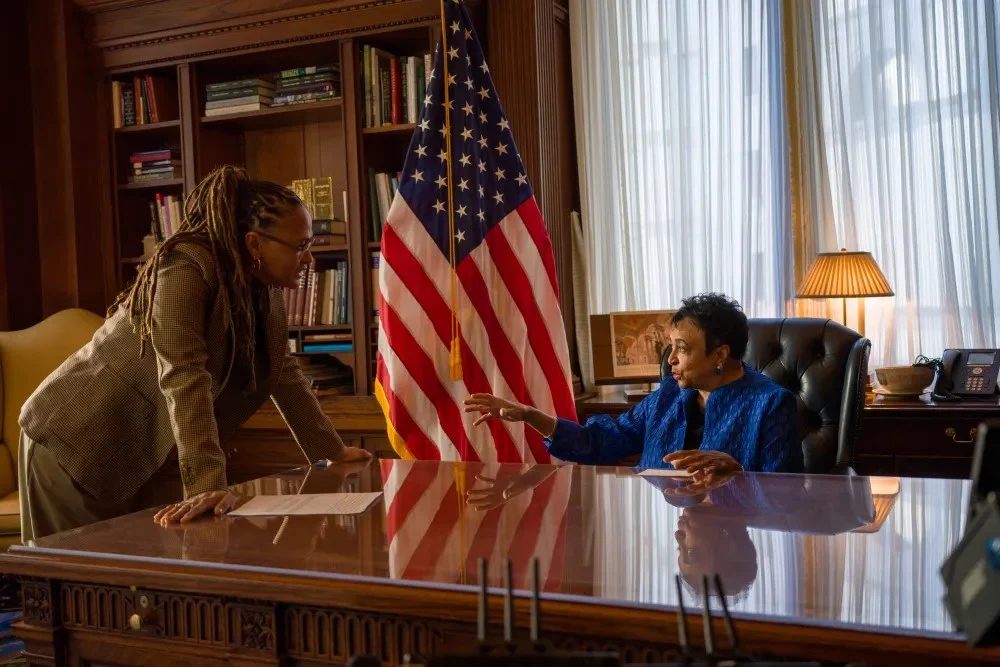
- Carla Hayden at the Library of Congress: Librarian of Congress Carla Hayden is captured on camera walking through the historic halls and greeting visitors, demonstrating the visceral impact of spatial movement over static dialogue.
- Breathing Life into Archives: The documentary’s archival curation is among its finest attributes. Rare photographs of Black life during Reconstruction—not only in the South, but in unexpected regions like New Mexico and Boston—are subtly animated, transforming static historical artifacts into dynamic windows of ordinary people navigating their present just as modern citizens navigate theirs.
- Cultural and Comedic Pressure Valves: Standup comedy clips from George Carlin, Paul Mooney, Neal Brennan, and Hasan Minhaj offer sharp, necessary comedic relief. Meanwhile, the film’s musical landscape—propelled by thumping hip-hop beats, including an instrumental cue of Kendrick Lamar’s anthem "Alright"—establishes a driving, urgent rhythm akin to a rock opera for the fate of democracy.
Official Responses and Public Discourse
Public and critical reception to 14th has centered on its ambitious scope and its emotional toll on the viewer. In various press conferences and interviews surrounding the New York Film Festival premiere, DuVernay noted that she deliberately sought to prevent the documentary from feeling like "medicine"—striving instead for an energetic, accessible, and frequently entertaining rhythm.
However, critics have observed a distinct paradox: in attempting to match the overwhelming pace of contemporary politics, the film occasionally risks overwhelming the viewer. By refusing to edit more rigorously or adopt a multi-part episodic structure, the project demands immense endurance from its audience. The sheer density of information, while intellectually stimulating, runs the risk of generating the very paralysis of despair that the filmmaker hopes to dismantle.
Implications: Standing at the Inflection Point
Despite its structural exhaustion, 14th concludes on a note of urgent agency. Drawing from Sherrilyn Ifill’s concluding arguments, the documentary posits that modern Americans stand at an inflection point directly comparable to the one faced by the architects of Reconstruction.
Just as the generation emerging from the Civil War was tasked with imagining a fundamentally different nation and writing that vision into constitutional law, contemporary citizens face the responsibility of debating in good faith the next iteration of American democracy. The Fourteenth Amendment was revolutionary precisely because it dared to envision an inclusive American republic that had never existed before.
As 14th prepares for its late November theatrical and December streaming rollout, it leaves its audience with a sobering, unmistakable mandate. More than 160 years after Frederick Douglass issued his warning about the "rank undergrowth of treason" passing down through generations, the age he predicted is far from over. Where American society goes from here remains an open question—and the answer, the film insists, rests entirely in the hands of the living.
Film Details
- 14th
- Director: Ava DuVernay
- Key Figures: Sherrilyn Ifill, Bryan Stevenson, David Blight, Jelani Cobb, Alexandria Ocasio-Cortez, Stacey Abrams, Jeff Flake.
- Festival Premiere: 64th New York Film Festival (2026)
- Release Schedule: Select theaters on Friday, November 27, 2026; Global streaming release on Netflix on Friday, December 4, 2026.
- Criticism Grade: B
