
Echoes of the Cosmos: How Composer Rob Simonsen Crafted the Sonic Landscape of Pixar’s ‘Elio’
In the pantheon of animation, few studios possess the distinct sonic identity of Pixar. From the jazz-infused streets of Soul to the haunting, industrial echoes of WALL-E, music at Pixar is rarely just background filler; it is a narrative anchor. For the studio’s latest cosmic odyssey, Elio, composer Rob Simonsen—known for his work on Deadpool & Wolverine and Ghostbusters: Afterlife—was tasked with the monumental challenge of scoring a coming-of-age story that traverses the loneliness of human existence and the vast, unknown expanses of the galaxy.
The result is a score that bridges the gap between intimate, piano-driven vulnerability and the sweeping, synth-heavy grandiosity of intergalactic travel. By blending traditional orchestral arrangements with avant-garde digital manipulation, Simonsen has crafted a soundscape that feels both alien and profoundly human.
The Genesis of a Galactic Score
The journey for Simonsen began in the hallowed halls of Pixar’s Emeryville campus. Unlike many film projects where the music is added in the final stages, Simonsen was brought in early to understand the emotional core of the film.
"They brought me up to Pixar, and I sat down and heard what the film was all about," Simonsen told IndieWire. "I was very moved; I felt very connected. I’m a huge alien and UFO nerd, and I think they were looking for a sound that they found in my work—a sound that had a lot of spaciousness and warm piano melodies, but with a sense of expansiveness."
This connection was vital, as Elio is fundamentally a story about isolation. The film follows a young, imaginative boy who finds himself beamed up to the "Communiverse," an interplanetary organization where he is mistaken for Earth’s leader. To capture the protagonist’s internal world, Simonsen leaned into the "Major Seventh" chord.

"That Major Seventh just felt right," the composer explained. "It offered an aspirational leap that mirrored Elio’s own reaching for the stars. It’s a simple musical interval, but when supported by the right chordal structures, it provides that sense of wonder and longing."
A Chronology of Collaboration and Creative Evolution
The production of Elio was marked by a unique transition in leadership, with director Adrian Molina initially at the helm, followed by the directing team of Madeline Sharafian and Domee Shi. For many composers, such a shift could prove disruptive to the creative flow, but Simonsen describes the experience as a remarkably "smooth transition."
"I think in a lot of ways they expanded the world, but they held onto the heart that I felt was there at the beginning," Simonsen noted. "They carried it through in a really beautiful way."
The consistency of the score was maintained by the "Elio Theme," which was written during the very first weeks of the project. "It was a fairly straight shot with Elio’s theme," Simonsen added. "It drives the film from the beginning to the end, and it was nice to see that theme remain a constant through the various stages of production."
The narrative arc of the music is meticulously timed. For instance, the main theme is deliberately withheld from the audience until a pivotal, emotional moment in the film: an early scene at a planetarium where Elio watches the Golden Record Voyager exhibit. "Pixar animators are deep students of human emotion," says Simonsen. "They know exactly the frame to release a theme and have the music turn. It’s a testament to their craft."

Technical Innovation: Coding the Choir
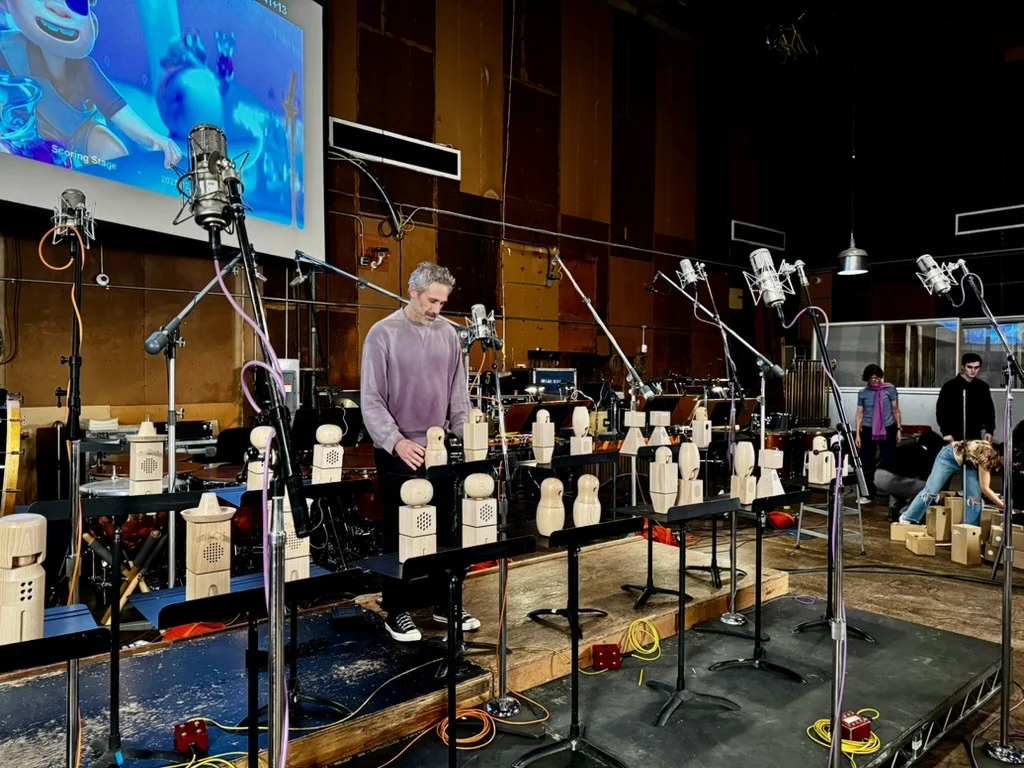
Perhaps the most fascinating aspect of Simonsen’s process for Elio was his decision to move away from a traditional human choir for the Communiverse sequences. Instead, he opted for an experimental approach involving robotic choir dolls from the Swedish firm Teenage Engineering.
These "choir dolls"—small, wooden, speaker-embedded figures—possess a timbre that is eerily human yet distinctly mechanical. "They have this very unique sound that I’ve never heard," Simonsen explained. "The shape of the wood gives a shape for their voice, and they function like a choir. We hear the dolls when we first arrive to the Communiverse."
The ambition did not stop at the out-of-the-box functionality of the dolls. To achieve a more complex sound, Simonsen’s assistant, a coding specialist named Tiger Lily, used Python to "hack" the dolls, creating custom functionality that allowed the composer to manipulate them with greater precision.
"We ended up with a 30-voice choir," Simonsen said, describing the scene on the cavernous Sony scoring stage. "We put these tiny wooden dolls in this massive space, singing their hearts out. It gave us this otherworldly texture that a standard choir simply couldn’t replicate. It feels like something that exists in the far reaches of space, which is exactly what we needed."
Supporting Data: Building the Sonic Motif
Simonsen’s approach to the "signal" within the film serves as a masterclass in thematic development. He created a one-note signal sound, representing the Golden Record Voyager’s journey through the vacuum of space.

"The sound plays on a synth that I created, and it echoes out and reverberates into space," he described. "That then becomes a more fully realized musical motif when the signal from the universe comes back. It’s a similar synth sound, but with more notes to it. The idea of this call-and-response of a signal is something that we played with throughout the film."
As the film reaches its climax—the moment Elio is fully immersed in the Communiverse—the music undergoes a transformation. The small, isolated signals of the earlier acts are replaced by full orchestral bombast. "Everything gets unfurled," said the composer, "augmented with a lot of different synths and textures that are popping and floating around."
Implications for Future Animation Scores
The release of Elio marks a significant milestone in how animation can utilize technology to push the boundaries of film scoring. By prioritizing "spaciousness" and using non-traditional instruments like the Teenage Engineering dolls, Simonsen has proven that the "Pixar sound" can evolve while still maintaining the emotional warmth that audiences have come to expect.
The success of this score suggests a shift toward more hybrid musical compositions in big-budget animation. As directors seek to distinguish their worlds from the standard orchestral fare, the integration of coding, custom hardware, and digital synthesis is likely to become more prevalent.
Furthermore, the "call and response" methodology employed by Simonsen offers a blueprint for how films with high-concept sci-fi themes can ground their storytelling in music. By mirroring the protagonist’s emotional journey with evolving motifs—moving from a single, lonely note to a full, symphonic, and robotic chorus—Simonsen ensures that the audience is not just watching Elio’s journey, but feeling the vastness of the universe alongside him.

Conclusion
As Elio prepares for its June 20, 2025 release, the anticipation surrounding its technical and emotional depth continues to mount. Rob Simonsen’s contribution is clearly central to this, providing a sonic tapestry that is as vast as the galaxies the film portrays and as small as the heart of a lonely boy in an observatory.
By blending the cold, calculated precision of code and robotic synthesis with the warmth of a piano-driven human narrative, Elio promises to be a landmark entry in the Pixar catalog. It is a film that asks us to look up at the stars, not just to wonder what is out there, but to hear the music that might be playing in the infinite, empty spaces between them.
