
Inside The Asylum: How David M. Built a High-Speed Independent Movie Machine
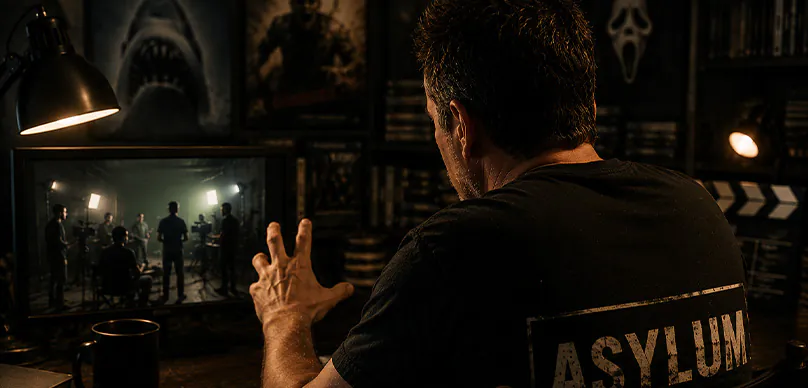
While most independent filmmakers spend years—sometimes decades—scratching together the financing for a single passion project, David M. Latt helped construct an industrial-scale machine designed to churn out movies continuously.
As the co-founder of The Asylum—the legendary independent studio responsible for pop-culture touchstones like Sharknado, Mega Shark vs. Giant Octopus, Z Nation, and hundreds of other fast-turnaround genre productions—Latt represents a radically pragmatic side of the entertainment industry. His career is a masterclass in where unbridled creativity, physical production, international distribution, targeted marketing, and financial survival collide.
Rather than waiting passively for Hollywood gatekeepers to approve a script, Latt and his team engineered a vertically integrated system that allows filmmakers to bypass the traditional studio bottlenecks and keep working year-round.
1. Main Facts: The Anatomy of a High-Volume Studio
At its core, The Asylum is an outlier in modern American cinema. While major studios rely on blockbuster gambles costing hundreds of millions of dollars, and micro-budget auteurs survive on Kickstarter campaigns and grant money, The Asylum operates in a profitable middle tier defined by speed, scale, and strict budgetary boundaries.
- The Output: The studio has produced roughly 150 feature films and television projects before even landing its historic breakout hit, Sharknado. Today, that library is exponentially larger.
- The Business Model: The company acts as both producer and distributor. By controlling the pipeline from script to storefront, The Asylum often knows the precise market value of a film before cameras even start rolling.
- The Philosophy: Latt famously summarizes the studio’s ethos not as making "cheap movies," but as executing big concepts under strict financial constraints.
- The Market Strategy: Eschewing unsolicited script submissions, The Asylum develops content in direct response to what networks, distributors, and global buyers explicitly request.
2. Chronology: From Living Room Art-House to Genre Empire
The story of The Asylum is less about a grand, master-planned corporate launch and more about resilience in the face of sudden unemployment.
Humble Beginnings and Unemployment
The company’s genesis was born out of necessity. In the mid-1990s, David M. Latt and his future partners found themselves out of work simultaneously. Rather than dispersing across the industry or settling into traditional junior corporate roles, they made a collective decision to stay in business together.
For the first several years, operations were kept remarkably lean. Operating out of an apartment, the founders took on whatever odd jobs and production gigs came their way to keep the lights on.
The Art-House Phase
Initially, the fledgling company distributed art-house and foreign independent films. However, they quickly realized they were swimming in a pool dominated by deep-pocketed competitors who could easily outbid them for high-profile indie acquisitions.
The Shift to Direct-to-Video and Original Production
A vital turning point occurred when the founders cultivated relationships with major home video retailers. They recognized a fundamental financial reality: they could not compete with larger distributors offering filmmakers substantial minimum guarantees on finished films.
The pivot was swift. Instead of buying finished movies, they would make their own. Securing early financial backing from an investor for a slate of low-budget horror projects, the team laid the groundwork for a self-sustaining cash-flow model. Revenue generated by one completed film cycle was immediately funneled into the production budget for the next slate.
The Television Evolution
As the physical media market shifted and the economics of DVD, Blu-ray, and traditional Video-on-Demand (VOD) began to contract, The Asylum proved its adaptability once again. Recognizing that audiences were migrating toward episodic storytelling and binge-watching, the studio transitioned into long-form television, eventually producing the hit series Z Nation for the Sci-Fi channel.
3. Supporting Data and Production Philosophy: "Big Budget on a Budget"
The most compelling aspect of Latt’s methodology is how it dismantles conventional Hollywood wisdom regarding budgets. A common pitfall for low-budget filmmakers is to write screenplays governed strictly by financial limitations—such as four characters trapped in a single room because renting locations is expensive.
The Asylum does the exact opposite.
+-------------------------------------------------------------+
|               THE ASYLUM PRODUCTION PIPELINE                |
+-------------------------------------------------------------+
| 1. Market Demand  --> Networks/Buyers state what they need.  |
| 2. Internal Dev.  --> Concept is scripted with high stakes. |
| 3. Pre-Sale       --> Film is valued & pre-sold to buyers.  |
| 4. Budget Cap     --> Costs locked strictly below revenue.  |
| 5. Execution      --> Fast-paced production & delivery.     |
+-------------------------------------------------------------+
When a script calls for monsters, cataclysmic natural disasters, submarines, deep-ocean sequences, or massive visual-effects-driven action sets, the studio leans directly into those demands.
"We’re not making a low-budget film," Latt explains. "We’re just making a big-budget film on a budget."
Buyer-Driven Development
This philosophy directly impacts how projects are brought to life. While traditional screenwriters spend years crafting spec scripts in isolation, hoping a studio might take a chance on them, The Asylum operates in reverse.
Networks, international distributors, and retail buyers approach the studio with specific conceptual needs—for instance, a disaster movie involving a severe storm and aquatic predators. The Asylum’s internal team then manufactures the screenplay to fit those exact parameters. This eliminates the guesswork of whether a movie has a commercial audience, because the audience’s demand was registered before Page 1 was written.
Financial Discipline
Financial discipline is the anchor that prevents this high-speed production model from capsizing. Because projects are frequently pre-sold to international and domestic buyers before principal photography begins, Latt’s responsibilities as a producer are brutally straightforward: make the movie for less than the guaranteed revenue while factoring in company overhead.
While this sounds like common sense, it flies in the face of a broader Hollywood culture where budgets routinely balloon to match creative ambitions rather than realistic marketplace returns. The Asylum’s unbroken survival relies on a simple rule: they refuse to spend money they do not have.
4. Official Responses and Industry Case Studies: The Sharknado Phenomenon
Nothing highlights the volatile, unpredictable nature of the entertainment industry quite like the trajectory of Sharknado.
By the time Sharknado landed on desks, The Asylum had already generated roughly 150 feature films. Yet, even seasoned veterans within the company failed to foresee that this specific creature feature would metastasize into an international cultural phenomenon.
Latt admits that he initially struggled to grasp the screenplay, worrying that its self-aware, comedic absurdity pushed too far outside the studio’s traditional, straight-faced genre formulas. Furthermore, casting proved uniquely difficult; mainstream actors were hesitant to attach their names to a movie explicitly titled Sharknado. During early casting calls, the production even utilized a decoy working title to secure talent.
However, the network buyer (Syfy) maintained fierce confidence in the concept. Latt trusted his buyer partner, and the project moved forward. What began as a routine, day-to-day production snowballed into a viral sensation that fundamentally shifted public awareness of The Asylum brand.
5. Implications for Independent Filmmakers: Sustainability Over Perfection
For independent creators watching from the outside, the core takeaway from David M. Latt’s career is not a magical formula designed to replicate Sharknado. Viral lightning cannot be bottled or intentionally manufactured on command.
Instead, the true lesson is sustainability.
Key Takeaways for Creators:
- Understand Your Market: Know the financial value of your work before you spend a dime. Align your production costs with realistic revenue streams.
- Control the Budget: Never let creative ambition outpace your financial reality. Operating in the red destroys independent companies.
- Be Flexible: Do not become emotionally or stubbornly attached to a distribution model just because it worked in the past. When audience behavior shifts—from DVD to VOD, or VOD to streaming—your business model must shift with it.
- The Power of Relationships: Beyond sharks, budgets, and visual effects, Latt emphasizes that the film industry is built entirely on human connections. Attend festivals, seminars, and industry gatherings. Shake hands. Meet producers, executives, writers, and crew members.
Resumes and cold-emailed PDF scripts often vanish into a digital void. Opportunities frequently emerge because a key decision-maker remembers that you were reliable, professional, and prepared when the right project finally materialized.
In the unpredictable ecosystem of independent filmmaking, the project that changes your career trajectory is usually impossible to predict—meaning the most vital thing a creator can do is stay in the game, control the variables, and keep making movies.
