
Maggie Gyllenhaal on the Art of Collaboration: A New Chapter in Directing
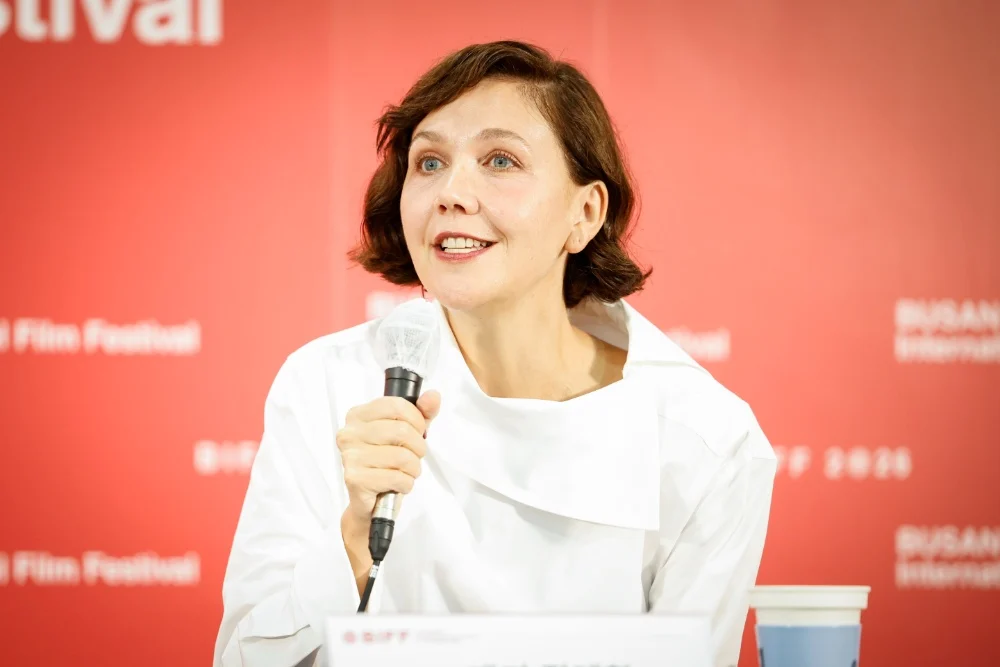
At the Busan International Film Festival, filmmaker Maggie Gyllenhaal offered a masterclass in leadership, reflecting on the transition from a celebrated actress to a visionary director. In a candid press conference, Gyllenhaal articulated a philosophy of filmmaking that prioritizes collective intelligence over the traditional, autocratic "auteur" model. Her insights, shaped by decades on set, suggest that the most successful directors are not those who impose their will, but those who cultivate an environment where every voice—from the gaffer to the lead actor—is empowered to contribute.
The Philosophy of Inclusion: Breaking the Silos of Authority
Gyllenhaal’s approach to filmmaking is rooted in the conviction that a movie is, by definition, a collaborative medium. During her discussion in Busan, she drew a sharp distinction between directors who lead with confidence and those who act out of insecurity.
"It was the people who were very scared… or just not very smart, who tried to squash other people’s voices," Gyllenhaal remarked. She noted that her most formative experiences working with high-caliber directors revealed a consistent pattern: the best in the business understood that their role was not to stifle the creative output of their team, but to act as a conduit for it.
For Gyllenhaal, the shift to the director’s chair has been defined by a desire to democratize the creative process. When helming her feature debut, the critically acclaimed The Lost Daughter, she made a conscious effort to ensure that the cinematographer, production designer, and the cast felt an ownership of the material. "The truth is… it is ultimately up to me as the director. I have the power, so there’s no reason to squash anyone else’s voice," she explained. "It’s just so obvious that the movie that I will make that includes all the minds of the people on my crew is going to be exponentially better than the movie I can make trying to recreate something I imagined all alone by myself in my room."
A Creative Evolution: From Acting to Auteurship
Gyllenhaal’s journey into directing was not an overnight decision, but a natural evolution of a career that began in front of the camera. Growing up in a household steeped in cinema—her father, Stephen Gyllenhaal, is a director, and her mother, Naomi Foner, is a celebrated screenwriter—she was surrounded by the mechanics of storytelling from an early age.
However, during her youth, the landscape of filmmaking was vastly different. With so few women occupying the director’s chair, acting felt like the only viable path for a woman who wanted to be involved in the creative process. "It felt satisfying and exciting for a long time, and then I think I hit the edge of what I was able to do as an actress," she admitted.
The turning point arrived approximately eight years ago with The Lost Daughter. Transitioning into writing and producing as well as directing allowed Gyllenhaal to find a sense of ease and creative agency that had previously remained out of reach. She describes her mother as her most vital sounding board, noting with a smile, "My mom directed her first film as a grandmother. I think she might be the only person to have directed her first film as a grandmother. She is probably the best note-giver that I have."
Flesh Impact: A Bold Interpretation of Iconography
Gyllenhaal’s presence at the Busan International Film Festival centers on her latest work, Flesh Impact, a short film that exemplifies her willingness to take creative risks. The project began as a commission from the luxury automotive brand Genesis, intended to commemorate what would have been Marilyn Monroe’s 100th birthday.
While the request was straightforward, Gyllenhaal’s execution was anything but. Rather than producing a standard biographical tribute, she envisioned a narrative where the screen icon actually reaches the age of 100. "I don’t think that when Genesis came to me… that they imagined she would actually be 100 years old in the movie," she noted. "I thought, ‘Okay, I have this idea. They’re never going to go for it.’"
To her surprise, the brand embraced the unconventional pitch. Gyllenhaal completed the script within a single weekend, casting the legendary Ellen Burstyn to portray the centenarian Monroe, with Dakota Johnson playing the icon in her youth. The film also features appearances by Peter Sarsgaard and Sepideh Moafi. Beyond the subject of Monroe, Gyllenhaal views the film as an homage to the craft of her lead actresses. "It is also 100% a celebration and an honoring of Ellen Burstyn and her incredible career, and Dakota Johnson and her incredible career," she said.
Looking Ahead: The Future of Gyllenhaal’s Lens
As she moves forward, Gyllenhaal is currently in the early stages of developing new projects. She described being in that "very exciting place" of gestation, where she is currently determining the thematic core of her next stories.
Industry reports have already confirmed her next major undertaking: directing and producing an adaptation of Rachel Kushner’s novel Creation Lake for Warner Bros. This project marks a significant step in her career as a studio-backed filmmaker, signaling a continued trust from major distributors in her unique vision.
The State of the Industry: A Call for Equity
Gyllenhaal’s recent reflections are not limited to the mechanics of set leadership; she remains a vocal advocate for systemic change in the film industry. During her time as the jury president at the Venice Film Festival, she was pointed in her critique of the persistent gender gap in high-level competition.
Highlighting that only one woman had a film in competition at that festival, Gyllenhaal used her platform to call for greater representation. Her advocacy is consistent with her directorial philosophy: if the best movies are those that incorporate the widest range of voices, then the industry’s failure to include women in top-tier directing roles is not just a social injustice—it is a creative failure.
Conclusion: The Power of Perspective
Maggie Gyllenhaal’s transition from an acclaimed performer to a director of substance serves as a blueprint for the next generation of filmmakers. By stripping away the ego and insecurity that often plague the director’s chair, she has discovered that the most powerful tool a filmmaker has is their ability to listen. Whether she is tackling the legacy of Marilyn Monroe or adapting contemporary literature, Gyllenhaal remains committed to the idea that a film is a living, breathing entity, enriched by every mind that touches it. As she continues to define her voice in the industry, her work stands as a testament to the fact that while the director may hold the power, the art is found in the collective.
