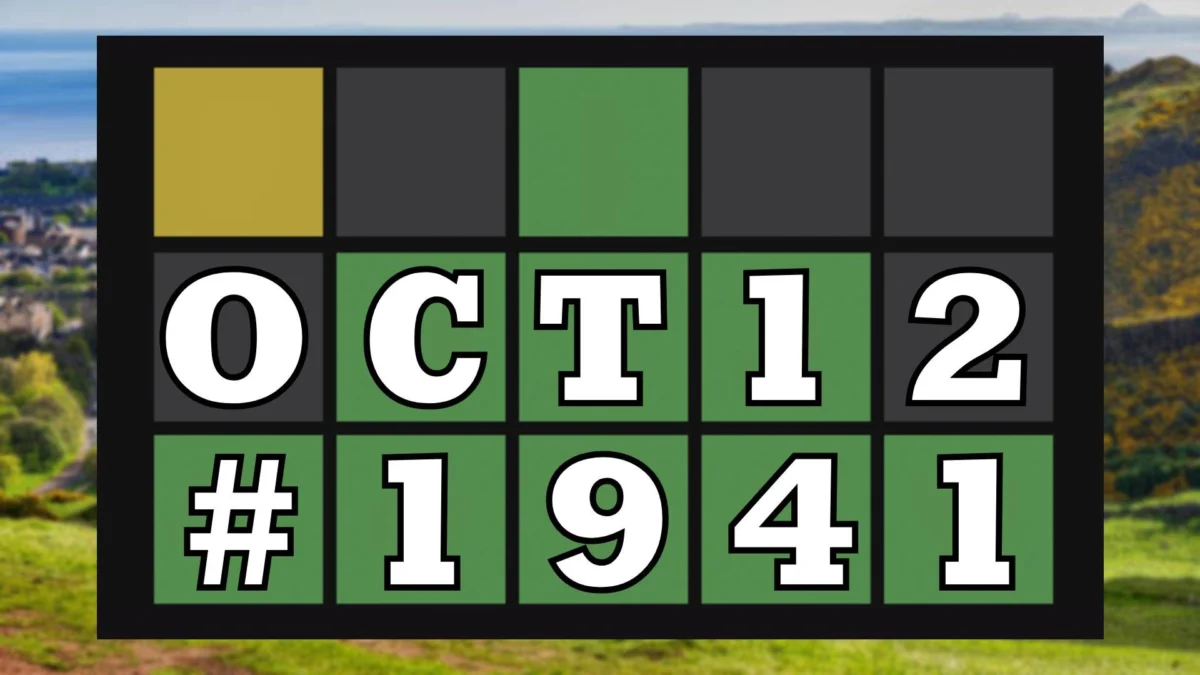
Navigating the Alpine Echoes: Comprehensive Guide and Analysis for the October 12, 2026 Wordle Puzzle (#1941)
Main Facts: Deconstructing the October 12, 2026 Challenge
For daily puzzle enthusiasts, maintaining a long-standing winning streak is a matter of pride, routine, and calculated lexical strategy. However, the Wordle puzzle released on October 12, 2026 (Puzzle #1941), proved to be a formidable stumbling block for veterans and novices alike. Rather than relying on standard structural patterns or conventional vowel placements, today’s grid layout deployed an unconventional design meant to deliberately throw players off balance.
The primary hurdle in Puzzle #1941 lay in its opening sequence and phonemic distribution. While the puzzle featured a standard 5-letter layout, the blend of letters skewed heavily toward an awkward structural arrangement that resisted standard opening gambits. The solution—YODEL—departed significantly from the predictable flow of common English five-letter configurations. Containing a unique spread of three vowels and two consonants (with the initial letter acting as a versatile phoneme that bridges both categories), the term caught many players off guard. Without reliable immediate clues or recurring double-letter safety nets, average scores ticked upward, and countless multi-week streaks came to an abrupt halt.
Chronology: The Evolution of Wordle’s Difficulty Curve
To understand why Puzzle #1941 generated such intense community frustration, it is helpful to place it within the broader timeline of the game’s modern iteration under The New York Times Company.
Phase 1: Acquisition and Standardization (2021–2023)
Following its viral explosion created by software engineer Josh Wardle and subsequent acquisition by The New York Times, the word lists underwent rigorous curation. Early institutional curation favored recognizable, highly accessible vocabulary to maintain broad appeal. Words like MAJOR, PROVE, and MOCHA defined this era, emphasizing logical deduction and straightforward consonant-vowel-consonant-vowel-consonant (CVCVC) structures.
Phase 2: The Complexity Shift (2024–2025)
As the puzzle entered its multi-thousand runs, curation boards began introducing linguistic outliers to challenge hardened veterans. Words utilizing rare letters, unusual starting phonemes (such as WRYLY or USURY), and specialized technical definitions became more frequent. This shift forced players to abandon autopilot heuristics in favor of Hard Mode strategies that penalized wild, exploratory guesses.
Phase 3: The Modern Outlier (Late 2026)
By October 2026, the baseline difficulty for Sunday and Monday puzzles had noticeably escalated. Puzzle #1941 (October 12) represents the peak of this design philosophy. By deploying a word beginning with a semi-vowel (‘Y’) and ending with a liquid consonant (‘L’) while eschewing any repeating letters, the puzzle disrupted standard heuristic pathways. Players who relied on routine starting words found themselves stranded by row three, forced to navigate a narrow window of viable options to save their game records.
Supporting Data: Statistical Breakdown of Recent Puzzles
To contextualize the linguistic profile of Puzzle #1941, examining the historical data of the preceding ten days provides clear insight into how player expectations were subverted.
Recent Wordle Solutions (October 2 – October 11, 2026)
Date
Puzzle Number
Solution Word
Structural Profile
October 11, 2026
#1940
UNCAP
Standard CVCVC, high-frequency letters
October 10, 2026
#1939
BUMPY
Consonant cluster, double ending
October 9, 2026
#1938
MAJOR
Classic structure, prominent root
October 8, 2026
#1937
STREW
Consonant cluster start, rare ending
October 7, 2026
#1936
PROVE
Standard enterprise vocabulary
October 6, 2026
#1935
DIMLY
Adverbial suffix (-LY), uncommon vowel balance
October 5, 2026
#1934
MOCHA
Noun-focused, highly recognizable
October 4, 2026
#1933
SHACK
Diagraph start (SH), hard stop ending
October 3, 2026
#1932
PEEVE
Double vowel core, repetitive structure
October 2, 2026
#1931
USURY
Vowel-heavy start, niche economic vocabulary
Strategic Starting Word Recommendations for Outliers
When encountering atypical linguistic layouts like the one seen on October 12, standard lexical toolkits require adjustment. Depending on a player’s tolerance for risk, three distinct starting tiers were recommended for Puzzle #1941:
The Challenging Start: WRYLY
Purpose: Designed for advanced players willing to court high variance. It tests rare consonants and forces immediate confrontation with structural anomalies.
The Medium Start: OAKEN
Purpose: Focuses heavily on foundational vowel extraction, offering safe footholds for identifying core structural components without sacrificing all guesses.
The Easy Start: LOYAL
Purpose: Aligns closely with the terminal linguistic patterns of the target solution, providing maximum overlap in consonant positioning.
Official Responses and Community Feedback
The reaction across digital forums, social media channels, and dedicated gaming hubs following the release of Puzzle #1941 was immediate and polarized.
Player Sentiment and Streak Preservation
On platforms dedicated to daily word games, community threads exploded with accounts of broken streaks. Many users noted that the placement of vowels in the first, second, and fourth positions created an optical illusion that led them to look for standard verbs and nouns rather than culturally specific stylistic terms.
One prominent gaming community moderator noted:
"When a puzzle relies on a semi-vowel lead-in like ‘Y’ coupled with a performance-based cultural term, it shifts the game away from pure mathematical probability into lateral semantic thinking. Players who stick strictly to anagram logic hit a brick wall."
Editorial Philosophy on Difficulty
While The New York Times editorial board rarely comments publicly on day-to-day puzzle mechanics, archival notes on game design indicate that occasional difficulty spikes are intentional. The goal is to prevent long-term players from developing rigid, unthinking routines. By occasionally inserting terms rooted in distinct human traditions—such as musical techniques or regional practices—the puzzle encourages players to think beyond basic corporate lexicon dictionaries.
Implications: The Future of Daily Web Puzzle Design
The design choices evidenced in the October 12, 2026 puzzle carry significant implications for the broader landscape of daily digital web games and casual puzzle ecosystems.
1. The Death of Autopilot Play
As casual gaming audiences mature, developers face the constant challenge of maintaining engagement without alienating casual participants. Puzzles that buck statistical trends—such as utilizing unexpected initial phonemes or cultural nouns—force an active cognitive engagement that passive matching cannot replicate. This ensures that even after years of daily play, the product retains an element of genuine surprise.
2. The Rise of Contextual Hints and Hybrid Guides
The increasing complexity of daily word and logic games has fostered a robust auxiliary economy of strategy guides, hint aggregators, and community-driven walkthroughs. Sites specializing in daily gaming content serve an essential buffering role: they allow users to protect their time and emotional investment (represented by multi-year streaks) without resorting to outright cheating.
3. Cross-Pollination with Companion Puzzles
The success and frustration surrounding Wordle continue to drive traffic toward companion games in the daily puzzle ecosystem, such as Connections, Globle, Worldle, and The Password Game. When a player’s Wordle streak is unexpectedly severed by a word like YODEL, they frequently pivot to alternative grid-based or lateral-thinking challenges to reset their problem-solving palette. This interconnected ecosystem ensures that casual puzzle platforms remain sticky, retaining user attention across multiple disparate titles throughout the day.
Conclusion
Ultimately, the October 12, 2026 Wordle puzzle will be remembered as a masterclass in subverting player expectation. By pairing an uncommon phonetic structure with a culturally specific musical term, the puzzle reminded millions of players why the daily ritual remains compelling. Whether a player emerged victorious with their streak intact or fell victim to the alpineechoes of YODEL, the puzzle successfully fulfilled its core mission: transforming a simple five-minute distraction into a shared, globally debated intellectual exercise.