
Stepping Into the Cockpit: How Jimmy Recreates the Untold World War II Era of Hollywood’s Most Beloved Legend
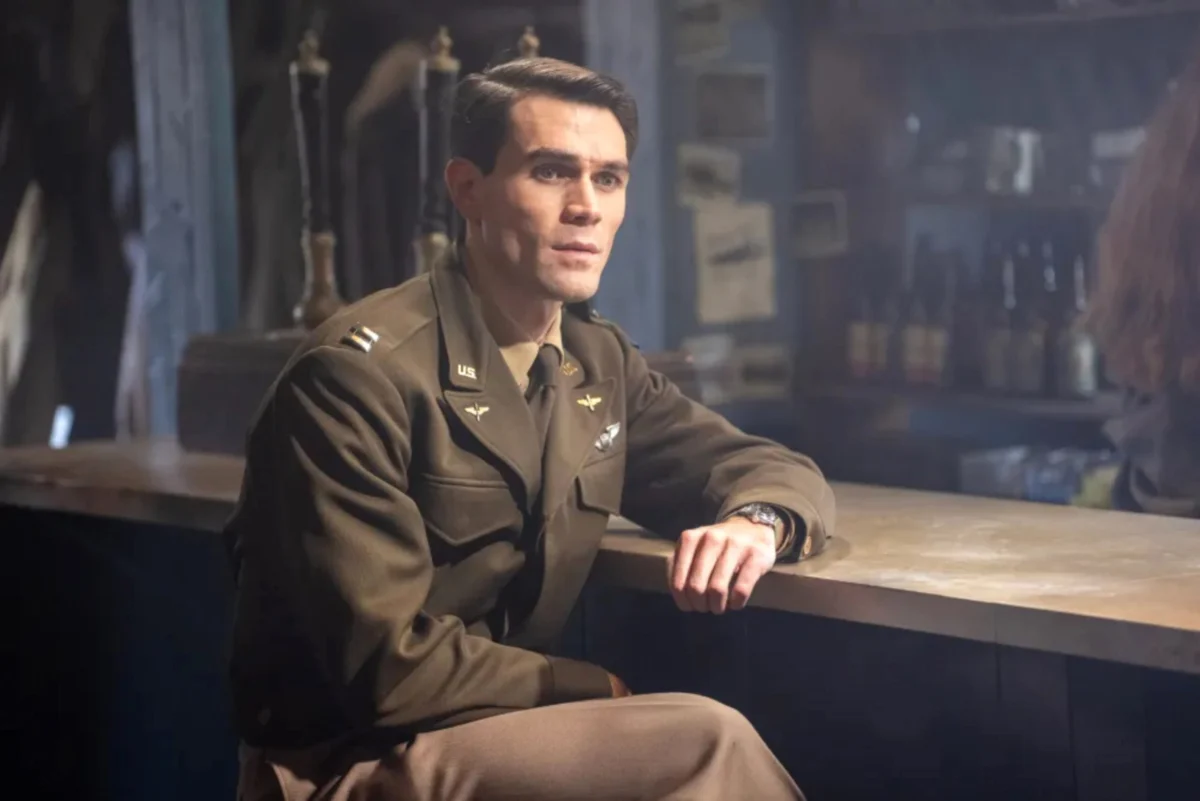
The Hollywood that James Stewart once inhabited has long since dissolved into the mists of cinematic folklore. Yet, a striking new biographical feature film titled Jimmy meticulously reconstructs that bygone Golden Age—bringing a level of tangible authenticity to the screen that few historical dramas achieve. In a remarkable bridging of past and present, the production even incorporates real historical mementos from the era directly into the frame, most notably the late actor’s actual Academy Award.
Directed by Aaron Burns and penned by screenwriter Justin Strawhand, Jimmy casts Riverdale breakout star KJ Apa in the towering role of the silver screen legend. Stewart famously delivered indelible, everyday-hero performances in timeless classics such as Mr. Smith Goes to Washington (1939), It’s a Wonderful Life (1946), and Harvey (1950). However, rather than tracing a predictable cradle-to-grave career trajectory across his extensive filmography, Burns and Strawhand tightly telescope their focus onto a transformative chapter of Stewart’s life: his years as a combat pilot in World War II. It was a perilous, world-altering career pivot that pulled him far away from the safe, bright lights of Hollywood soundstages and thrust him into the skies above Europe.
Distributed by Fathom Entertainment, Jimmy is slated to open in theaters on November 6. Beyond the cockpit, the film explores Stewart’s romantic entanglements prior to meeting his ultimate life partner, Gloria (played by Jen Lilley). Notably, the movie depicts an era when one of his nearly-wed matches was none other than fellow Hollywood royalty, Ginger Rogers.
Chronology: From Oscar Gold to the Front Lines
The historical timeline tackled by Jimmy captures a pivotal crossroads in the actor’s life. In 1941, James Stewart reached the pinnacle of the American entertainment industry, capturing the Academy Award for Best Actor for his work in the sophisticated comedy favorite The Philadelphia Story (1940). This marked the second of five competitive Oscar nominations he would earn throughout his illustrious career, which would later be complemented by an Honorary Oscar in 1985.
Yet, even as the glittering statuette cemented his status as Hollywood A-list royalty, a deeper sense of duty tugged at his conscience. Raised in a military family with a lineage tracing back to the Civil War and World War I, Stewart chose to enlist in the United States Army Air Forces shortly after his Oscar triumph. He eventually flew more than 20 combat missions as a bomber pilot over Europe, an experience that fundamentally altered his psyche and forever transformed his approach to acting upon his return.

Following Stewart’s passing in 1997, his cherished Best Actor statuette remained safely within the family. Remarkably, his daughter, Kelly Stewart-Harcourt, agreed to bring the original Oscar to the set of Jimmy. It was utilized directly in one of the film’s opening sequences, which recreates the morning after the 1941 Oscar ceremony.
"Kelly let us film with his Oscar," director Aaron Burns shares, reflecting on the surreal experience of handling cinematic history. "I just remember thinking, ‘Holy smokes, this was his!’"
KJ Apa echoes that sentiment, noting the visceral impact of holding the exact heavy metal object that once rested in the hands of the man he was portraying. "It was really cool," Apa says. "It was really heavy, and worn down a little, but it was so awesome to have in the scene."
Supporting Data: Capturing the Voice and the Man
Bringing a cinematic icon of Stewart’s magnitude to life required intense physical and vocal discipline from its lead actor. In exclusive interviews, director Aaron Burns and star KJ Apa detailed the meticulous preparations behind capturing the essence of a man whose cadence, height, and gentle demeanor are etched into the collective cultural memory.
When asked what drew him to this specific slice of Stewart’s life, Burns explained that he stumbled across an article written by the actor himself detailing his wartime service. "Actors don’t go to war. What is this?" Burns recalled thinking. Upon realizing that It’s a Wonderful Life was the very first film Stewart made after returning from active duty—a project that served as a therapeutic outlet for his post-traumatic stress—Burns knew the story had to be told.

Casting the lead proved to be an extensive search before landing on Apa. "When I got on a Zoom with KJ, we just hit it off and I was like, ‘This is my guy,’" Burns notes.
For Apa, the prospect was initially daunting. "Coming from New Zealand, I wasn’t all that familiar with old Hollywood," the actor confesses. Recognizing that he lacked Stewart’s natural lanky height, Apa opted to alter his physical presence entirely. "I knew that if I lost weight, it would at least help me physically embody his presence onscreen. I’ve never lost that much weight for a part before, but I felt it was necessary."
Mastering Stewart’s signature vocal cadence presented an entirely separate hurdle. Apa immersed himself in audio and visual archives. "You have to really sit and immerse yourself in everything that is Jimmy Stewart for the amount of time that I had, which wasn’t a whole lot of time!" he explains. "I couldn’t have any reservations about doing the voice. There was never a way I was just going to do his physicality and not the voice; I had to commit one hundred percent to both."
Official Responses and Family Blessing
A biographical project of this nature requires delicate navigation, particularly when dealing with the living descendants of a beloved icon. Fortunately, the production secured the full-hearted endorsement and active participation of Stewart’s daughter, Kelly Stewart-Harcourt.
According to Burns, the filmmakers connected with Kelly early on to outline their vision: a focused, character-driven slice of life rather than a sweeping, unfocused biopic. Kelly responded enthusiastically, noting that her father always considered his military service to be the most meaningful chapter of his life.

Consequently, Kelly boarded the project as an executive producer. She granted the team access to her father’s personal journals, handwritten notes detailing the harrowing realities of losing comrades in combat. Kelly even makes a brief cameo appearance in the film. On set, watching Apa’s performance, she whispered to the director: "He makes a damn fine Dad."
Navigating the financial and logistical realities of independent filmmaking also proved daunting, but Burns credits what he calls the "Jimmy Bulldozer" for smoothing the path. "Jimmy Stewart was marching in front of us with his legacy," Burns says, noting that fans, investors, and even legendary British producer David Puttnam (Chariots of Fire) came out of the woodwork to support the production while filming in Ireland.
Broader Implications: Redefining Heroism on Screen
At its core, Jimmy touches upon broader cultural themes regarding duty, sacrifice, and the evolution of masculinity across generations. Both the director and star view Stewart’s generation as representing a disappearing breed of public figures who willingly traded comfort and career success for harrowing national obligation.
"For me, it was this breed of men that a lot of people say is slowly dying," Apa reflects, noting that his own upbringing in Samoa under a traditional chieftain father gave him a personal framework for understanding duty and expectations. "Jimmy wanted to be of use, and when he felt he had that opportunity, he took it."
As independent cinema continues to navigate a landscape dominated by franchise IPs, Jimmy relies instead on the enduring power of real human resilience. By shining a spotlight on the trauma, courage, and quiet dignity of James Stewart’s wartime years, the filmmakers hope to inspire modern audiences to listen to their own inner convictions.

With its theatrical release set for November 6 via Fathom Entertainment, Jimmy promises to remind moviegoers that beneath the folksy cinematic persona lay a battle-tested veteran whose greatest performance was simply living an honorable life.
