
The New Benchmark for APS-C: Sigma Unveils the 50-120mm F2.8 DC OS | Contemporary
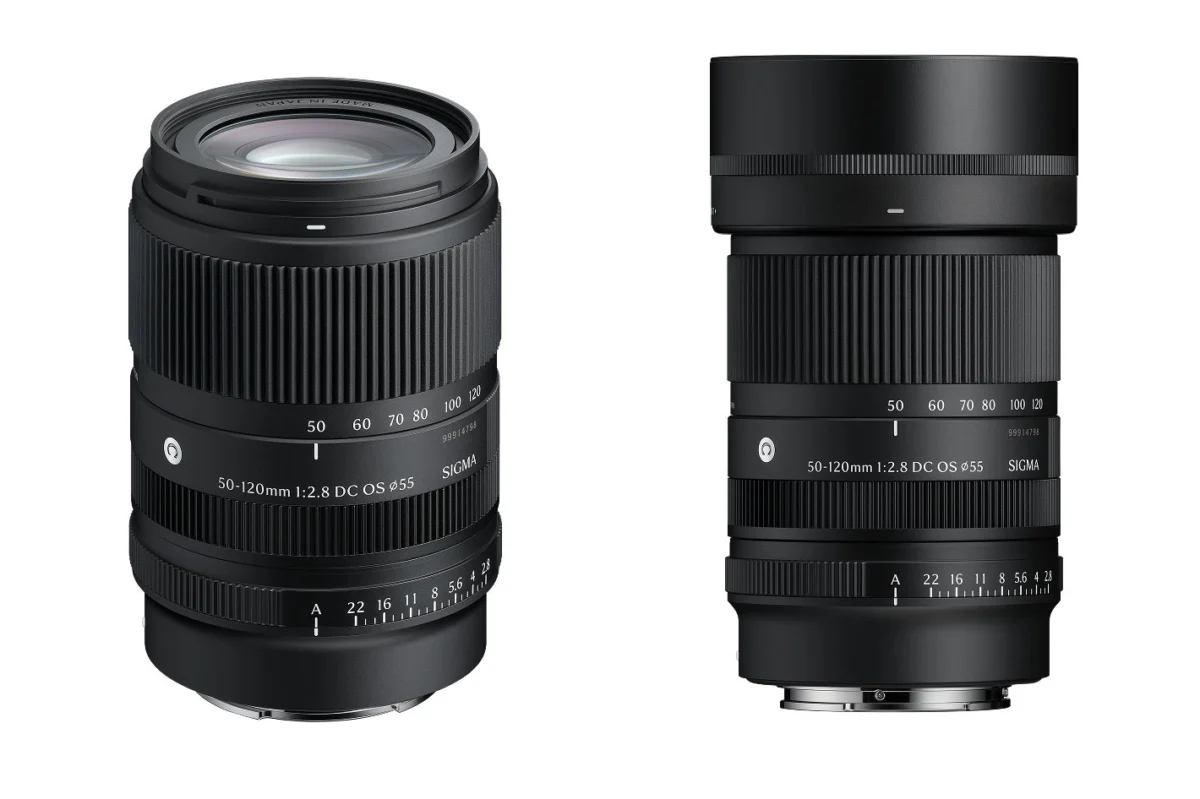
In a strategic move that fundamentally reshapes the expectations for crop-sensor photography and videography, Sigma Corporation has announced the expansion of its "Contemporary" lens line with the introduction of the 50-120mm F2.8 DC OS. This lens represents more than just another focal length; it is the final piece of a trinity that promises to provide professional-grade, constant-aperture coverage for APS-C shooters in a package small enough to fit into a jacket pocket.
By combining an effective full-frame equivalent range of 75-180mm with a constant F2.8 aperture and robust optical stabilization, Sigma is positioning the 50-120mm as the definitive alternative to the bulky, heavy 70-200mm lenses that have long defined the industry standard for professional telephoto work.
Main Facts: A Technical Overview
The Sigma 50-120mm F2.8 DC OS | Contemporary is designed to be the ultimate workhorse for APS-C mirrorless systems. Its primary specifications include:
- Focal Range: 50-120mm (approximately 75-180mm full-frame equivalent).
- Aperture: Constant F2.8 throughout the entire zoom range.
- Optical Stabilization: Rated for up to 6.5 stops of compensation, a significant feat for a telephoto lens of this size.
- Aperture Ring: A first for the Contemporary line, offering tactile, manual exposure control—a feature highly requested by cinema operators and traditional photographers.
- Video-Centric Features: Engineered to minimize focus breathing, ensuring smooth transitions for narrative and documentary video work.
- Build Quality: Dust- and splash-resistant construction, complemented by a water- and oil-repellent front element coating.
- Motor: A high-speed linear autofocus motor designed for quiet, precise performance in both stills and video capture.
At its core, this lens is designed to address the "portability paradox"—the historical necessity of choosing between high-quality glass and the physical burden of heavy equipment. By keeping the weight and dimensions to a minimum, Sigma is enabling a new class of "run-and-gun" professionals to achieve high-end results without the need for heavy gimbals or extensive support systems.
Chronology: Completing the Contemporary Trinity
The launch of the 50-120mm is the culmination of a multi-year development roadmap by Sigma to redefine the APS-C ecosystem. To understand the significance of this release, one must look at the progression of the Contemporary F2.8 series:
1. The Foundation: The 18-50mm F2.8 DC DN
The journey began with the 18-50mm F2.8 DC DN, which quickly became a fan favorite for its impossibly small size. It proved that Sigma could maintain its "Contemporary" ethos—high optical performance in a compact form—without sacrificing the professional-grade F2.8 aperture.
2. The Expansion: The 10-18mm F2.8 DC DN
Sigma followed up with the 10-18mm ultra-wide zoom. This lens cemented the strategy of the trinity: providing wide-angle, standard, and telephoto coverage in a lightweight, consistent series. The 10-18mm provided the architectural and landscape utility that complemented the 18-50mm perfectly.
3. The Completion: The 50-120mm F2.8 DC OS
With the announcement of the 50-120mm, the set is now complete. A photographer can now carry an ultra-wide (10mm) to a portrait telephoto (120mm) in three lenses that, combined, weigh less than a standard ultrabook laptop. This is a logistical revolution for event photographers, wedding shooters, and travel documentarians who previously had to choose between system weight and focal range versatility.
Supporting Data: Why the 50-120mm Changes the Game
To appreciate the engineering achievement, we must compare the 50-120mm against the industry’s traditional "70-200mm F2.8" standard.
The Weight and Size Factor
A standard full-frame 70-200mm F2.8 lens typically weighs between 1.2kg and 1.5kg (roughly 2.6 to 3.3 lbs). The Sigma 50-120mm, conversely, is engineered to be a fraction of that mass. For the videographer, this means the ability to use smaller, more affordable stabilizers (gimbals) or even handheld shooting for extended periods without the physical fatigue associated with full-frame telephoto glass.
The Stabilization Threshold
The inclusion of 6.5 stops of optical stabilization (OS) is particularly noteworthy. In low-light environments, such as indoor sports or wedding receptions, stabilization is the difference between a crisp image and a motion-blurred one. By integrating such effective OS into the lens itself, Sigma ensures that even camera bodies lacking In-Body Image Stabilization (IBIS) can produce steady, sharp imagery at the 120mm end of the zoom.
The Aperture Ring Integration
Historically, Sigma’s Contemporary line has prioritized a "clean" design, often relying on camera-body dial control for aperture. However, the decision to include a dedicated aperture ring on the 50-120mm signifies a shift in Sigma’s philosophy. By providing tactile feedback, Sigma is acknowledging the growing demand from videographers who prefer the manual, fluid control of an aperture ring for rack-focusing and manual exposure adjustments during a take.
Official Responses and Strategic Vision
During the product announcement, Mark Amir-Hamzeh, president of Sigma Corporation of America, emphasized that the 50-120mm is not merely a tool, but a statement of intent.
"Sigma’s Contemporary line has always emphasized an exceedingly compact form factor and reduced weight without compromising our standard for image quality," Amir-Hamzeh noted. He further highlighted that the 50-120mm serves as a "benchmark" for the future of the series. By pushing the build quality—specifically the inclusion of weather-sealing and the manual aperture ring—Sigma is blurring the lines between their "Contemporary" and "Art" lines.
Industry analysts suggest that this reflects Sigma’s confidence in their current optical design processes. They are no longer simply "making small lenses"; they are engineering high-performance optics that happen to be small. This shift is likely a direct response to the massive migration of professional shooters toward mirrorless APS-C systems, which prioritize efficiency and mobility.
Implications: The Future of the Professional Toolkit
The release of the Sigma 50-120mm F2.8 DC OS | Contemporary will have immediate ripple effects across several sectors of the imaging industry.
1. The Impact on Wedding and Event Photography
For wedding photographers, the ability to swap lenses within a constant F2.8 system without changing the weight distribution of the camera significantly is a massive advantage. The 50-120mm allows for intimate portraits and tight event coverage while remaining inconspicuous—a key requirement in professional settings where a massive 70-200mm can feel intrusive.
2. The Rise of the "Compact Cinema" Workflow
Videographers working on tight budgets or small crews will find the 50-120mm indispensable. The focus-breathing suppression is a critical feature that allows for more cinematic storytelling. When coupled with the 10-18mm and 18-50mm, the set provides a complete cinema-style focal range at a price point ($799 for the 50-120mm) that was previously unthinkable for this level of performance.
3. Market Competition
Sigma’s move puts significant pressure on camera manufacturers who produce their own native APS-C lenses. Many first-party systems lack a robust "pro" line of APS-C glass, often leaving users to adapt larger, heavier full-frame lenses. By providing a dedicated, high-quality, lightweight alternative, Sigma is effectively "owning" the APS-C market for users who want pro results without the full-frame tax.
4. Sustainability and Portability
Finally, there is an environmental and practical implication to the reduced size of this glass. Smaller lenses require less material and are easier to transport, reducing the carbon footprint of professional gear kits. For the working professional, the reduction in travel weight—particularly when flying or hiking to locations—cannot be overstated.
Conclusion
The Sigma 50-120mm F2.8 DC OS | Contemporary is a testament to the idea that professional quality does not require massive physical scale. By completing their F2.8 trinity, Sigma has provided the market with a sophisticated, highly capable, and remarkably portable solution for the modern APS-C shooter.
Whether it is the 6.5 stops of stabilization, the precision of the new aperture ring, or the seamless integration with existing Contemporary lenses, every element of this lens feels intentional. Starting October 22, 2026, photographers and filmmakers will have access to a tool that effectively shrinks the size of their gear bag while expanding the scope of their creative possibilities. As the industry moves toward lighter, more integrated systems, Sigma has firmly planted its flag as the leader in high-performance, compact optics.
