
The Richmond Way Forward: Decoding the Emotional and Strategic Twists of the Ted Lasso Season Finale
Main Facts
The television landscape was once again captivated by the emotional highs, quirky charm, and surprising tactical shifts of Apple’s hit sports dramedy, Ted Lasso. The season finale delivered a potent cocktail of betrayal, narrative turnabouts, inevitable departures, genuine surprises, and heavy-handed foreshadowing regarding the future of AFC Richmond. While Apple has yet to officially confirm a fifth-season renewal at the time of publication, the finale carefully balanced definitive character closures with fertile setup for a potential continuation.
At the center of the episode’s sprawling narrative web are seismic shifts for the core ensemble. Most notably, fan-favorite Roy Kent has accepted a dream offer to become the head coach of Premier League rival Chelsea, setting up a high-stakes professional leap intertwined with the impending reality of fatherhood. Meanwhile, AFC Richmond’s ecosystem undergoes a dramatic internal restructuring: Ted Lasso steps down from his primary leadership perch, handing the managerial reins of the women’s team (the Lady Greyhounds) to the hardworking and emotionally hardened Alice.
Parallel to these athletic maneuvers, the corporate threat to AFC Richmond’s ownership—orchestrated all season by the scenery-chewing Zelda, played by Tracey Ullman—is neutralized in a boardroom coup. Supported by a posthumous plot twist involving the beloved, recently deceased pub owner Mae, Rebecca Welton secures her grip on the club. Simultaneously, Rebecca pivots toward a romantic future by proposing to her boyfriend, Matthijs.
The episode operates on a character-by-character basis, ensuring each arc either resolves satisfyingly or acts as a seamless springboard for a yet-to-be-announced fifth season. However, the finale’s tonal whiplash—pivoting wildly from mourning to workplace comedy and parental trauma—underscores a series that continues to wrestle with its own expanding scope.
Chronology of the Finale: From Mourning to Management
The narrative timeline of the season-ender begins under a heavy cloud of grief, immediately following the unexpected death of Mae, the beloved proprietor of the Crown & Anchor pub, who passed away in episode nine while passionately supporting the Lady Greyhounds.
The Opening Act: Grief and Truth
The finale opens with a poignant celebration of life for Mae. These mourning scenes carry genuine emotional weight, establishing a somber foundation before rapidly accelerating into a tonally erratic hour of television. During a quiet moment at home, young Henry confesses his ongoing wish that Mae could help him with his homework. This leads to a tender yet painful query: Henry asks how Ted’s father died. Initially, Ted resorts to a protective lie—a nod to the audience’s knowledge that Ted’s father died by suicide. However, recognizing the necessity of honesty, Ted swiftly corrects course, sitting Henry down for a serious, off-screen conversation to reveal the unvarnished truth.
The Corporate Showdown
Concurrently, the boardroom drama reaches its apex at the club’s shareholders’ meeting. Zelda, revealed as the mysterious benefactor secretly buying up Richmond shares throughout the season, attempts to wrest control of the club. In classic Ted Lasso fashion, Rebecca and Higgins outmaneuver the usurper using a clever turnabout involving Zelda’s own assistant. This leaves a deadlock: a stark 49–49 percent ownership split between the two women.
The tiebreaker arrives from beyond the grave. Mae, who experienced a surge of public affection just prior to her unexpected passing, left her critical 2 percent stake in AFC Richmond directly to Rebecca. The hostile takeover is decisively thwarted, preserving the club’s independent spirit.
The Passing of the Torch
The emotional climax of the episode centers on Alice, whose breakout season established her as the emotional anchor of the series. Having worked tirelessly all season to drag the fledgling Lady Greyhounds toward competitive respectability through sheer grit and hard-earned emotional growth, Alice is met with the finale’s most unexpected twist.
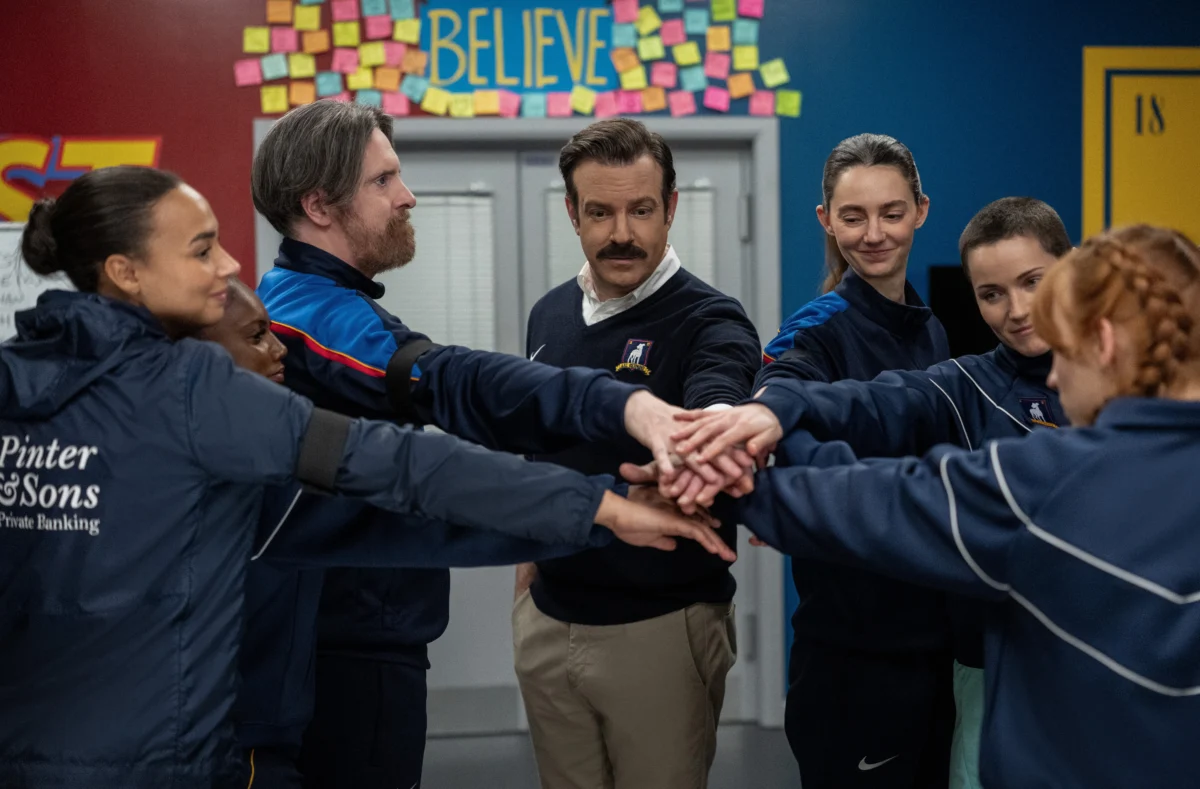
Gathered in her dimly lit office alongside Ted, Keeley, and Rebecca, Alice learns that Ted has formally requested a demotion from his managerial post, handing the head coach position of the women’s team directly to her. The scene functions as a brilliant thematic bookend to the season premiere, where a bitter Alice originally marched into Rebecca’s office demanding to know if she had ever even been considered for a leadership role.
Final Goodbyes and New Beginnings
As the episode draws to a close, narrative threads snap into place. Roy Kent prepares to clean out his office at Richmond. Before his departure, he shares a moment of vulnerability—complete with a spot-on Roy Kent impression—with Ted, Beard, Higgins, Nate, and Alice, revealing that Keeley is pregnant and expressing his deep-seated fear of failing as a father.
In the final moments, as Roy clears his desk, he discovers a parting gift from Ted: a note expressing absolute confidence in his parenting abilities, accompanied by one of Ted’s signature little green Army men. Meanwhile, Rebecca impulsively proposes to Matthijs, and Ted contemplates an uncertain future that may keep him anchored indefinitely in the Richmond orbit.
Supporting Data and Character Arcs
To fully understand the weight of the finale, one must examine the trajectory of the season’s key players, whose paths converged and diverged during the climax.
- Ted Lasso (Jason Sudeikis): Throughout the season, Ted largely operated outside a distinct personal narrative thread. After early hints teasing a romance in southwest London, Ted functioned primarily as a philosophical anchor—hovering over various plot points to offer heartfelt, occasionally hokey wisdom. While his comedic charm remains undiminished, his reduced narrative footprint positions him as an omnipresent guardian angel of the AFC Richmond universe.
- Roy Kent (Brett Goldstein): Roy’s arc balances professional ascension with personal terror. His transition to Chelsea as head coach places him in a larger pond, but the emotional core of his journey is rooted in his anxiety over fatherhood alongside Keeley Jones, whose corporate C-suite success runs parallel to her impending motherhood.
- Alice: Representing the most grounded, realistic character arc of the season, Alice’s transformation from an angry, cynical player-turned-coach to a respected leader offers the series a vital dose of grit. Her promotion to head coach of the Lady Greyhounds validates her labor and positions her as a central pillar for any future episodes.
- Zelda (Tracey Ullman) and Mae: The inclusion of veteran actress Tracey Ullman injected theatricality into the corporate plotline, while Mae’s posthumous intervention served as a narrative deus ex machina that neatly resolved the ownership crisis while honoring a foundational community figure.
Official Responses and Industry Context
As of the episode’s release on Wednesday, Apple has maintained official silence regarding a formal renewal for a fifth season. The lack of an immediate pickup has fueled rampant speculation among fans and industry analysts alike.
In a recent cover story with The Hollywood Reporter, series co-creator and star Jason Sudeikis famously discussed the show’s original construction around a planned three-season arc. However, the unexpected cultural and financial success of the subsequent expansion has forced a recalibration. Sudeikis and the creative team have repeatedly demonstrated that, much like Ted’s folksy idioms, the boundaries of the narrative can expand or contract based on creative inspiration.
Industry insiders note that Apple views the franchise as a cornerstone of its streaming catalog, making a fifth season an attractive proposition if the key creative talent—including Sudeikis, Brett Goldstein, and co-creator Brendan Hunt—are willing to return. Critical reception to the finale has been generally warm, though reviewers have increasingly noted the narrative challenges of keeping a formerly finite story fresh.
Implications for Season 5 and Beyond
Should Apple greenlight a fifth season of Ted Lasso, the finale has laid an exceptionally rich groundwork of narrative tension, comedic friction, and emotional evolution.
- The Evolution of AFC Richmond: The shifting of the tactical guard leaves the club in an entirely new era. With Alice at the helm of the women’s team, the series can explore the unique pressures, locker-room dynamics, and societal hurdles of women’s professional football—a domain previously only grazed by the series.
- Roy Kent’s Cross-Town Rivalry: Roy taking the Chelsea job while remaining a Richmond local creates instant comedic and dramatic conflict. Pitted against his old club in a high-stakes Premier League environment, Roy must simultaneously navigate the terrifying, uncharted waters of fatherhood.
- Rebecca’s Next Chapter: Between consolidating 51 percent ownership of AFC Richmond and her sudden engagement to Matthijs, Rebecca enters a potential fifth season poised at the center of both the boardroom and romantic comedy spheres. The wedding of the decade appears all but guaranteed.
- Ted’s Indefinite Orbit: The ultimate question mark remains Ted Lasso himself. Whether he acts as a women’s team assistant coach, eventually drifts back to the men’s side, or simply flutters around the Richmond premises indefinitely—dispensing aw-shucks platitudes and mixed-metaphor advice to bewildered Britons—his presence ensures the show’s signature warmth will never be far away.
As viewers digest the emotional roller coaster of the season finale, the overarching sentiment is clear: whether AFC Richmond hangs up its boots for good or laces them back up for another run, the cultural footprint of Jason Sudeikis’ optimistic American export has permanently altered the landscape of modern television comedy.
