
The SWIT K7: A New Standard for Daylight-Viewable, Cross-Conversion Monitoring
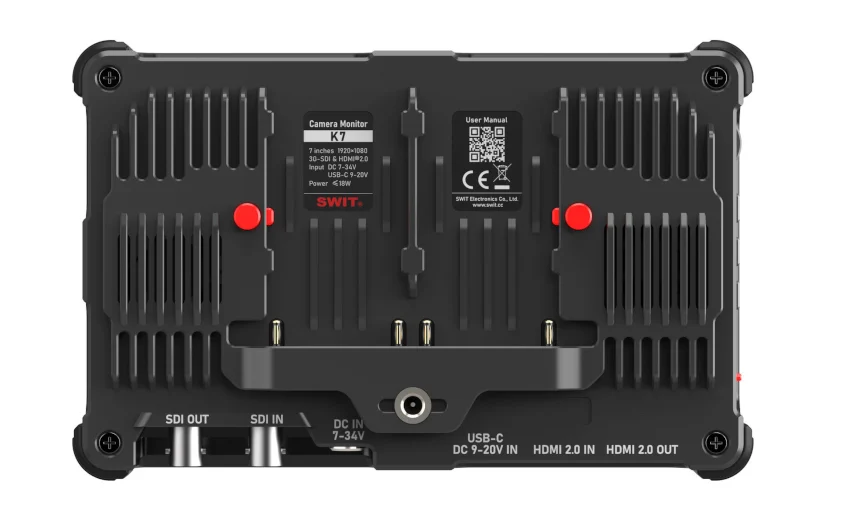
In the fast-paced world of professional cinematography, the ability to monitor high-resolution footage under challenging lighting conditions—while maintaining signal integrity across disparate camera systems—is a constant struggle. SWIT has officially unveiled the K7, a 7-inch on-camera monitor engineered specifically to bridge the gap between HDMI-based mirrorless workflows and SDI-based professional cinema environments. With its ultra-bright 2,800-nit display and sophisticated signal-handling capabilities, the K7 is positioned as a versatile powerhouse for modern production teams.
Main Facts: High-Brightness and Cross-Connectivity
The core proposition of the SWIT K7 lies in its hardware versatility. Designed for outdoor field production, the unit features an optically bonded 7-inch Full HD (1920 x 1080) touchscreen capable of hitting an impressive 2,800 nits of brightness. This high luminance is critical for operators working in direct sunlight, where traditional monitors often fail to provide sufficient visibility for critical focus and exposure.
Beyond the panel, the K7 excels in connectivity. It is equipped with HDMI 2.0 and 3G/HD-SDI inputs and outputs. Notably, the monitor includes built-in cross-conversion, allowing users to input an HDMI 4K signal (up to 4K60p) and output it as an HD-SDI signal. This feature effectively eliminates the need for external converter boxes in many mid-tier production workflows, streamlining the camera-to-monitor chain.
Constructed from a robust all-metal aluminum housing reinforced with protective rubber corners, the K7 is built to withstand the rigors of on-set abuse. Weighing just 575g and measuring 187 x 121 x 32mm, it remains compact enough for camera-top use while offering the build quality expected of professional-grade equipment.
Chronology: The Evolution of On-Camera Monitoring
The development of the K7 follows a clear industry trend toward "all-in-one" solutions. Over the last decade, we have seen a transition from basic low-resolution displays to complex, feature-rich monitors that double as signal routers and data processors.

Historically, filmmakers had to choose between monitors that prioritized color accuracy and those that prioritized brightness. In the early 2010s, sunlight-readable monitors were prohibitively expensive, often relegated to high-end rental houses. The middle of the decade saw the democratization of these tools, but they often lacked the necessary signal conversion features, forcing operators to carry bulky, battery-draining converters.
The release of the K7 marks the next step in this evolution. By integrating a 3G-SDI/HDMI bridge into a chassis that also features advanced image-assist tools, SWIT is responding to the demands of "hybrid" shooters—creators who use compact, HDMI-only cameras like the Sony Alpha series or Canon EOS R-line but find themselves needing to plug into larger, SDI-equipped video village systems or wireless transmission setups.
Supporting Data: Technical Specifications and Performance
The K7’s technical profile is a mix of high-end utility and specific, well-defined limitations.
The Display and Processing
The 2,800-nit panel is the standout feature. While many competing monitors offer 1,000 to 2,000 nits, the K7 pushes into the territory required for high-glare environments. It is important to note, however, that the display panel itself is 1920 x 1080. While it accepts 4K 60p inputs, it performs a down-sampling to fit the native 1080p resolution. For the purpose of composition and focus pulling, this is more than sufficient, though it means the monitor is not a "true" 4K viewing device.
Signal Conversion Dynamics
The conversion aspect is where the K7 requires a nuanced understanding of signal paths:

- HDMI Input: Accepts up to 4096 x 2160 at 60p.
- SDI Output: Limited to 3G-SDI, meaning it maxes out at 2048 x 1080p60.
- Implication: This unit is ideal for projects finishing in HD or those using a 4K camera to record internally while sending a high-quality HD monitoring feed to a director’s monitor via SDI. It is not intended for workflows that require a 4K signal to be sent over an SDI infrastructure.
Power Management
Power flexibility is often the difference between a successful shoot and a dead camera. The K7 provides three distinct power paths:
- Dual NP-F Battery Slots: These support hot-swapping, allowing for continuous operation.
- 2-pin LEMO Input: Designed for 7–34V external power from professional rigs (e.g., V-Mount or Gold Mount plates).
- USB-C Power Delivery (PD): A modern inclusion that accepts 9V, 12V, 15V, and 20V inputs, providing a lightweight power solution for run-and-gun setups.
Official Responses and Strategic Positioning
In official statements accompanying the launch, SWIT emphasized the "all-in-one" philosophy. By focusing on the integration of 3D LUT support—with the ability to import up to 50 custom LUTs via an SD card—the company aims to satisfy colorists and DPs who need to see a "baked-in" look while shooting Log.
Furthermore, the inclusion of frame capture functionality is a direct response to the request for better continuity management. By allowing operators to overlay a previous frame with adjustable transparency, the K7 assists in complex match-shots and subject placement, a feature previously reserved for higher-end dedicated monitor/recorders.
Regarding the choice of a 3G-SDI interface, industry experts suggest that SWIT likely balanced cost and demand. Moving to 12G-SDI for 4K delivery would have significantly increased the price point and thermal output of the unit, potentially alienating the core demographic of independent filmmakers and freelance operators who prioritize cost-to-performance ratios.
Implications for the Modern Filmmaker
The introduction of the K7 has several implications for the current landscape of video production.

Streamlining the Workflow
The primary implication is the reduction of "rig bloat." By eliminating the need for an external HDMI-to-SDI converter, the K7 simplifies the cable management of a camera rig. Less hardware means fewer points of failure, fewer batteries to manage, and a lighter load for handheld operation.
The "Hybrid" Standard
As more manufacturers introduce cameras that output 4K via HDMI, the K7 serves as a vital bridge. It validates the "hybrid" workflow, where a creator might use a mirrorless camera for its high-bitrate internal codec but requires the robust connectivity of an SDI ecosystem for on-set monitoring, wireless transmission, or live-streaming via a switcher.
Ergonomics and Durability
The design choice to include physical controls alongside a touchscreen is a nod to real-world experience. Touchscreens are excellent in a studio but can be unreliable in extreme humidity, cold, or when wearing gloves. The inclusion of a scroll/enter wheel and function keys ensures that the K7 remains usable in any environment, reflecting a deep understanding of the realities of location work.
Conclusion: A Tool for the Working Professional
The SWIT K7 is not trying to be a 4K reference monitor or a high-end recorder; it is aiming to be the most practical, durable, and reliable interface between the camera and the eyes of the operator. Its limitations—the 1080p display and 3G-SDI bottleneck—are clearly communicated and are unlikely to be a hindrance for the target audience.
For the independent cinematographer, the K7 represents a significant upgrade in on-set capability. It provides a bright, high-contrast window into the image, advanced exposure and focus tools, and the flexibility to jump between professional and consumer-grade signal standards. By consolidating these functions into an all-metal, weather-conscious chassis, SWIT has created a compelling piece of hardware that is likely to become a staple in many camera bags across the globe.

The unit is currently available for purchase, with optional accessories like the MA-K7CAGE and the KA-F20S V-mount adapter available to further customize the unit for specific production needs. As workflows continue to evolve toward higher resolutions and more complex monitoring requirements, the SWIT K7 provides the stability and versatility that professionals demand.
