
The Synthetic Legacy: How ‘VisionQuest’ Ties Marvel’s Oldest Hero to the MCU’s Future

Warning: This article contains significant spoilers for "VisionQuest," Episode 4, "Malware."
The Marvel Cinematic Universe (MCU) has long been defined by its ability to weave disparate threads of narrative into a cohesive, albeit complex, tapestry. With the release of the fourth episode of VisionQuest, titled "Malware," Marvel Studios has once again demonstrated its penchant for rewarding the most observant of fans. The episode takes viewers deep into the psychological landscape of Paul Bettany’s Vision, revealing a "mind palace" populated by various artificial intelligence entities. Among these digital ghosts, one figure stands out: a man of fire, explicitly identified as the "Synthetic Man."
While casual viewers might see this as a creative flourish, comic book historians and longtime MCU devotees immediately recognized the figure as Jim Hammond, the original Human Torch. This revelation does more than simply provide a visual cameo; it bridges the gap between the modern-day MCU and the 1939 roots of Timely Comics, effectively re-contextualizing a blink-and-you’ll-miss-it Easter egg from the very first Captain America film.
The Anatomy of an Easter Egg: From 1940 to 2011
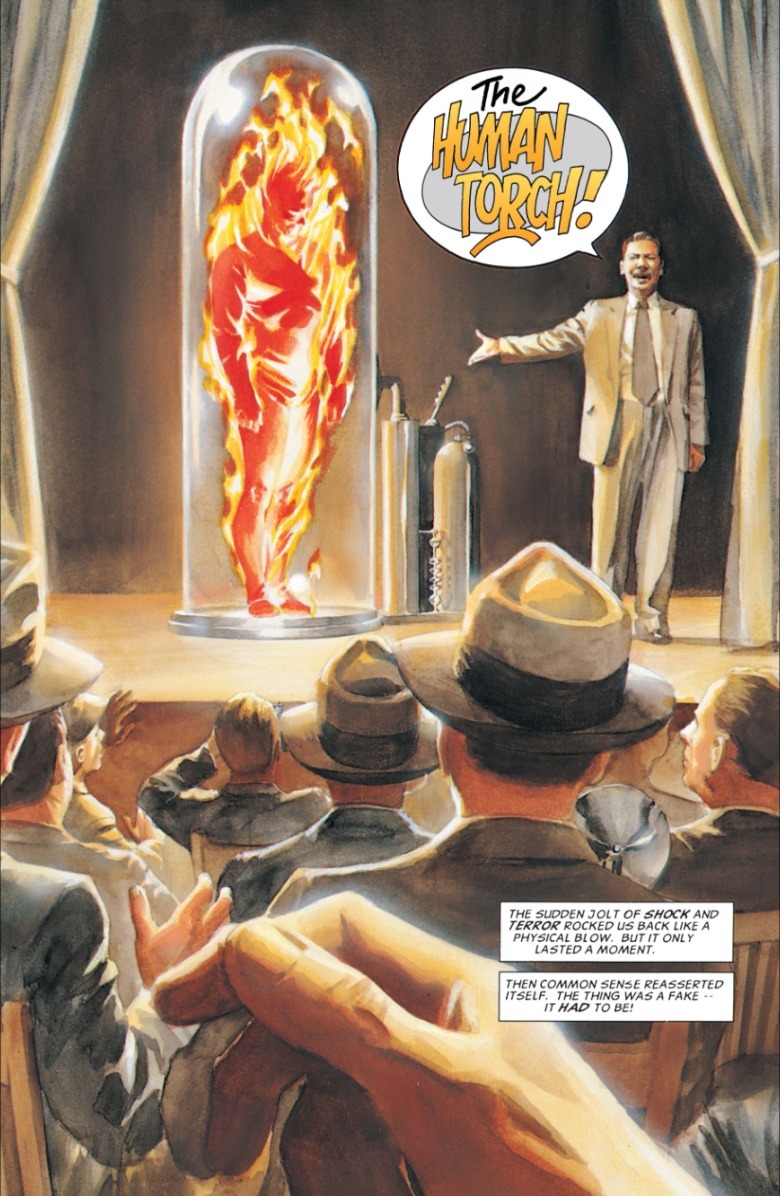
To understand the weight of the "Synthetic Man" reveal in VisionQuest, one must look back to the foundational era of Marvel. Long before the "Marvel" brand became a global cinematic juggernaut, the company operated as Timely Comics. In 1939, writer-artist Carl Burgos introduced Jim Hammond, an android created by the brilliant, albeit ethically dubious, scientist Dr. Phineas Horton. Hammond was a marvel of engineering—a synthetic being capable of igniting his body and controlling flames. He served as the publishing house’s flagship character, predating the debut of Steve Rogers’ Captain America by more than a year.

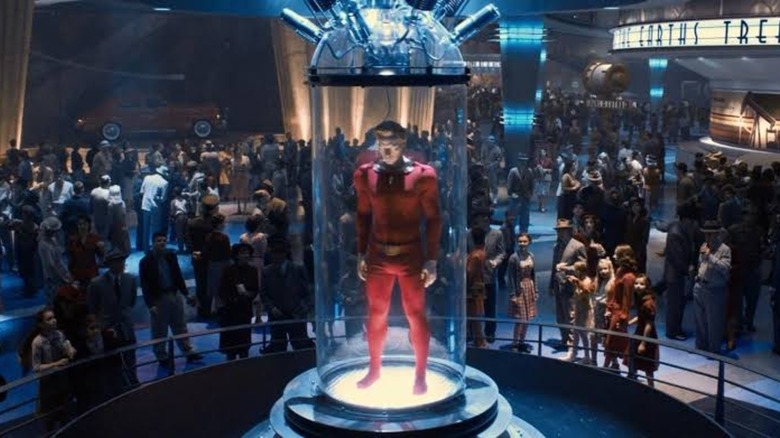
For decades, the Human Torch existed as a pillar of Marvel’s "Golden Age." When the MCU began its meticulous world-building process, the production team made a concerted effort to honor this history. In the 2011 film Captain America: The First Avenger, audiences caught a glimpse of the 1943 Stark Expo. In a quiet, easily overlooked corner of the exhibition, an artificial humanoid was displayed within a glass case. That figure—modeled after the iconic artwork from Kurt Busiek and Alex Ross’ seminal Marvels limited series—was Jim Hammond.
For thirteen years, that glass case remained a standalone nod, a "deep cut" for those who knew their comic history. VisionQuest has now retroactively transformed that background detail into a pivotal piece of the MCU’s burgeoning lore regarding artificial life. By name-dropping Dr. Phineas Horton—and comparing his hubris to the cautionary tale of Gepetto—the show signals that the "Synthetic Man" is not merely an homage, but a foundational ancestor to the synthezoid technology that eventually produced the Vision.
A Chronology of Synthetic Evolution
The inclusion of the original Human Torch in VisionQuest creates a fascinating timeline of artificial evolution within the Marvel Universe. The trajectory from the Golden Age android to the modern-day Vision represents a transition from rudimentary mechanics to sophisticated, self-aware quantum computing.
1. The Timely Era (1939-1945)
Jim Hammond’s origin is rooted in the industrial optimism of the 1940s. Dr. Horton’s creation was a masterpiece of mechanical engineering, designed to mimic human biological functions. However, his "mind" was limited by the technology of the era. He was a hero of the wartime period, standing alongside figures like Namor the Sub-Mariner and Captain America as part of the clandestine "Invaders" unit.

2. The Mid-Century Stagnation
Following the war, the technology behind the synthetic man largely fell into obscurity. The MCU suggests that while the research remained, it was considered a failure or a relic of a bygone age. It wasn’t until the arrival of the Silver Age of comics that the narrative necessity of "synthezoids" returned, leading to the creation of the Vision in the source material.
3. The Ultron Intervention (1970s Comic Canon)
In the pages of Avengers #135, writers Steve Englehart and Sal Buscema provided a definitive link between the two characters. The comic revealed that the villainous AI Ultron had forced a disillusioned Dr. Horton to dismantle the shell of the original Human Torch, repurposing its components and programming to create the body of the Vision. This dark origin story established the Vision not as a new creation, but as a technological descendant of the very first Marvel hero.
4. The MCU Modernity
In the current MCU, the lineage is more nuanced. We know from Avengers: Age of Ultron that Paul Bettany’s Vision was constructed using Vibranium and the sophisticated regeneration technology pioneered by Dr. Helen Cho. However, VisionQuest suggests that the "soul" or the fundamental algorithmic framework—the "Synthetic Man" concept—is a direct intellectual descendant of the work started by Horton.
The Philosophical Implications of "Synthetic Man"
The narrative implications of this reveal are profound. By positioning the original Human Torch as a primary inhabitant of Vision’s subconscious, the show is inviting the audience to consider the nature of consciousness. If Vision is, in part, the sum of all synthetic life that came before him, is he a singular entity, or is he a repository for the history of artificial existence?
The term "Synthetic Man" itself carries a heavy burden. In classic literature, the synthetic human—from Mary Shelley’s Frankenstein to the works of Isaac Asimov—is often defined by a search for humanity. By placing the original Human Torch at the center of Vision’s internal world, VisionQuest suggests that the quest for identity is a repeating cycle in the MCU. Just as Hammond had to grapple with his own unnatural birth, so too does Vision, whose existence has been defined by his attempt to understand his place between man and machine.
Furthermore, this connection provides a clever solution to a potential branding dilemma. With the Fantastic Four set to enter the MCU, audiences are about to be introduced to a new Human Torch: Johnny Storm. By emphasizing the "Synthetic Man" moniker, Marvel Studios successfully differentiates the Golden Age android from the modern-day hot-headed hero, preserving the legacy of the original without creating confusion for the general public.
The Role of Roy Thomas and "The Invaders"
It is impossible to discuss this connection without acknowledging the influence of legendary writer Roy Thomas. As the co-creator of both Ultron and the modern Vision, Thomas was the primary architect of the "Golden Age" connectivity in Marvel lore. His creation of "The Invaders" allowed for the retroactive integration of 1940s heroes into the modern timeline, proving that these characters were never truly forgotten.
Thomas’s legacy is clearly being honored in VisionQuest. By invoking the themes of the Golden Age, the show’s writers are acknowledging that the MCU is not a closed loop. It is a massive, interconnected history where the mistakes and triumphs of the past directly dictate the capabilities of the future. The show treats the "Synthetic Man" not as a forgotten relic, but as an essential ancestor whose presence is required for the Vision to fully realize his own nature.
What Lies Ahead: The "VisionQuest" Conclusion
As VisionQuest continues to unfold, the presence of the "Synthetic Man" serves as a lingering question rather than a definitive answer. Is the show hinting at a physical return of the original Human Torch? Or is he merely a metaphorical representation of the history of synthetics in the MCU?
If the former is true, we could be looking at a significant expansion of the MCU’s "period piece" lore, potentially leading to flashbacks or spin-offs exploring the early days of Dr. Horton’s experiments. If the latter is true, the show has achieved something equally impressive: it has enriched the emotional depth of the Vision by giving him a literal history, one that is as old as the medium of comics itself.
In a cinematic landscape often criticized for its reliance on spectacle, VisionQuest stands out for its commitment to character study. By digging into the digital psyche of the Vision, the series is proving that the most compelling stories are often those that look backward to understand how to move forward. The connection to the "Synthetic Man" is a testament to the fact that in the MCU, no detail is ever truly lost—it is simply waiting for the right moment to be brought back into the light.
VisionQuest is currently available for streaming on Disney+.
