
Unleashing the Beat and the Blade: Inside the Making of Netflix and Sony’s Groundbreaking Animated Feature ‘KPop: Demon Hunters’
Main Facts
For first-time feature director Maggie Kang—who previously served as head of story on The Lego Ninjago Movie—bringing KPop: Demon Hunters to the screen represents the realization of a two-decade-long creative vision. What began humbly as an artistic exploration into traditional Korean demonology and folklore eventually morphed into an explosive, high-octane cinematic collision between pulse-pounding K-pop choreography and supernatural martial arts action.
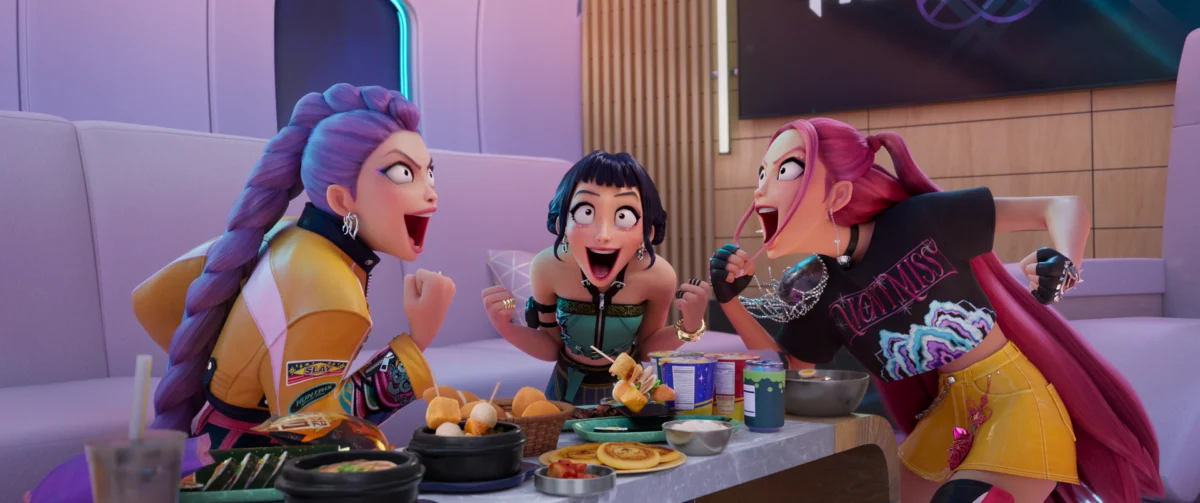
A high-profile co-production between Netflix and Sony Pictures Animation, the film centers on Huntrix, a fictional powerhouse K-pop girl group whose members lead breathless, high-stakes double lives. By day (and during sold-out stadium world tours), Rumi (voiced by Arden Cho), Mira (voiced by May Hong), and Zoey (voiced by Ji-young Yoo) are international pop icons. By night, they trade their glittering designer stage outfits for weapons, operating as a fierce trio of elite demon hunters.
Their mission to protect humanity from the forces of darkness is complicated by Gwi-Ma (voiced by Byung-hun Lee), a fiery and malevolent supernatural entity controlling an army of ghouls, shapeshifters, and grim reapers. Adding to the pressure, Huntrix finds themselves locked in a fierce industry and supernatural rivalry with the Saja Boys, an irresistibly charming up-and-coming rival boy band that secretly serves as a front for a cadre of demons led by the enigmatic Jinu (voiced by Ahn Hyo-seop). Weaving a classic, emotionally resonant K-drama romance between Jinu and Rumi, KPop: Demon Hunters fearlessly tackles complex themes of dual identities, fame, existential crisis, and confronting one’s inner darkness.

Chronology of Development: From Concept to Screen
The long developmental trajectory of KPop: Demon Hunters highlights the meticulous planning required to fuse two entirely disparate cultural phenomena into a cohesive narrative.
- The 20-Year Genesis: Director Maggie Kang’s journey began nearly twenty years ago with a simple fascination regarding Korean demonology and how its vivid, distinct creatures could be visually maximized within mainstream western and global media.
- Shaping the Heroines: This early conceptual phase naturally funneled into the creation of demon hunters, prompting Kang to design a core cast of dynamic, relatable superhero women who broke away from the overly sanitized archetypes dominating the contemporary superhero landscape.
- Folding in the Music: Interestingly, the K-pop element was structurally integrated into the project during the latter stages of concept development. Because traditional demon hunting requires absolute secrecy, the creative team realized the protagonists needed a profoundly public, high-profile cover. K-pop provided the ideal cultural anchor, bringing unmatched scale, theatricality, and spectacle to the narrative while naturally transforming the project into a musical.
- The Animation Pipeline and Sony Pictures Imageworks: With co-director Chris Appelhans (Wish Dragon) joining the venture, the production leaned heavily on Sony Pictures Imageworks—the technical powerhouse behind the revolutionary Spider-Verse franchise. The studio utilized an innovative, anime-influenced computer-graphics approach, combining eye-popping neon palettes with 2D-inspired stylistic flourishes.
- Finalizing Musical Sequences: Due to the rhythm-driven nature of the project, animators had to wait for core tracks to be fully polished before completing the final animation frames, relying instead on preliminary storyboards timed strictly to the underlying tempos.
Supporting Data, Voice Cast, and Musical Highlights
KPop: Demon Hunters relies heavily on a stellar ensemble cast and an authentic auditory landscape crafted by prominent figures in the music and entertainment industries.
Key Cast & Characters
- Rumi (Arden Cho): The complex, driven leader of Huntrix whose secret romance and deep ties with Jinu form the emotional core of the film.
- Mira (May Hong): The grounded, fierce member of Huntrix balancing performance pressures with tactical combat.
- Zoey (Ji-young Yoo): The energetic, goofy breakout star unafraid to showcase her humanity and snack addictions before a major battle.
- Gwi-Ma (Byung-hun Lee): The formidable, fiery primary antagonist orchestrating the demonic onslaught against the pop idols.
- Jinu (Ahn Hyo-seop): The leader of the Saja Boys who hides his true demonic nature behind a pristine idol persona.
Soundtrack Highlights and Industry Collaborations
The musical numbers function as both narrative milestones and high-adrenaline action sequences. The production features standout tracks such as "Golden" and "What It Sounds Like," alongside the lead single, "Takedown." To ensure absolute authenticity for the musical sequences, "Takedown" was officially performed by prominent members of the real-world K-pop sensation TWICE (specifically Jeongyeon, Jihyo, and Chaeyoung).

Official Responses and Creative Insights
Speaking with IndieWire, the creative minds behind the film detailed the deliberate artistic choices that shaped the movie’s distinct aesthetic and tone.
"I was drawn to demonology and thought that [it] would be very visually impactful to feature in mainstream media," director Maggie Kang explained. "And so that naturally led to demon hunters and a group of really badass superhero women. I felt like I wasn’t seeing women who were too relatable for me in this superhero market that is so saturated."
Kang emphasized her desire to showcase female characters who possessed genuine range—women who could be funny, goofy, and unabashedly flawed, such as gorging themselves on comfort snacks immediately before stepping onto a massive stage or charging into a supernatural battlefield.

Co-director Chris Appelhans expanded on the stylistic hurdles of combining high-end 3D animation with stylized 2D aesthetic choices: "You wanna find some unique visual elements for your film that are unique to animation, and you need to let the film help tell you what those are. And so this idea that Maggie had, representing women with more range, was really helpful in pulling from this wonderful language of goofy, cheapie aesthetic that some anime do."
Appelhans noted that achieving high-glam character models alongside hyper-exaggerated facial expressions required a specialized pipeline. "To work in 3D, it didn’t need to feel like a momentary illustration, but more of a claymation approach," he said. "As soon as we committed to that, it felt okay to cross those boundaries. We’re not trying to do 2D shorthand; we’re trying to keep it all feeling dimensional, whatever the characters do."
Discussing the technical intricacies of the action-heavy sequences, Kang pointed to films like Edgar Wright’s Baby Driver as a primary structural inspiration. "I think we always talked about it being kind of like Baby Driver, with the fight punches on the beat," Kang noted. "So, as soon as the music kicks in, we change lighting, all these other things happen. We just wanted the girls to have fun and kick butt to the beat."

Implications for the Animation Industry
The release of KPop: Demon Hunters on Netflix carries profound implications for the future of mainstream global animation, particularly regarding cross-cultural storytelling and stylistic innovation.
- Redefining Western-Asian Co-Productions: By seamlessly blending traditional Korean folklore with the hyper-modern aesthetics of the global K-pop industry, the film proves that culturally specific narratives can achieve broad, mainstream international appeal without diluting their cultural roots.
- Pushing Visual Boundaries: Following in the footsteps of Sony’s Spider-Verse films, KPop: Demon Hunters demonstrates the commercial and critical viability of hybrid animation styles—fusing 3D computer graphics with 2D rendering techniques and anime-inspired camera blocking. This encourages major studios to take bolder risks with their visual languages rather than adhering to a uniform, hyper-realistic 3D standard.
- Elevating Diverse Female Protagonists: The film offers a refreshing template for female-led action properties. By refusing to sacrifice vulnerability, humor, and flaws in favor of stoic perfection, Kang and her team have established a new benchmark for character development in animated superhero narratives.
- The Synergy of Music and Visual Media: The integration of top-tier K-pop talent—such as collaborations with members of TWICE—cements a powerful cross-promotion model between the global music recording industry and feature-length animation, opening new avenues for box office and streaming success.
“KPop: Demon Hunters” is now available to stream globally on Netflix.
