
Unlocking the Veil: Dave Boyle’s ‘Never After Dark’ Redefines the Modern Ghost Story
Introduction: A Fresh Spin on Familiar Haunts
In the ever-crowded landscape of modern horror cinema, few premises feel as reliably well-worn as the slow-burn supernatural thriller. Time and again, audiences are introduced to the same architectural cliché: a sprawling, isolated estate shrouded in shadows, a panicked family desperate for relief, and an intrepid paranormal investigator hired to purge the premises of a malevolent entity. Yet, director Dave Boyle’s clever, immersive, and deeply engaging feature Never After Dark takes this standard-issue blueprint and sneakily turns the entire genre on its head.
Set against the striking backdrop of a massive, isolated home nestled deep within the dense forests of Hokkaido, Japan—a real-world architectural marvel in Kiyosato that feels purposely designed as a spiritual tribute to Stanley Kubrick’s Overlook Hotel—the film immediately establishes a mood of eerie familiarity. But beneath its classic surface lies a meticulous subversion of traditional horror tropes. Blending Eastern and Western supernatural idioms with the distinct auteurist flair that defined his previous work like Man from Reno, Boyle crafts a singular genre exercise. Never After Dark is a film that refuses to rely on cheap jump scares or deafening sonic stings, opting instead for a patient, atmospheric unraveling of time, memory, and the thin boundary separating the living from the dead.
Chronology of a Haunting: From First Contact to the Twilight Hours
Act I: The Premise and the Practitioner
The narrative commences when a wealthy homeowner, Teiko (played by Tae Kimura), alongside her peevish, watchful son and producer Kento Kaku in the role of Gunji, hires a professional medium to cleanse their architectural monolith. Enter Airi, a jaded thirtysomething medium who is considerably more comfortable navigating the spectral plane than she is interacting with the living. Brought to vivid, forceful life by Shōgun breakout star Moeka Hoshi, Airi’s performance constantly teeters right on the edge of control.
Unlike the typical paranormal investigator who approaches the spirit world with wide-eyed terror or solemn reverence, Airi treats her profession with a weary, blue-collar familiarity. This comfort is rooted in a deeply personal condition: she is intimately haunted by the sweet, encouraging ghost of her older sister, Miku (Kurumi Inagaki). Miku remains forever frozen at the exact teenage age she was when she died, serving as Airi’s sole confidante and constant companion.
This opening dynamic serves as a vital thematic clue regarding how Boyle’s spare and patient script will manipulate temporal mechanics. As the narrative progresses, the invisible boundary between this world and the next begins to mirror the line separating the present from the past. In Never After Dark, blurring one of these boundaries inherently blurs the other.
Act II: The Mechanics of the Seance and the Gaping Mouth Man
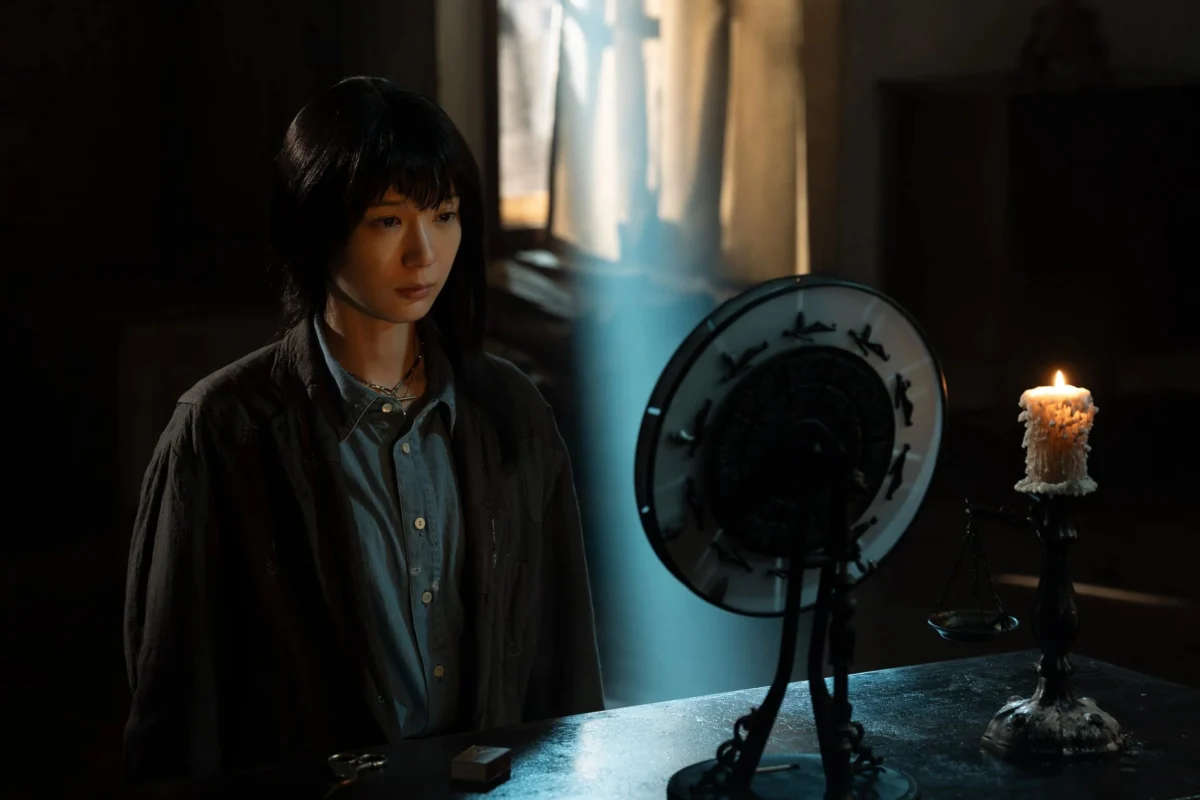
Rather than relying solely on the standard tropes of lighting a candle and whispering into the dark, Airi’s methodology introduces a fascinating visual and mechanical element to the supernatural procedural. To open a portal into the spirit world, she employs a spinning, zoetrope-like contraption. This mesmerizing device flattens time into a perfect circle, allowing Airi to step entirely outside of her unconscious physical body. Viewers are treated to the chilling visual of Airi exploring the expansive mansion while her physical shell kneels motionless on the living room floor—a brilliant setup for a harrowing sequence in which she must race against time to awaken herself before an encroaching evil traps her in the spirit world permanently.

It does not take long for Airi to encounter the target of her employment: a pale-faced entity known in the credits as the "Gaping Mouth Man." Portrayed by Chime star Mutsuo Yoshioka, whose trademark twisty-faced blankness is utilized to marvelous effect, this entity features a bloody, gaping wound where his mouth should be. Curiously, the demon displays no immediate hostility toward Airi. Instead, he shuffles aimlessly down empty corridors and endlessly scratches at a mysterious cabinet hidden in the back of a second-floor bedroom. This lack of overt aggression allows Airi to casually brush off Miku’s repeated warnings of grave danger.
Act III: The Lull in the Shadows
Because Airi possesses zero fear of ghosts—and indeed finds a strange sense of comfort in their presence—the film purposefully de-escalates its tension as she settles into her gig. The narrative establishes a rhythm dictated by the supernatural rules of the house: because the veil between worlds grows too thin after dark, Airi is legally and practically unable to perform her exorcism duties once the sun sets.
Consequently, she must find ways to idle away the long night hours. These sequences provide some of the film’s most unusual and character-defining moments. Airi chats casually with her sister (who can only be seen through mirrors and reflective surfaces), dances around the empty mansion while drinking beer, and even debates the merits of Kraftwerk albums when Gunji periodically appears to monitor her progress.
At a certain point, the film flirts brilliantly with ambiguity, nearly convincing the audience that Airi is running an elaborate scam for a free luxury stay, using the "no witnesses" rule simply to avoid human contact. Miku serves as her only emotional anchor, though even the spectral sibling recognizes the unhealthy codependency of their arrangement.
Supporting Data and Production Insights
Never After Dark operates on a modestly scaled yet immersively self-contained budget, utilizing its single-location setting to maximize claustrophobia and psychological depth. Key production details highlight the film’s precise craftsmanship:
- Location: Shot on location in a massive residential property in Kiyosato, Hokkaido, chosen specifically for its uncanny architectural resemblance to classic cinematic horror spaces like the Overlook Hotel.
- Cast Highlights:
- Moeka Hoshi (Shōgun) as Airi, delivering a vibrant, unpredictable lead performance.
- Kurumi Inagaki as Miku, the spectral sister trapped in eternal adolescence.
- Mutsuo Yoshioka (Chime) as the chilling, silent "Gaping Mouth Man."
- Tae Kimura as homeowner Teiko and Kento Kaku as Gunji.
- Cinematic Influences: Critics and early reviewers have compared the film’s measured pacing and atmospheric build-up to Ti West’s The House of the Devil and the chilling, slow-burn dread characteristic of Kiyoshi Kurosawa’s filmography.
- Thematic Device: The zoetrope contraption utilized by Airi serves as a brilliant meta-textual nod to the medium of cinema itself—flattening static images into the illusion of motion, much like a film projector.
Official Responses and Creative Intentions
Director Dave Boyle has spoken extensively about wanting to subvert the moralizing "letting go" tropes that traditionally anchor cinematic ghost stories. Rather than treating grief as an obstacle to be summarily conquered through a sudden burst of emotional epiphanies, Never After Dark treats the past and present as fluid, interlocking dimensions.

In promotional interviews and early festival discussions, the production team emphasized that the film’s horror stems not from sudden jump scares or aggressive spectral attacks, but from the quiet erosion of boundaries. The choice to cast actors known for arthouse and historical dramas—such as Hoshi from Shōgun and Yoshioka from Kiyoshi Kurosawa’s stable—was a deliberate effort to ground the supernatural narrative in nuanced, highly physical performances rather than reliance on digital effects. Magnolia Pictures, which acquired the distribution rights, has highlighted the film as one of the premier intelligent genre releases of the autumn season.
Implications and Critical Reception
As Never After Dark transitions from its relaxed, character-focused first half into its traditionally horror-coded later chapters, the stakes elevate dramatically. The film ultimately forces its "ronin ghostbuster" protagonist into an impossible dilemma: instead of banishing a dead person’s ghost from the living world, Airi is confronted with the horrifying prospect of banishing a living person to the other side of the veil—effectively committing murder under the guise of supernatural reclamation.
While Boyle’s character work occasionally leaves some emotional gaps that are tested by the ambiguous, unmoored final moments, the film succeeds wildly as a formal exercise. It avoids the tired moralizing of standard genre fare, opting instead for a soft, elusively ambiguous conclusion.
The true triumph of Never After Dark lies in how it uses the mechanics of time to comment on the horror of being stuck in the past. Every time Airi spins her zoetrope, the film reminds us that cinema itself has always been the ultimate medium for exploring the spectral spaces between what was and what is.
Magnolia Pictures is scheduled to release "Never After Dark" in theaters nationwide on Friday, September 25.
