
Insta360 Expands US Footprint and Unveils "Spatial Capture" to Turn 360 Video Into Explorable 3D Scenes
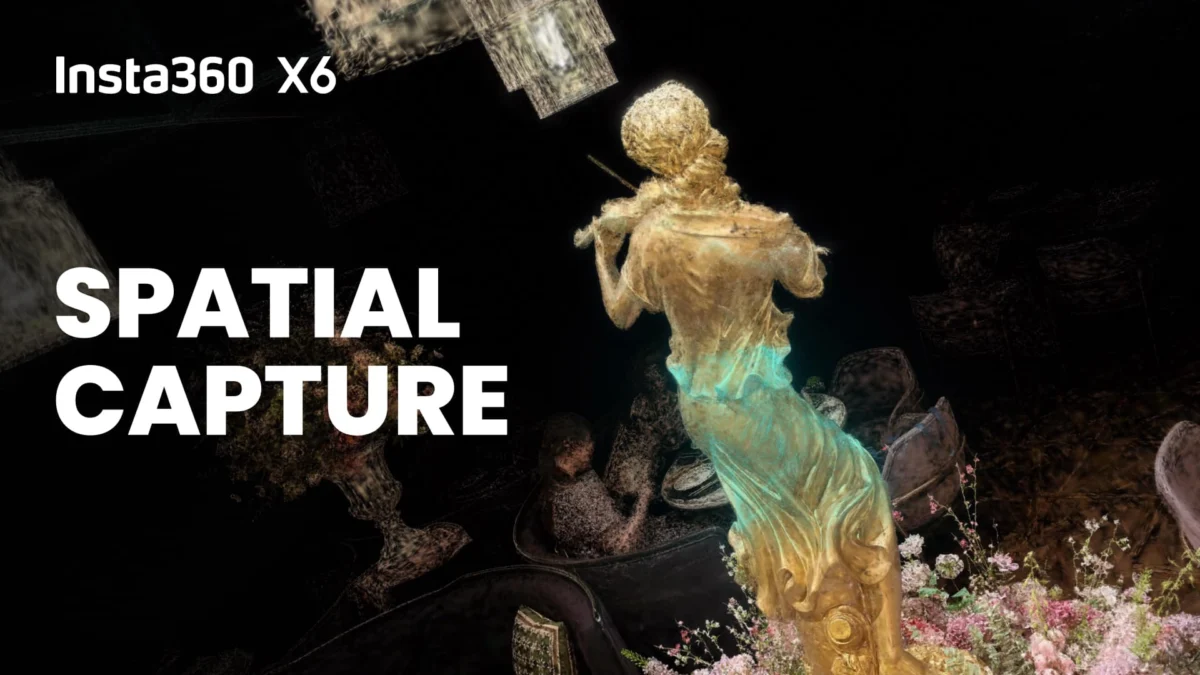
NEW YORK — In a major push to solidify its presence in the North American market, camera innovator Insta360 has officially opened its first flagship brick-and-mortar store in the heart of New York City’s Times Square. Capitalizing on a favorable retail landscape and a massive surge in consumer interest, the brand is simultaneously rolling out a groundbreaking software update: Spatial Capture.
Slated to launch in the United States on September 28, this new feature promises to fundamentally alter how content creators, real estate agents, and casual users interact with volumetric media. By leveraging 3D Gaussian Splatting (3DGS), Spatial Capture seamlessly translates standard 360-degree video captured on supported devices—namely the new Insta360 X6, alongside the X5 and X4 Air—into fully explorable, interactive three-dimensional environments.
Main Facts
The core of Insta360’s latest announcement centers on the intersection of accessible hardware and advanced computer vision.
- The Times Square Flagship: Insta360 has opened its inaugural North American retail hub in Times Square, NYC. Benefiting from a competitive landscape where rival DJI faces regulatory and retail hurdles in the US, the launch drew massive crowds and heavy consumer engagement.
- Spatial Capture Rollout: Beginning September 28, users in the US will gain access to Spatial Capture. The feature converts standard 360-degree footage into immersive 3D scenes.
- Device Compatibility: While spearheaded by the flagship Insta360 X6, the feature is backward-compatible and will also be supported via firmware updates on the Insta360 X5 and X4 Air models.
- The Technology: The system utilizes 3D Gaussian Splatting (3DGS)—a rendering technique that constructs high-fidelity 3D spaces from multiple image perspectives. Because the dual-lens architecture of Insta360 cameras captures a full spherical perspective simultaneously, users can generate 3D scenes from a single, continuous walk-through without the tedious, multi-angle stitching processes typically required by traditional photogrammetry.
- Accessibility and Limits: The workflow is housed directly within the Insta360 mobile ecosystem. Users can process up to four 3DGS scenes per month for free, utilizing cloud-based rendering that takes roughly one to two hours per file.
Chronology of Events
The convergence of Insta360’s physical retail expansion and its technical software rollout represents the culmination of years of R&D in immersive imaging.
Phase One: Hardware Dominance and Ecosystem Growth
Over the past several years, Insta360 established itself as a dominant force in the action camera and 360-degree video sectors. By consistently refining its stabilization algorithms, increasing sensor resolutions, and introducing user-friendly editing suites, the company laid the groundwork for a broader consumer base. The release sequence of the X4, followed by the X5 and the newly minted X6, built an installed user base equipped with dual-lens capture hardware capable of handling high-bitrate spherical video.
Phase Two: Capitalizing on the US Retail Vacuum
With competitors like DJI facing unique market headwinds and fluctuating retail access across North America, Insta360 recognized an opening to build direct-to-consumer brand awareness. The planning and execution of the Times Square flagship store served as a massive statement of intent. Opening to immediate, dense crowds, the store provided consumers with hands-on access to the ecosystem, priming the market for the company’s next software leap.
Phase Three: The Introduction of Spatial Capture
Parallel to the physical store opening, Insta360 formally scheduled the US deployment of Spatial Capture for September 28. Moving beyond traditional flat or re-framed 360 video, the company integrated cloud-based 3D Gaussian Splatting processing directly into its application architecture. This bridge between spherical video capture and volumetric 3D modeling eliminates the historical technical barriers that kept 3D scene creation confined to high-end VFX studios and specialized scanning hardware.
Supporting Data and Technical Breakdown
To fully understand the significance of Spatial Capture, one must examine the underlying mechanics of 3D Gaussian Splatting (3DGS) and the operational workflow established by Insta360.
Demystifying 3D Gaussian Splatting
For years, converting real-world spaces into interactive 3D models relied heavily on photogrammetry—a process requiring hundreds of overlapping still photographs taken from rigidly calculated positions. More recently, Neural Radiance Fields (NeRFs) emerged, but they traditionally demanded immense computational power and lengthy training times.
3D Gaussian Splatting bridges this gap. It represents a scene as a collection of anisotropic 3D Gaussians (essentially mathematical "blobs" with spatial coordinates, opacity, and color properties). When rendered, these Gaussians project onto a 2D image plane, yielding real-time, photorealistic novel-view synthesis.
The Insta360 Workflow
Getting from a physical room to a shareable 3D environment involves a streamlined, four-step pipeline:

- Capture: The user records a continuous 360-degree video using the Insta360 X6 (or compatible X5/X4 Air models). Recordings can be up to two minutes long for optimal processing results, with longer clips easily trimmed inside the app.
- Submission: Within the Insta360 mobile app, the user navigates to the Spatial Capture page, selects the desired clip, and taps "Generate."
- Cloud Processing: Because generating 3DGS scenes requires substantial computing horsepower, the heavy lifting is offloaded to Insta360’s cloud servers. Processing typically takes between one and two hours. Users are not required to keep the app open; a push notification alerts them once the scene is fully compiled. The free tier permits four scene generations per month, though pricing structures for excess usage have yet to be finalized.
- Exploration and Export: Once rendered, the scene can be navigated using touch controls, a virtual on-screen joystick, or the mobile device’s internal gyroscope. Creators can apply visual effects, plot custom camera pans and paths, and ultimately export the project as a traditional video file or an interactive web link. This link allows third parties to explore the volumetric scene directly in a browser without requiring specialized software or file downloads.
Early demonstrations—such as test footage showcased by prominent tech creator Hugh Hou, capturing environments in locations like Stratford-upon-Avon—highlight the surprising fidelity achievable from a consumer-grade 360 camera mounted on a standard selfie stick.
Official Responses and Industry Perspective
While Insta360’s marketing rollout has been heavily focused on consumer excitement and the physical energy of the Times Square opening, industry analysts and creators have begun weighing in on the broader implications of democratized spatial capture.
Bridging the Gap for Content Creators
Speaking on the launch, early beta testers and spatial media creators have emphasized how this tech lowers the barrier to entry for virtual reality and spatial computing platforms.
"We are moving past the era where creating a 3D environment required a rack of laser scanners or thousands of dollars in specialized photogrammetry rigs," notes one industry observer. "By piggybacking on hardware that consumers already own for action vlogging, Insta360 has effectively weaponized everyday 360 video for the spatial web."
Parallels in the Industry
Insta360 is not alone in exploring the boundaries between traditional video data and 3D modeling. Similar innovations are appearing across the imaging landscape. For instance, Canon’s introduction of Dual Pixel 3D (DP3D) imaging software for select EOS R cameras utilizes dual-pixel autofocus data to generate 3D models and images. However, whereas Canon’s implementation currently targets isolated objects and individual products, Insta360’s Spatial Capture focuses squarely on capturing expansive, walkable environments in their entirety.
Implications for the Future of Imaging
The rollout of Spatial Capture on September 28 signals a profound shift in how we document personal memories, real estate, and cultural heritage.
1. The Real Estate and Tourism Sectors
For real estate agents, hospitality venues, and travel vloggers, the implications are immediate. Traditionally, creating an interactive 3D virtual tour required specialized cameras (like Matterport systems) alongside dedicated software subscriptions. If a consumer-grade 360 camera can produce comparable explorable environments via a simple cloud-processing queue, the cost and technical friction of virtual walkthroughs will plummet. Viewers will no longer be locked into rigid panoramic photos; they will be able to dynamically navigate through spaces recorded on a casual afternoon walk.
2. The Spatial Computing Ecosystem
As headsets like the Apple Vision Pro and various Meta Quest iterations drive consumer appetite for immersive content, the bottleneck has always been content creation. Users want to revisit memories, travel destinations, and family events in 3D. By turning standard 360 videos into explorable scenes optimized for modern display paradigms, Insta360 is actively populating the spatial web with user-generated volumetric content.
3. Retail Dominance and Market Strategy
Back on the ground in New York, the successful launch of the Times Square flagship store proves that physical retail remains a powerful anchor for tech brands—especially when capitalizing on favorable competitive dynamics. By pairing a high-profile physical footprint with a forward-looking software ecosystem, Insta360 is signaling that it is no longer just an action-camera manufacturer, but a primary architect of how the world captures and explores reality in three dimensions.
As the September 28 US launch date approaches, all eyes will be on how the cloud infrastructure handles the influx of 3DGS generation requests, and whether consumers embrace the transition from flat video to fully explorable worlds.
