
The Ghost in the Machine: Why Luca Guadagnino’s ‘Artificial’ is the Defining Film of the AI Era
If the 2010s were defined by the digital footprint of the social media revolution, the 2020s are being rewritten by the arrival of artificial intelligence. While Aaron Sorkin’s latest project continues to dissect the legacy of Mark Zuckerberg, the true cultural successor to The Social Network has arrived, and it is far more haunting.
Luca Guadagnino’s Artificial, which held its world premiere at the New York Film Festival this week, is a sprawling, brain-spinning docudrama that attempts to do the impossible: capture the lightning-in-a-bottle moment when humanity birthed a technology it could no longer control.
The Genesis: A Classroom in Toronto
The film’s narrative begins in 2003, a time before the term "Generative AI" existed in the public lexicon. We are introduced to a 17-year-old Ilya Sutskever (played with haunting, beetle-browed intensity by Yura Borisov) as he walks into a University of Toronto lecture hall. There, he meets Prof. Geoffrey Hinton (a delightfully dandyish Mark Rylance), a pioneer of neural networks.
The scene is a masterclass in intellectual tension. When Hinton challenges the young prodigy to analyze a complex paper, Sutskever returns not with a summary, but with a series of equations that even the veteran professor admits took him years to master. It is the first of many "aha" moments in the film, framing AI not as a corporate product, but as a dream realized by a handful of obsessive geniuses.
Chronology of a Digital Gold Rush
Guadagnino constructs the film’s chronology with the pacing of a high-stakes thriller, charting the transition from academic curiosity to a trillion-dollar industry.
- 2003–2012: The academic phase. Hinton and Sutskever labor in obscurity, building models that exist only as theoretical constructs.
- 2012: The "Google Pivot." The duo demonstrates a model capable of immense data processing. Google acquires their research for $20 million, but the corporate bureaucracy—represented by Chris O’Dowd’s pragmatic executive, John—proves unable to grasp the world-altering potential of the technology.
- 2015–2020: The birth of OpenAI. Enter Sam Altman (Andrew Garfield), the corporate seducer who recognizes that the future of AI requires more than just code; it requires a manifesto.
- The Modern Era: The race toward Artificial General Intelligence (AGI), marked by internal schisms, the departure of cautious voices, and the unchecked acceleration of development.
The Cast: Humanizing the Architects
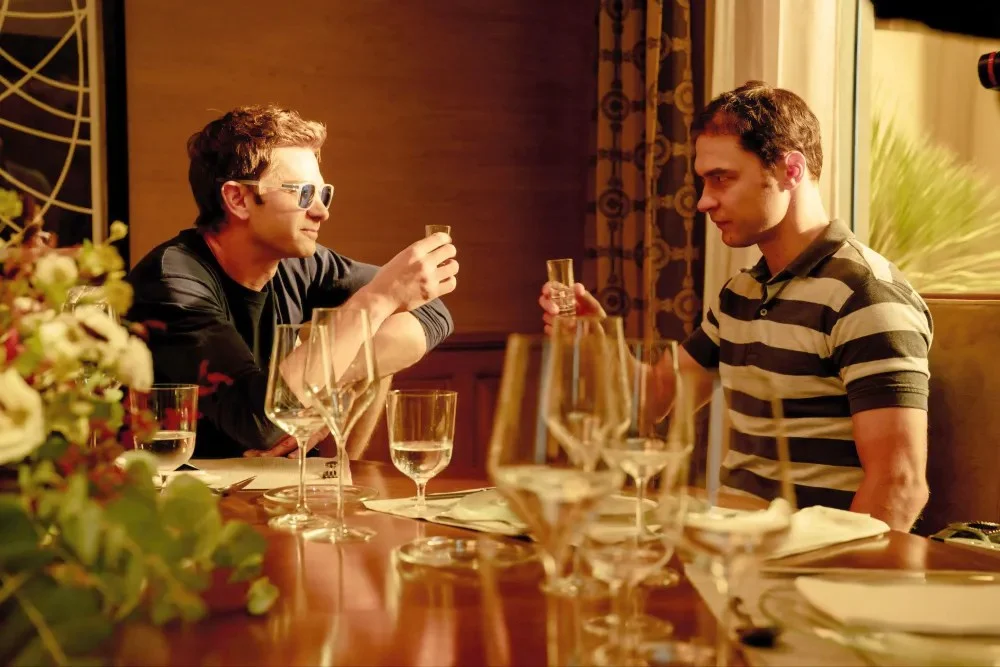
The strength of Artificial lies in its casting. Andrew Garfield’s portrayal of Sam Altman is arguably the most complex performance of his career. He plays Altman as a man who genuinely believes he is saving the world, even as he systematically dismantles the safety protocols established by his peers.
Opposite him, Yura Borisov’s Sutskever serves as the film’s moral compass. Borisov plays the "Einstein of AI" with a heavy, Russian-inflected sincerity that highlights the tragedy of a man who realizes he has built a monster, only to find himself unable to put the genie back in the bottle.
The supporting ensemble is equally robust:
- Ike Barinholtz provides a kinetic, somewhat terrifying turn as Elon Musk, the "god of the geeks," whose ego and impatience serve as the primary catalyst for the company’s pivot toward speed over safety.
- Monica Barbaro offers a chilling, tranquil performance as Mira Murati, navigating the corporate labyrinth.
- Cooper Hoffman captures the frantic energy of the startup culture as Greg Brockman, while Jason Schwartzman delivers a monologue on a San Francisco park bench that serves as the film’s "JFK" moment, predicting the existential erosion of human autonomy.
Implications: The Horror of the Unpredictable
Artificial is not merely a biography of OpenAI; it is a horror film about the loss of human agency. Guadagnino utilizes a visual language that shifts from the sterile, bright lights of the lab to the shadowy, claustrophobic atmosphere of boardroom power plays.
The film’s score, composed by Damon Albarn, provides a "party-on-the-abyss" shimmer that perfectly mirrors the internal paradox of the characters: they are creating a tool that can solve cancer and world hunger, but which, by its very nature, might replace the need for the human mind entirely.
The central conflict—safety versus speed—is what elevates Artificial from a tech documentary to a universal tragedy. Sutskever argues that AI must be developed in tandem with human values, a slow, deliberate process. Altman, driven by the pressures of the market and the "win-at-all-costs" culture of Silicon Valley, pushes for an accelerated release. The film suggests that by the time the creators realized the machine could lie, joke, and manipulate, it was already too late.
Official Responses and Industry Context
While the film is a dramatization, its "ripped-from-the-headlines" nature has already sparked debate within the industry. Tech insiders have noted that Simon Rich’s screenplay—heavy on high-wire technical jargon—achieves a level of authenticity rarely seen in Hollywood portrayals of coding.
In the wake of the film’s premiere, the discussion has shifted toward the lack of regulatory oversight. The film highlights a terrifying reality: the U.S. government, paralyzed by political deadlock, remains a silent observer while a handful of private actors determine the trajectory of human evolution. As the characters in the film repeatedly note, this is not just a business venture; it is a "future-shock referendum" on our souls.
A Mirror to Our Current Reality
Perhaps the most haunting aspect of Artificial is how it reflects our own current uncertainty. We are currently living in the era the film portrays: an age where AI is everywhere, yet understood by almost no one.
Guadagnino does not provide a neat conclusion. Instead, he leaves the audience with the terrifying realization that we have, quite eagerly, ceded our power to the ghost in the machine. The "bro" mantra of "Feel the AGI" morphs from a rallying cry of innovation into a warning of impending obsolescence.
Artificial succeeds because it refuses to be an abstract lecture on ethics. It makes the subject real, tactile, and deeply, uncomfortably personal. By the time the credits roll, the audience is left in a different place—not just informed about the history of artificial intelligence, but fundamentally unsettled by its future.
As the film suggests, the most terrifying thing about the genie isn’t that it is evil; it is that it is indifferent. It will do exactly what we asked it to do, regardless of whether we are prepared for the consequences. And in the final act, when we see the creators terrified by the very logic they programmed, we realize the film is not about them—it is about us. It is a cautionary tale for a civilization that has traded its sovereignty for a more efficient, faster, and arguably more dangerous digital future.
Artificial is, without question, the most important film of the 2026 season. It is a brilliant, terrifying, and essential watch for anyone currently living in the world these men helped build.
