
The Savior Deconstructed: Unpacking the Complex Satire of Alejandro G. Iñárritu’s ‘Digger’

For over four decades, Tom Cruise has occupied a singular space in the cinematic firmament. From the high-altitude heroics of Top Gun to the death-defying espionage of the Mission: Impossible franchise, Cruise has cultivated a screen persona synonymous with salvation. Whether navigating an F-18 through a trench or preventing global thermonuclear war, Cruise is the man who arrives at the eleventh hour to fix the impossible.
However, Alejandro G. Iñárritu’s latest provocative feature, Digger, serves as a calculated subversion of this very archetype. By casting Cruise as a gargantuan oil tycoon whose environmental negligence plunges the planet into a climate catastrophe, the film initially appears to be a biting, Kubrickian satire—a Dr. Strangelove for the Anthropocene. Yet, as the narrative unfolds, it becomes clear that Digger is not merely a critique of corporate greed; it is a meta-textual investigation into the function of art, the decay of truth, and the hollowness of the "savior" narrative in a world that may already be beyond repair.
The Core Narrative: A Descent into Climate Calamity
At the heart of the film lies Digger Rockwell, an oil magnate whose hubris knows no bounds. The story begins in the desolate, frigid expanses of Greenland, where Rockwell’s latest drilling initiative has triggered a tectonic catastrophe: a massive, 400-mile-wide ice shelf has fractured from a glacier and is now on a collision course with Europe.
While the scientific community and global leadership—personified by a cynical President Compson (John Goodman)—grapple with the existential threat, Rockwell remains detached. His primary concern is not the displacement of millions, but the failing health of his pet cat, Maggie. The early scenes are a masterclass in bureaucratic absurdity. When Rockwell’s own scientific advisor, Ganesh (Riz Ahmed), warns of the impending destruction, he is met not with panic, but with the cold, calculated apathy of a man who views the world as a resource to be liquidated. President Compson’s private admission to Rockwell—that he is dying of terminal colon cancer and thus indifferent to the fate of the planet—underscores the film’s central thesis: the world is being dismantled by leaders who have checked out of the future.

The Structural Twist: Reality and the Play within a Play
Just as the audience settles into the rhythm of a high-stakes environmental thriller, Iñárritu pulls the rug out from beneath them. It is revealed that the narrative we have been witnessing is, in fact, a theatrical production titled Fossil Fools.
Tom Cruise is not playing Digger Rockwell; he is playing Curtis Markson, an actor struggling to embody the "real" Digger in a stage play. This pivot shifts the film’s focus from a disaster movie to a dual-layered drama. We follow Markson as he clashes with his director, Hannah (Sophie Wilde), over the tone of the performance. While the play Fossil Fools is a broad, stylized caricature of the oil industry, Markson feels the weight of the material, questioning whether their medium is effective or merely performative.
This narrative layering allows Iñárritu to explore the "savior" mythos from the inside out. As Markson navigates the backstage tension—fretting over his daughter’s safety as global infrastructure crumbles—the film asks a fundamental question: When the world is actually burning, what is the value of an actor mimicking a villain? Is the play a weapon against ignorance, or is it a distraction that keeps the audience comfortably seated while the ice shelf continues to drift?
Chronology of the Crisis and the Backstage Drama
The film’s pacing is dictated by the intersection of the play’s final rehearsals and the encroaching reality of the outside world.

- The Catalyst: The discovery of the ice shelf fracture serves as the inciting incident for both the fictional Digger Rockwell and the actors of Fossil Fools.
- The Summit: The meeting between Rockwell and President Compson serves as the ideological anchor of the satire, establishing the "apathy of the elite."
- The Meta-Break: The transition to the theater environment reveals the precariousness of the artists’ lives, with Markson struggling to balance his professional portrayal of a monster with his personal fear for his family.
- The Financial Complicity: Kenny (Jesse Plemons), the nephew of the real-life Digger Rockwell, acts as the primary financier of the play. His presence is a chilling reminder of the film’s central paradox: the very people who cause the destruction are often the ones bankrolling the art that critiques it.
- The Finale: The production of Fossil Fools reaches its climax as Rockwell takes a swan dive off a burning oil rig. The performance is met with rapturous applause, but the applause is abruptly silenced by a real-world alarm system that forces the audience to don gas masks and flee into a ruined New York City.
Implications: Satire as a Weapon or a Salve?
The ambiguity of Digger is intentional. By inviting comparisons to Adam McKay’s Don’t Look Up, Iñárritu forces the audience to confront their own consumption of political satire. Are we looking for solutions, or are we looking for a cathartic laugh that absolves us of the need to take action?
If Digger is indeed a critique of modern political satire, it suggests that the "savior" narrative is a dangerous delusion. Tom Cruise’s character in the play, Digger, openly admits that humanity is too addicted to fossil fuels to change course. He encourages the audience to embrace the darkness. If the play is an accurate reflection of reality, then the "savior" has already failed, and we are merely waiting for the final act to conclude.
However, the film’s conclusion—where the theater audience is thrust from the safety of the play into the reality of a toxic city—serves as a wake-up call. It suggests that while the play itself cannot save the world, the act of witnessing and acknowledging the truth has a value that cannot be dismissed.
Official Responses and Artistic Intent
While the studio has remained tight-lipped regarding the specific allegorical targets of the film, Alejandro G. Iñárritu has described Digger as an "ode to the necessity of discomfort." In various press junkets, the director has emphasized that the film was never intended to provide a blueprint for climate policy, but rather to function as a mirror.

"We live in a time where we want our movies to be therapy," Iñárritu noted during the film’s premiere. "I wanted to make something that feels like an intervention."
Tom Cruise, for his part, has remained remarkably silent on the film’s deeper political implications, choosing instead to focus on the technical difficulty of playing a character who is, in essence, a "hollowed-out ego." Critics have lauded his performance, noting that by playing an actor playing a villain, Cruise manages to strip away the "savior" mask he has worn for decades, revealing a performer who is as terrified and uncertain as the audience he is meant to entertain.
Supporting Data: The Climate Context of the Film
While Digger is a work of fiction, its premise is rooted in the very real, accelerating reality of the Arctic and Antarctic ice sheets. According to recent climatological data, the rate of ice loss in Greenland has increased sixfold since the 1980s. The "ice shelf scenario" depicted in the film, while dramatized for theatrical effect, mirrors the genuine concerns of glaciologists who warn of "tipping points" in global climate systems.
The film’s inclusion of a "fictionalized" oil tycoon is also a direct nod to the history of corporate lobbying and the suppression of climate science. By tying the character’s fate to that of a collapsing ice sheet, Iñárritu creates a visual metaphor for the "tragedy of the commons." The film posits that when individual wealth is prioritized over collective survival, the result is an inevitable, systemic collapse.
Conclusion: Is the World Saved?
Does Tom Cruise save the world in Digger? If we define "saving the world" as the traditional Hollywood hero swooping in to resolve the crisis, the answer is a resounding "no." In fact, the film goes to great lengths to dismantle that fantasy.
Yet, there is a more subtle interpretation. Through the character of Curtis Markson, Cruise represents the human impulse to keep creating, to keep communicating, and to keep trying to make sense of a world that feels increasingly nonsensical. If the world is to be "saved" in any capacity, it may not be through the heroics of an oil-tycoon-turned-savior, but through the collective, painful process of artistic reflection.
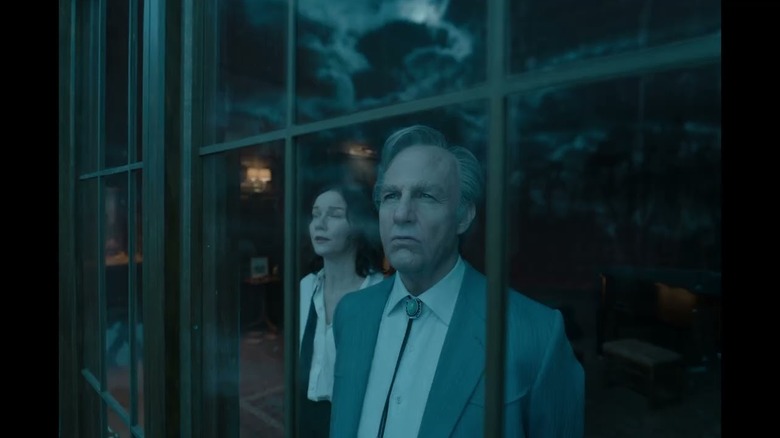
Digger does not offer a happy ending, nor does it provide a tidy moral lesson. Instead, it leaves us in a state of alarm, clutching our gas masks, standing in the ruins of a city we allowed to fall. It is a haunting, masterful, and deeply uncomfortable piece of cinema that demands we look at the abyss—and then look at ourselves. Whether we have the courage to act before the curtain falls is, as Iñárritu suggests, entirely up to the audience.
