
A Love Across the Divide: “Father Father” Captures the Resilience of Family Amidst Conflict
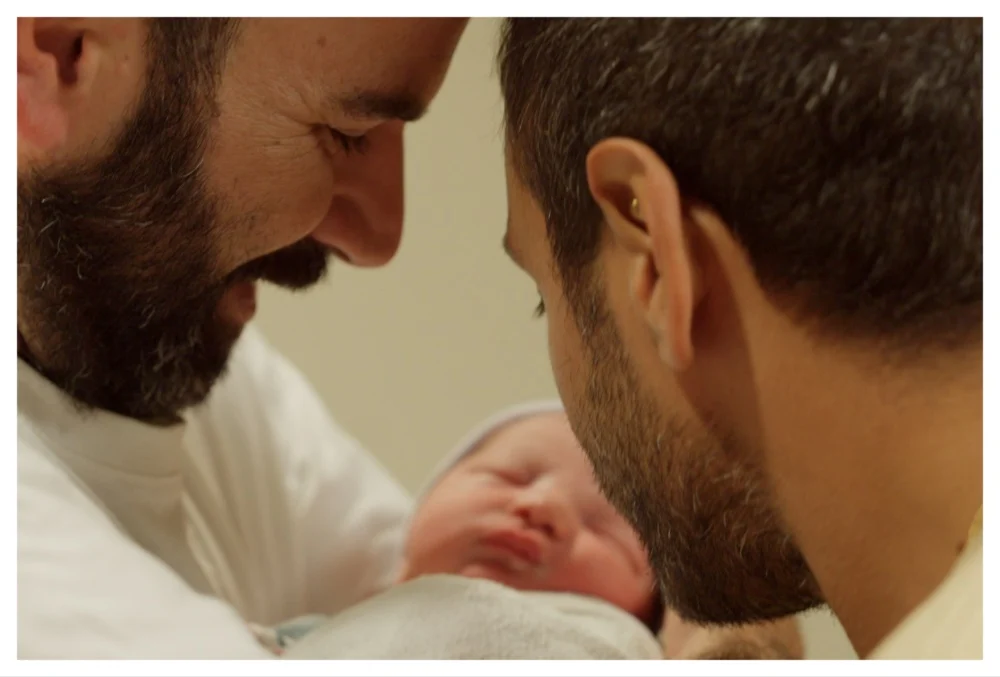
In an era defined by polarized narratives and the hardening of geopolitical borders, the new documentary Father Father arrives not as a political manifesto, but as a deeply intimate, fragile, and ultimately defiant love story. Premiering at the Festival do Rio, the film serves as a chronicle of two lives—Aviv, a Jewish Israeli, and Khader, a Palestinian-Israeli—navigating the complexities of parenthood, identity, and the existential threat of war. Directed by British filmmaker Jake Witzenfeld, the documentary captures the couple’s journey to welcome their son, Albi, into the world, a process that takes them from the streets of Tel Aviv to a surrogacy clinic in Texas, only to be met by the seismic shift of October 7, 2023.
The Genesis of a Modern Odyssey
The seeds of Father Father were sown in 2021, when Khader—whom Witzenfeld had known since his 2015 acclaimed documentary Oriented—reached out to the director with a life-altering announcement. Khader and his partner, Aviv, were beginning the arduous journey toward starting a family.
For Witzenfeld, the project was initially an exploration of what it meant to build a future as a mixed gay couple in a country undergoing profound internal shifts. At the time, Israel was in a state of political flux; Benjamin Netanyahu’s long-standing grip on power was briefly interrupted, only for him to return with a coalition government that pivoted sharply to the right.
"My instinct was that it felt like an interesting time to look at the future of a Muslim and Jewish mixed gay couple in Tel Aviv," Witzenfeld reflects. "Initially, it didn’t have a clear direction. It was an exploratory piece about their ability to do this inside the country. Then, once the government skewed extremely to the right, the film took on this macro context of whether they could hang in there and fight."
Chronology: From Tel Aviv to Texas and the Shadow of War
The production of Father Father tracks a timeline that is as much about the physical geography of the couple as it is about their psychological endurance.
- 2021: The decision is made to pursue surrogacy. The couple faces bureaucratic hurdles in Israel, including a surreal moment at a surrogacy agency where they are told they must share the same religion to qualify for certain domestic procedures. This prompts the move to Texas.
- 2022–2023: As the couple documents the surrogacy process, the political landscape in Israel deteriorates. Protests against judicial reform become a backdrop for their daily lives, forcing them to confront the fragility of their safety as a gay couple in a shifting political climate.
- October 6, 2023: Albi is born in Texas. The joy of the birth is immediate and overwhelming.
- October 7, 2023: The world changes. As news of the Hamas-led attacks on Israel filters through, the couple’s plans to return home are shattered. They remain in Texas for a month, extending their stay in a state of shock and grief.
- 2023–2024: The film continues to track the family through the first year of the war, concluding around Albi’s first birthday—a year that has seen the region engulfed in a cycle of violence that has claimed thousands of lives and fundamentally altered the social fabric of the Middle East.
The Bureaucracy of Identity
One of the most revealing segments of the film involves the couple’s attempt to navigate Israeli surrogacy policy. The requirement that both parents belong to the same faith serves as a microcosm of the state’s internal contradictions.
Witzenfeld describes the encounter at the agency as "absurd." The couple is treated with professional, everyday courtesy, yet confronted with a policy that acts as a gatekeeper to their fundamental right to family. This moment underscores the tension between Israel’s self-conception as a liberal democracy and its rigid adherence to sectarian definitions of the state. For the couple, this barrier was not just an administrative hurdle; it was a reminder that even in their private, loving world, the state’s definitions of "belonging" could intervene at any moment.
Supporting Data: The Impact of Conflict on Personal Narratives
While the film remains a character study, it exists within a harrowing data set. The war that began on October 7 has led to the death of over 1,200 people in Israel and tens of thousands of Palestinians in Gaza. These numbers are not just statistics in Father Father; they represent the lived realities of the subjects’ families.
The documentary highlights the harrowing reality of the couple’s extended family members. In one particularly poignant scene, Khader’s mother, wearing a hijab, shares a moment with Aviv’s brother. The brother is home on reserve duty, an AK-47 resting on his lap as they discuss mundane topics like cooking. This image of "the personal as political" is the film’s central thesis: the ability for these two families to coexist in the same space, despite the fact that they return to their separate homes to watch vastly different news broadcasts and process the conflict through opposing lenses.
Implications: Can Love Survive the "Dark Moment"?
The strain the war puts on Khader and Aviv is palpable. The film captures moments where their differences—in heritage, in perspective, and in grief—become almost irreconcilable. However, instead of forcing a resolution or a neat ending, the film allows these contradictions to exist.
"There’s no question that we are in a challenging cultural moment for films that want to try to say that there can be an opening [between Israelis and Palestinians]," Witzenfeld notes. "I think they’re incredible as a couple. I don’t know if I’d have the emotional intelligence to survive a relationship in those contexts."
The implication of Father Father is that resilience in the modern age may not come from solving the "Middle East problem," but from the radical act of maintaining a personal connection in spite of it. By refusing to let their differences break their union, Aviv and Khader offer a blueprint for a kind of humanity that is increasingly under threat.
Conclusion: A Testament to Hope
As the film concludes, it offers no easy answers. The war continues, the region remains volatile, and the future for a mixed couple in the Levant remains fraught with uncertainty. Yet, the film acts as a powerful witness to the endurance of the human spirit.
Witzenfeld summarizes his hope for the audience: "This film definitely wants to keep alive the dream of a possibility of love across difference, and the hope that it can exist even in this very dark moment."
In the final, raw scenes, Khader speaks directly to Albi, articulating the complex, painful, and beautiful world the boy has been born into. It is a message that extends beyond the family unit and speaks to a global audience struggling to find common ground in a fractured world. Father Father is, ultimately, a reminder that while politics may draw lines on a map, it is the quiet, daily persistence of love that continues to define the human experience.
