
Amazon MGM Studios Adapts Garth Ennis and Mike Perkins’ Supernatural Noir Comic Freddie the Fix for the Big Screen
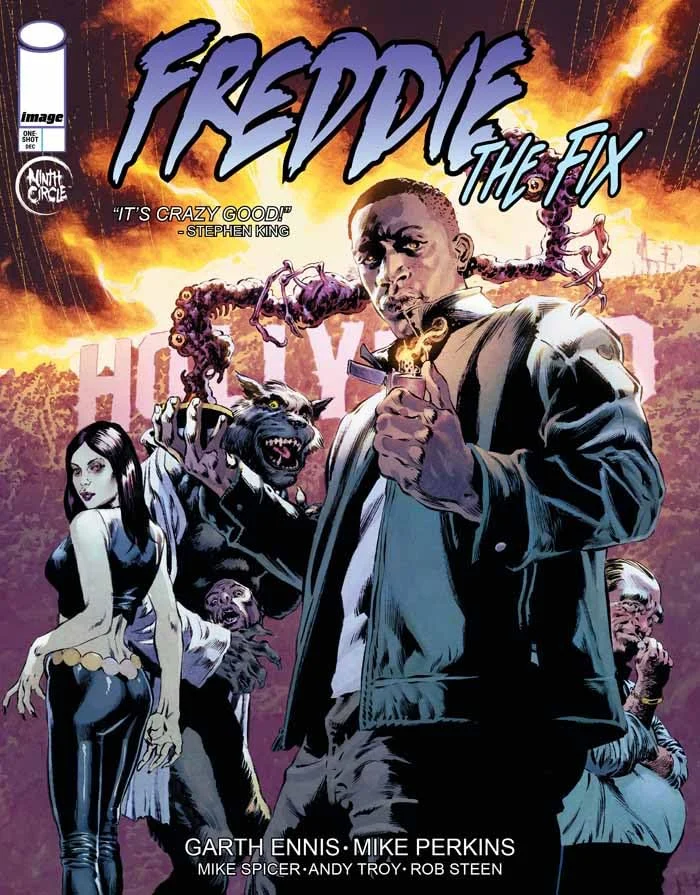
LOS ANGELES — Hollywood’s supernatural underbelly is officially getting its close-up. Amazon MGM Studios is developing a feature film adaptation of Freddie the Fix, the gritty, monster-infused Hollywood-noir comic book created by The Boys mastermind Garth Ennis and acclaimed artist Mike Perkins.
The project brings together a powerhouse creative team, pairing the subversive storytelling instincts that made Ennis a household name in modern comicdom with the cinematic momentum of director Lawrence Lamont. As Hollywood continues its relentless pursuit of fresh, creator-owned intellectual property with built-in subversive appeal, Freddie the Fix positions itself as a distinct entry in the pantheon of dark, genre-bending adaptations.
Main Facts: The Premise and Creative Team
At its core, Freddie the Fix trades the spandex-and-capes superhero satire of The Boys for a blood-soaked, neon-lit neo-noir vision of Los Angeles. The story centers on the titular Freddie, a high-end Hollywood fixer whose clientele list bypasses marquee-name actors, studio executives, and power agents. Instead, Freddie’s roster features vampires, werewolves, extraterrestrial visitors, and a menagerie of other supernatural entities navigating the treacherous waters of the entertainment industry.
When these creatures of the night—or the cosmos—find themselves knee-deep in incriminating evidence, public relations nightmares, or existential crime scenes after dark, Freddie is the man they call. Armed with an uncanny, near-magical aptitude for wiping away the unholy messes of Los Angeles’ secret elite, Freddie navigates the city’s seediest corridors.
The feature film adaptation will be directed by Lawrence Lamont, fresh off helming the Sony comedy One of Them Days. The screenplay is penned by the writing duo Kalen Egan and Travis Sentell, widely recognized for their atmospheric work on Philip K. Dick’s Electric Dreams.
Production duties are being spearheaded by Kimberly Steward and Alex Foster under their K Period Media banner. Notably, K Period Media served as lead investors on the original comic book release alongside Kenya Barris and his Khalabo Ink Society production label. Garth Ennis will remain closely tied to the cinematic translation, serving as an executive producer alongside Jeremy Allen, Adam Glass, Michael Bogner, David Stone, and director Lawrence Lamont.
Chronology: From Page to Screen
The journey of Freddie the Fix from a nascent concept to a major studio feature has moved at a blistering pace, highlighting the modern Hollywood appetite for turnkey, high-concept comic adaptations.
- December 2024: Freddie the Fix officially debuts on comic shop shelves as an oversized, complete-in-one-volume graphic novel. Published by Image Comics, the book serves as the inaugural launch title for Ninth Circle, a newly minted creator-owned horror imprint.
- Early 2025 (Implicit Development): Following strong critical reception and robust sales—buoyed by the unique trans-media partnership between K Period Media as comic investors and eventual film producers—conversations regarding a screen adaptation rapidly crystallize.
- September 2026: Industry trades break the news that Amazon MGM Studios has officially secured the rights to develop Freddie the Fix into a major feature film, locking in Lawrence Lamont to direct and outlining the core creative and production team.
- Present Day: The project sits firmly in active development. With a director, writers, and producers attached, the industry turns its attention toward casting announcements and eventual production timelines.
Supporting Data: The Birth of Ninth Circle and Industry Backing
To understand the weight of the Freddie the Fix film deal, one must examine the publishing ecosystem from which it emerged. Launched in late 2024, Ninth Circle was envisioned as a sanctuary for uncompromising, creator-owned horror and genre narratives. The imprint was co-founded by Garth Ennis alongside a murderer’s row of comic industry luminaries, including Ram V, Marguerite Bennett, Joe Pruett, and Adam Glass.
Rather than traditional serialized monthly issues, Ninth Circle carved out a niche by releasing oversized, self-contained graphic novels ("one-shots") designed to deliver complete, cinematic narrative arcs in a single volume. Freddie the Fix was chosen as the inaugural flagship title, designed to establish the aesthetic and tonal template for the imprint: gritty, mature, deeply atmospheric, and effortlessly translatable to other mediums.
The artistic pedigree of the book cannot be overstated. Mike Perkins, a veteran illustrator whose masterworks include Swamp Thing and Batman: First Knight, brought a distinct, shadowy, noir-drenched visual language to Los Angeles. Perkins’ art strips away the glamorous veneer of Hollywood, replacing palm trees and Hollywood Hills mansions with rain-slicked asphalt, subterranean hideouts, and monstrous silhouettes.
Furthermore, the financial and structural backing of the property offers a blueprint for modern IP incubation. K Period Media didn’t just option a finished comic; they partnered as lead investors on the original print release. By securing production rights alongside Kenya Barris’ Khalabo Ink Society from the ground floor, the stakeholders engineered an integrated pipeline designed to fast-track comic properties directly into Hollywood studio systems. For Ninth Circle, having their very first published title make the leap to Amazon MGM Studios within a remarkably tight window signals an extraordinary early victory for the boutique publisher.
Official Responses and Industry Context
While formal press statements from Amazon MGM Studios executives have remained measured as the project transitions into active development, the creative team has left little doubt about their enthusiasm for the material.
The involvement of Garth Ennis as an executive producer ensures that the adaptation will retain the acerbic wit, moral ambiguity, and unapologetically violent edge that has defined his career. Ennis, best known for redefining modern anti-heroes through The Boys, Preacher, and The Punisher, has continually proven his ability to subvert traditional genre tropes. In Freddie the Fix, he takes the classic hardboiled detective archetype—think Raymond Chandler or Dashiell Hammett—and drops him squarely into a world populated by blood-sucking aristocrats and misunderstood cosmic horrors.
Director Lawrence Lamont steps into the director’s chair with a fascinating dual trajectory. Having helmed comedies like One of Them Days, Lamont brings a sense of pacing, character-driven humor, and kinetic energy that will prove vital in balancing the absurd premise of a monster-cleaner with the hardboiled gravity of traditional film noir.
Meanwhile, producers Kimberly Steward and Alex Foster continue to lean into bold, auteur-driven storytelling through K Period Media. Their early faith in the comic medium—betting on the property before a single frame of film was shot—validates a growing trend in Hollywood: film production companies moving upstream to co-create source material rather than waiting for comic books to prove themselves over years of publication.
Implications: What Freddie the Fix Means for Hollywood and Comic Publishing
The acquisition and development of Freddie the Fix carry several significant implications for both the entertainment industry and the independent comic book publishing landscape.
1. The Acceleration of Creator-Owned Incubators
In the wake of mega-franchises dominating the box office, studios are continually searching for unexploited intellectual property that possesses distinct voice and built-in visual styling. The rapid adaptation of Freddie the Fix proves that boutique imprints like Ninth Circle can function effectively as pre-vetted Hollywood incubator labs. By pairing high-profile creators (Ennis and Perkins) with elite financial backers (K Period Media and Khalabo Ink Society), creators can bypass years of traditional comic development hell and pitch directly to major studios with a fully realized visual bible in hand.
2. A Fresh Spin on Supernatural Noir
The "supernatural detective" or "fixer" trope is certainly not new—properties ranging from Constantine to Men in Black have explored the intersection of the mundane and the monstrous. However, Freddie the Fix focuses heavily on the logistics of the fantastic. By framing vampires and aliens not as epic world-ending threats, but as high-maintenance clients with messy personal lives and legal liabilities, the narrative injects a darkly comedic, blue-collar absurdity into traditional noir tropes. If Amazon MGM Studios leans into this tone, the film could carve out a unique space distinct from standard superhero blockbusters.
3. The Big Question: Casting Freddie
As the project moves deeper into pre-production, the speculative machinery of Hollywood has already begun turning. The most immediate question facing Amazon MGM Studios, director Lawrence Lamont, and the casting directors is simple: Who will play Freddie?
The role demands a very specific kind of cinematic presence—an actor capable of projecting world-weary cynicism, effortless cool, and the deadpan pragmatism required to tell a werewolf to clean up his own mess after a particularly brutal full-moon bender.
As casting announcements and production schedules loom, Freddie the Fix stands as a testament to the shifting tides of media development. What started as an experiment in creator-owned horror publishing by Garth Ennis and his peers is rapidly evolving into Amazon’s next major genre hopeful. If the film successfully captures the neon-drenched, monster-infested cynicism of the comic page, Hollywood might just find that its favorite new fixer operates in the shadows of the supernatural.
