Most Excellent Afterlife: Re-evaluating Bill & Ted’s Bogus Journey 35 Years Later
There are sensible, formulaic ways to follow up a surprise comedy hit. Then there is Bill & Ted’s BogusJourney.
When 1989’s Bill & Ted’s Excellent Adventure sent two endearingly dim-witted, air-guitar-strumming Californian teenagers hurtling through history in a police phone booth—scooping up historical luminaries from Napoleon to Socrates along the way—a conventional studio sequel easily could have served up more of the same temporal tourism.
Instead, creators Chris Matheson and Ed Solomon chose a path of sublime cinematic anarchy. They killed Bill and Ted in the first act. They sent them straight to Hell. They forced the cosmic duo to challenge the Grim Reaper to high-stakes rounds of Battleship, Clue, electric football, and, naturally, Twister.
Now, 35 years after its theatrical debut, this defiantly bizarre sequel is receiving a comprehensive, high-definition critical reassessment and a definitive physical media restoration courtesy of Arrow Video’s Limited Edition 4K UHD release.
Main Facts: Defying the Sequel Rulebook
Released on July 19, 1991, Bill & Ted’s Bogus Journey was directed by feature film newcomer Pete Hewitt from a screenplay by Matheson and Solomon. Arriving just two years after its predecessor, the film disrupted expectations from its very premise.
Rather than focusing on high school history reports, the narrative catches up with Bill S. Preston, Esq. (Alex Winter) and Ted “Theodore” Logan (Keanu Reeves) as young adults. Though still hopeless musicians, they are now engaged to the medieval princesses rescued in the first film and are preparing for a local Battle of the Bands that could finally steer their band, Wyld Stallyns, toward its universe-uniting destiny.
The future, however, has other plans. The villainous De Nomolos (Joss Ackland) dispatches evil robotic doppelgängers of Bill and Ted into the past to sabotage their reputations, usurp their lives, and prevent them from fulfilling their musical destiny as prophesied by their mentor, Rufus (George Carlin).
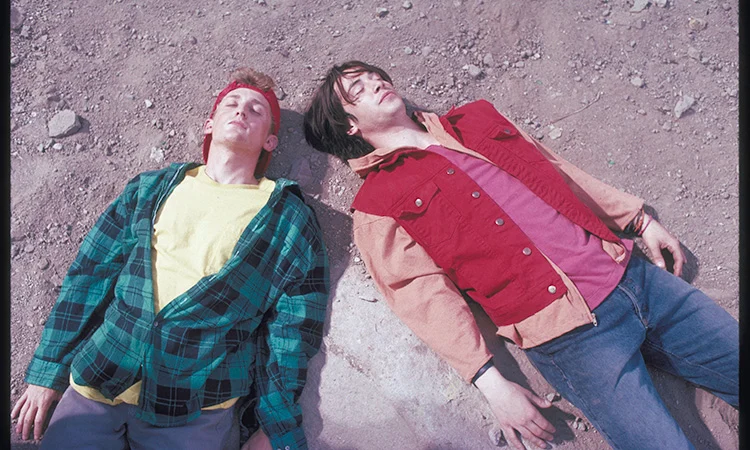
To stop them, the villainous robots murder the real Bill and Ted, hurtling them over a literal and figurative cliff into the afterlife. What follows is a surreal odyssey featuring personal nightmares, a trip to Heaven, Martian scientists named Station (“Station!”), good robot duplicates built to fight the evil ones, and, ultimately, the Grim Reaper playing bass on stage for Wyld Stallyns.
Chronology: From Concept to Cult Classic
The trajectory of Bogus Journey began almost immediately after the commercial success of Excellent Adventure. Discussions for a follow-up commenced while the first film was still playing in cinemas.
During early development, several working titles were bandied about, including Bill & Ted’s Weird Journey, The Second Coming of Bill & Ted, and, most famously, Bill & Ted Go to Hell.
The Production Grind
Despite the film’s playful tone on screen, making the movie was an uphill battle. Reflecting on the production, Alex Winter recalls that survival and completion often overshadowed thoughts of long-term cultural legacy:
"When we were making it, it was so hard… We loved it. We had a lot of fun, and we were very, very taken with our director Pete Hewitt. But it was hard, and there were a lot of cuts being made as we went, and a lot of budget issues. We just weren’t sure what was going to happen to this movie."
When asked if they ever imagined the film would remain a topic of conversation three-and-a-half decades later, William Sadler (who played the Grim Reaper) admits the thought never crossed his mind:
"If you’d asked me when we were making it, I don’t think I would have imagined 30 years down the road we’d be talking about it still."
Winter echoes this sentiment, noting the inherent unpredictability of the profession:
"I don’t think it’s false modesty to say that I don’t know of any actor who is making a film that thinks, ‘Oh boy, this one, this movie. We’ll be talking about this 10, 20, 30, 40 years down the road.’"
Supporting Data: Ambition vs. Budget Realities
Even within its wildly creative narrative framework, Bogus Journey was scaled back from an even more massive blueprint. Winter reveals that an enormous, ambitious sequence involving the duo confronting the literal manifestations of their personal nightmares was partially shot before financial realities intervened.
"On the second movie, it was this massive, ambitious thing where Keanu and I are told we have to make peace with all of our nightmare from Hell characters," Winter explains. "So there’s the car chase between us in the van, and we’re being chased by Granny in a turbo rocket-powered wheelchair, the Easter Bunny barreling down the road, and Colonel Oates flying an aeroplane… We shot some of that because I was the Granny, so we shot some of me in my turbo-powered wheelchair flying down the road. God knows where it is, but they couldn’t afford it."
Box Office Performance
At the box office, Bogus Journey performed moderately rather than spectacularly. Opening in the United States on July 19, 1991, it brought in $10.24 million over its opening weekend, securing the number two spot at the box office. It finished its domestic run with approximately $38 million against a reported $20 million production budget—slipping slightly behind Excellent Adventure, which grossed roughly $40.5 million domestically on a tighter $10 million budget.
However, box office figures failed to capture the franchise’s staying power. The films rapidly built an enduring multimedia footprint, expanding into a Saturday morning animated series (with Reeves, Winter, and Carlin reprising their voice roles), a short-lived live-action television series in 1992, comic books, video games, and enduring pop-cultural slang.
Official Responses and Casting Insights
A cornerstone of the film’s success is its central chemistry, forged during an exhaustive casting process.
"The audition process was so long for Bill & Ted that we became friends while we were auditioning," Winter says. "So by the time we got down to shoot the first one, we were already friends… We also tapped into this idea of Bill and Ted being played as not the age the characters were, which was also not the age we were. It was like 23-year-olds playing 18-year-olds who were acting like nine-year-olds."
William Sadler and the Birth of Death
This childlike naivety extended directly to William Sadler’s iconic portrayal of the Grim Reaper. Initially introduced as an imposing, shadowy figure straight out of Ingmar Bergman’s The Seventh Seal, Death’s intimidating aura evaporates the moment he loses a board game.
Landing the role required an unorthodox preparation. Sadler recalls the instructions of casting director Karen Rea:
"You have to come back. They like the accent. They want you to do it again, but they need you to look older. So you should go to a Halloween store and get grey and put it in your hair, and black out your teeth because you’re too young and cute."
Seeking professional help, Sadler visited Die Hard 2 makeup artist Scott Eddo, who transformed him into a septuagenarian in a Marina Del Rey kitchen. Combined with a deadpan, thick Czechoslovakian accent, the character clicked.
Sadler also took creative control over the film’s musical climax. Unimpressed with the scripted rap lyrics provided for Death’s final performance, he asked for a chance to write his own:
"They had written a Reaper rap, and it was unspeakable. I couldn’t make it make sense… I said, ‘Would you mind if I tried? Would you mind if I wrote something and just tried to write a poem that works?’ And they said, ‘Yeah, sure. If it doesn’t work, we’ll force you to do the one we wrote.’ And then I wrote that one."
Implications: A Legacy of Radical Wholesomeness
Critical reception upon Bogus Journey’s release in 1991 was notably mixed, with reviewers divided over its jarring tonal shifts. Yet, champions like Roger Ebert praised its visual invention and strange humor, while The New Yorker lauded its slapstick riff on The Seventh Seal.
Decades later, that exact weirdness is celebrated as its greatest asset. The franchise’s long-term cultural impact culminated in 2020 with the release of a long-awaited second sequel, Bill & Ted Face the Music, which reunited Reeves, Winter, and Sadler.
Ultimately, the enduring appeal of the Bill & Ted universe lies in its total absence of cynicism. Bill and Ted are profoundly clueless and chronically unsuccessful, yet their default reaction to the cosmic, the terrifying, and the bizarre is always boundless curiosity and radical enthusiasm rather than fear or malice.
As Arrow Video brings Bill & Ted’s Bogus Journey back into the cultural conversation with its Limited Edition 4K UHD release, it cements a rare cinematic truth: when filmmakers and actors commit entirely to an absurd, high-concept vision with absolute sincerity, even a movie about metalheads playing Battleship with the Grim Reaper can achieve artistic immortality.