
The Sound of Investigative Courage: Eli Keszler’s Score for Peacock’s "Kill. Bury. Print."
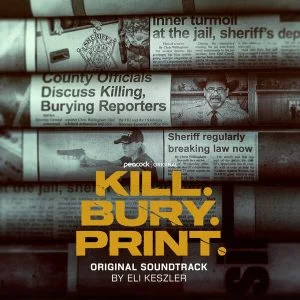
The intersection of investigative journalism and high-stakes documentary filmmaking has rarely been as tense—or as musically evocative—as in the recent Peacock original release, Kill. Bury. Print. Beyond the harrowing narrative of a small-town newspaper fighting for its life, the documentary gains much of its atmospheric weight from a haunting, rhythmic, and deeply unsettling original score composed by Eli Keszler. Lakeshore Records has officially released the soundtrack, allowing audiences to experience the sonic landscape of McCurtain County, Oklahoma, outside the confines of the film.
The Narrative Core: Journalism Under Siege
Directed by Ben Klein and produced by an elite team including Joshua Rofé, Steven J. Berger, and the journalistic powerhouse Rachel Maddow, Kill. Bury. Print. chronicles the precarious existence of the McCurtain Gazette. This family-run local publication found itself in the crosshairs of a dangerous power struggle after daring to expose alleged corruption, violence, and systematic abuse within the local sheriff’s office.
The documentary does not merely recount the facts; it immerses the viewer in the claustrophobic environment of a town where the line between law enforcement and criminality has been dangerously blurred. As the Gazette staff digs deeper into the sheriff’s activities, the tone of the documentary shifts from a procedural investigation to a high-stakes thriller. This transition is expertly navigated by Keszler’s score, which captures the paranoia, the physical threats, and the stubborn persistence of a newsroom refusing to be silenced.
Eli Keszler: A Sonic Architect of Unease
Eli Keszler, a composer known for his complex, percussion-heavy soundscapes and avant-garde sensibilities, brings a unique texture to this project. His previous work on films such as Pet Shop Days, Harka, and Alex’s War established his ability to craft scores that feel organic yet deeply disorienting. For Kill. Bury. Print., Keszler departs from the traditional, orchestral "true crime" tropes—often defined by generic minor-key piano motifs—to create something more visceral.
The "Gazette Theme," a standout track on the album, serves as the heart of the soundtrack. It acts as a sonic anchor for the film, oscillating between a sense of duty and the looming dread of the consequences of truth-telling. The percussion is sharp and unrelenting, mirroring the rhythmic clatter of a printing press, while the melodic undercurrents suggest the fragility of the democratic institutions the Gazette fights to protect.
Chronology of the Conflict: From Headlines to Retaliation
The documentary outlines a timeline that is as infuriating as it is gripping. The conflict began with whispers—allegations regarding the McCurtain County Sheriff’s Office involving illicit drugs, sexual misconduct, and violent outbursts.
- The Discovery: The Gazette receives credible tips regarding the internal culture of the sheriff’s office.
- The Investigation: Despite limited resources, the family-run paper initiates a formal inquiry, documenting witness testimonies and inconsistencies in public records.
- The Retaliation: As the Gazette prepares to go to print, the pressure mounts. The sheriff’s office begins a campaign of intimidation, escalating from public disparagement to direct threats against the journalists.
- The Climax: The documentary covers the fallout of the report, leading to a public outcry, legal battles, and the ultimate test of the community’s integrity on Election Day.
- The Aftermath: The film examines the lingering trauma of the reporters and the long-term impact on the county’s political landscape.
Keszler’s score tracks this progression with surgical precision. Tracks like "Threats," "Evidence Room," and "Take Off the Gloves" provide a rising tide of tension, while the final tracks, such as "Voted Out" and "Success Is Hell," offer a nuanced resolution that feels more like a hard-won exhaustion than a triumphant victory.
Supporting Data: The Soundtrack Anatomy
The full tracklist for the Kill. Bury. Print. album, released by Lakeshore Records, spans 34 tracks, reflecting the meticulous attention to detail paid to the film’s pacing. The sheer volume of music highlights how essential the score is to the documentary’s narrative flow.
Selected Track Analysis:
- "Never a Good Idea to Wound a Bear" (1:55): An opening salvo that sets the tone of danger and unpredictability.
- "The Stench" (1:58) & "Evidence Room" (3:07): These tracks utilize distorted, metallic sounds to evoke the feeling of digging through the "garbage" of a corrupt administration.
- "Election Day" (4:05): A sprawling, rhythmic piece that captures the anticipation and anxiety of the democratic process in a volatile environment.
- "Success Is Hell" (3:40): A poignant, melancholic reflection on the cost of winning a battle when the war leaves permanent scars.
The album is available now on all major digital music services, including Amazon. Listening to the collection in isolation provides a fascinating look at how modern documentary scoring utilizes ambient noise and structural repetition to simulate the "noise" of information warfare.
Official Responses and Public Reception
The release of Kill. Bury. Print. has sparked significant conversation regarding the importance of local journalism. In an era where newsrooms are shrinking across the United States, the story of the McCurtain Gazette serves as a sobering reminder of what happens when local watchdogs are neutered.
Producers Joshua Rofé and Steven J. Berger have noted in interviews that the goal of the documentary was to show that "the most dangerous place in America is often the one closest to home." By involving Rachel Maddow as an associate producer, the team ensured that the documentary reached a national audience, shining a spotlight on the specific, often overlooked, power dynamics of county-level government.
The sheriff’s office at the center of the controversy has largely faced intense public scrutiny, and the film has provided a platform for the voices of those who felt empowered to speak out only after the Gazette dared to break the silence.
Implications for Investigative Filmmaking
The collaboration between Keszler and the production team signals a shift in how true crime is presented. By moving away from the sensationalist, "true crime" aesthetic that often relies on shock value, Kill. Bury. Print. utilizes a sophisticated, artistic score to elevate the subject matter.
The implications for the industry are clear: audiences are increasingly seeking documentaries that treat the subject matter with gravitas. Keszler’s score proves that a soundtrack can act as a character in its own right, grounding the audience in the reality of the situation while providing the emotional vocabulary to process complex themes of intimidation and courage.
Conclusion
The soundtrack to Kill. Bury. Print. is more than a mere collection of background cues; it is an exploration of the psychological weight of investigative reporting. Eli Keszler has created a work that is simultaneously an homage to the grit of small-town journalism and a warning about the fragility of local accountability.
As the documentary continues to stream on Peacock, the score stands as a testament to the fact that when the printed word is threatened, it takes a unique kind of resilience to keep the presses rolling. For those interested in the craft of film scoring or the state of modern American journalism, the Kill. Bury. Print. soundtrack is an essential listen—a dissonant, beautiful, and urgent reminder that the truth is rarely easy, but always worth the price of admission.
