
Unearthing the Terrors of the Past: How the Queer Horror Short Burning of a Family Tree Redefines Generational Trauma
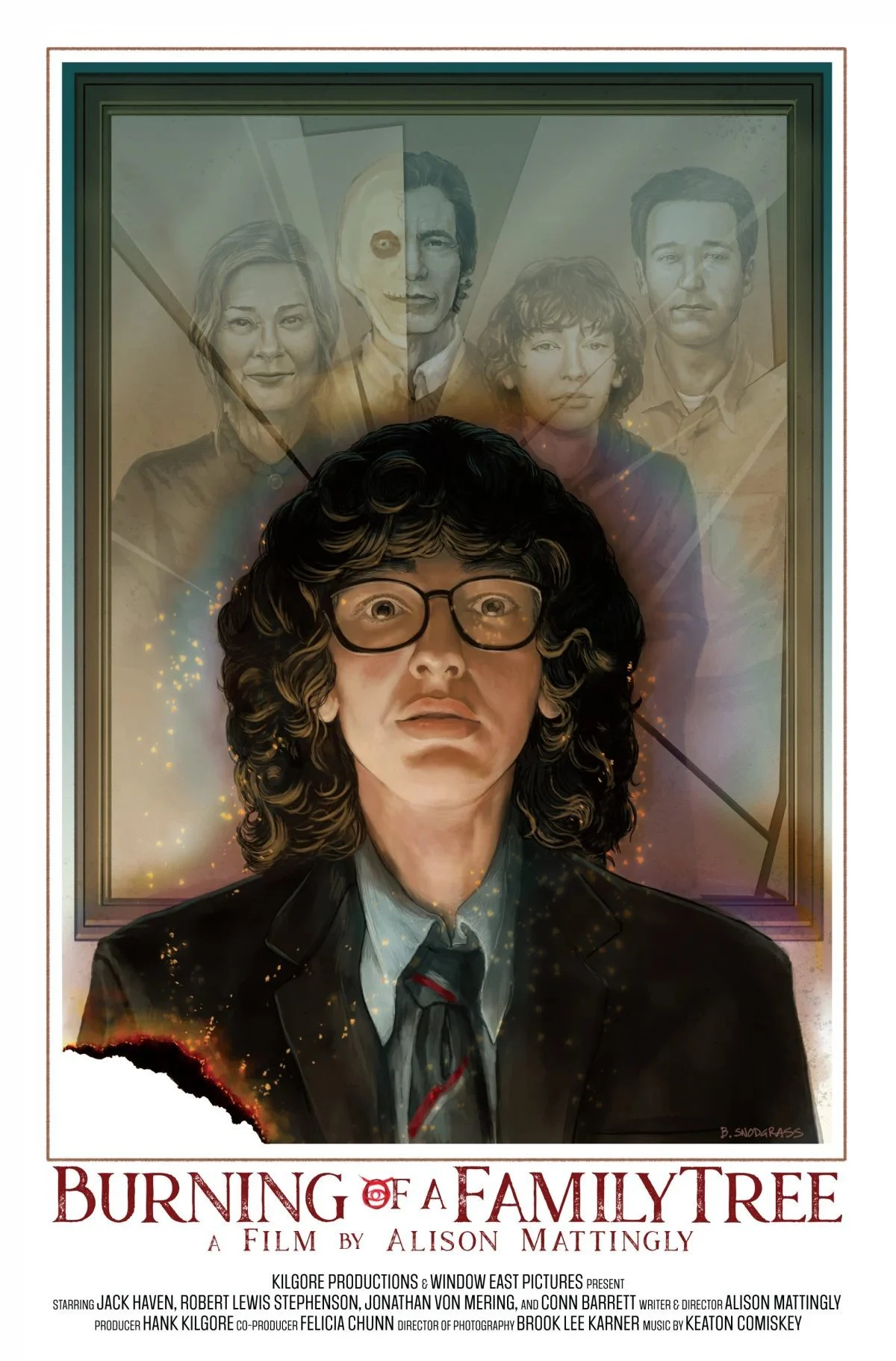
Every queer person knows the heavy calculus of survival: if there is a way out of a hostile environment, you take it. You pack your bags, distance yourself geographically and emotionally, and try to build a life free from the conditional affection and overt rejection of the people who raised you. But toxic family dynamics—particularly those rooted in dogmatic religious fanaticism and deep-seated bigotry—have a magnetic, monstrous way of trying to pull you back in.
What true horror is there beyond the inescapable gravity of your own origins?
This exact sensation of responsibility, yearning, lingering anger, paralyzing fear, and the desperate hope for catharsis is masterfully distilled into just 10 glorious, terrifying minutes in the new queer horror short film Burning of a Family Tree. Written and directed by filmmaker Alison Mattingly, the short weaves a tightly paced, deeply unsettling tale that introduces an eerie new horror villain to the genre, hints at a richer, more expansive lore, and leaves audiences universally lamenting that they couldn’t watch eighty more minutes of it. For fans of elevated, socially resonant horror, Burning of a Family Tree is an essential watch currently making waves on the festival circuit.
Main Facts: Inside the Nightmare of Burning of a Family Tree
At its core, Burning of a Family Tree is a visceral exploration of estranged family ties, religious abuse, and the literal and metaphorical ghosts of the past. The narrative follows a non-binary protagonist named Eden Becker, brought to life by the brilliant rising star Jack Haven (I Saw the TV Glow, Teenage Sex and Death at Camp Miasma).

Following the death of their abusive, ultra-religious father, Gerald, Eden makes the difficult decision to return home. However, upon arrival, they discover that their family’s already stifling religious fanaticism has metastasized into something far darker—a full-blown cult-like nightmare. This homecoming forces Eden to confront not only the deep-seated psychological trauma of their past but a far more immediate physical terror: their father’s reanimated corpse.
Despite a runtime of merely ten minutes, the short achieves what many feature-length films fail to accomplish. It establishes fully dimensional characters with intricate inner lives, complex relationship dynamics, and high-stakes emotional arcs. Furthermore, it delivers on the scares; viewers have reported jumping out of their seats multiple times as the tension ratchets up to a fever pitch.
The production boasts a stellar supporting cast alongside Haven, featuring Robert Lewis Stephenson (Landman, Criminal Minds), Jonathan von Mering (The Pitt, The Holdovers), and Conn Barrett (It’s Florida, Man, The Legend of Resurrection Mary). Produced by Kilgore Productions, the short utilizes its tight runtime for maximum atmospheric dread, practical effects, and psychological impact.
Chronology: From Concept to the Festival Circuit
The journey of Burning of a Family Tree from script to screen represents a major milestone for its creative team, culminating in a competitive festival run through late 2026.
- Pre-Production and Development: Alison Mattingly conceptualized the project as a way to process personal and collective queer trauma. Setting out to blend traditional gothic horror tropes with modern queer narratives, Mattingly secured a talented ensemble cast led by Jack Haven.
- World Premiere (August 2026): The short film made its official world premiere at the prestigious Popcorn Frights Film Festival 2026, where it immediately caught the attention of horror critics and genre enthusiasts for its punchy runtime, sharp creature design, and emotional resonance.
- Upcoming Los Angeles Premiere (October 2026): Building on its momentum out of Florida, Burning of a Family Tree is slated for its Los Angeles premiere this October at the renowned ScreamFest Horror Film Festival, a major milestone for independent horror shorts looking to break into the broader industry conversation. Additional regional festival screenings continue to roll out, cementing its status as a must-see indie darling of the 2026 horror calendar.
Supporting Data and Production Details
While independent short films often struggle to capture mainstream attention due to distribution limitations, Burning of a Family Tree has defied expectations through strong word-of-mouth, high-caliber performances, and technical proficiency.
- Runtime: 10 minutes.
- Key Cast Members:
- Jack Haven as Eden Becker
- Robert Lewis Stephenson
- Jonathan von Mering
- Conn Barrett
- Key Crew: Written and directed by Alison Mattingly; produced by Kilgore Productions.
- Premiere Venues: Popcorn Frights Film Festival 2026 (World Premiere); ScreamFest Horror Film Festival (LA Premiere, October 2026).
- Official Social Media: Fans and prospective viewers can track upcoming screening dates and festival announcements via the film’s official Instagram account: @BurningOfAFamilyTree.
(Editorial Note: Alison Mattingly is employed by Legendary Digital Networks, of which Nerdist is a subsidiary.)
Official Responses and Creator Statements
For writer and director Alison Mattingly, the film is much more than a standard creature feature—it is a deeply personal exercise in emotional exorcism and solidarity with the global LGBTQ+ community.
Speaking on the film’s selection for ScreamFest, Mattingly expressed profound gratitude and excitement:

"Playing at ScreamFest has long been a personal goal of mine as a filmmaker, and I’m beyond ecstatic to see that dream realized with Burning of a Family Tree," Mattingly shared in a press statement.
Elaborating on the thematic weight driving the narrative, Mattingly added:
"Through Eden’s journey, my goal was to form a catharsis for not only myself, but all the trans and queer individuals in this country and across the world who have had to live under the terror of a looming monster like Gerald."
That mission has been resoundingly accomplished. By externalizing the suffocating nature of abusive, dogmatic family structures into a literal reanimated corpse, Mattingly gives physical form to the ghosts that many queer individuals spend a lifetime trying to outrun.

Implications: The Rise of Queer Horror as a Vehicle for Catharsis
The success and reception of Burning of a Family Tree arrive during a golden era for queer horror, a subgenre that has increasingly utilized dark fantastic elements to explore marginalized realities. From feature films like I Saw the TV Glow (which also featured Jack Haven) to indie shorts making waves on the festival circuit, queer creators are weaponizing horror not merely to shock, but to heal.
For generations, queer storytelling was dominated by tragedy—tales of coming out ending in alienation, abuse, or death. While Burning of a Family Tree does not shy away from the dark realities of abuse and religious trauma, its framing subverts traditional tropes. The monster is not the queer protagonist coming to terms with their identity; rather, the monster is the lingering, rotting infrastructure of patriarchal, homophobic dogma that refuses to stay buried.
By forcing Eden to return home and literally face the corpse of their abuser, the film argues that true peace cannot be found through avoidance alone. Instead, it requires confrontation, resistance, and the willingness to burn down the metaphorical family tree to clear the ground for something new to grow.
As Burning of a Family Tree continues its tour through international and domestic film festivals, it leaves an indelible mark on audiences who see their own battles reflected in Eden’s desperate, brave eyes. For horror fans and advocates of independent queer cinema alike, this 10-minute short proves that profound terror and deep emotional resonance can—and often do—inhabit the exact same space. If you have the opportunity to catch a screening this festival season, secure your ticket immediately; you will not leave the theater unchanged.
