
The Silicon Singularity: Luca Guadagnino’s Artificial and the Reckoning of the Tech Elite
The world premiere of Luca Guadagnino’s Artificial—a biting, hallucinatory dramatization of the rise of OpenAI—was punctuated by a haunting performance that set the tone for the entire evening. As the lights dimmed, Blur frontman and acclaimed composer Damon Albarn took the stage, flanked by a youth choir, to perform a dirge written specifically for the film. The composition, a bleak meditation on humanity’s automated march toward self-destruction, served as a jarring overture to a film that functions less as a traditional biopic and more as an existential mirror.
If David Fincher’s The Social Network (2010) was the definitive portrait of the 21st century’s birth—a chamber drama about the punks who weaponized their own social alienation to dismantle privacy—Guadagnino’s Artificial is its darker, more frantic spiritual successor. Sixteen years ago, audiences watched a choir of angelic children belt out Radiohead’s "Creep" to introduce the rise of Facebook. Today, those same children seem to have returned, not to sing of isolation, but to lament the total dissolution of human agency in the age of the algorithm.
The Chronology of a Silicon Tragedy
Artificial maps the rapid-fire ascent of OpenAI, beginning in the academic halls of the University of Toronto, where a young, balding Ilya Sutskever (played with vulnerable intensity by Anora breakout Yura Borisov) is introduced as an overeager, computer-obsessed prodigy. The narrative arc moves with the breakneck speed of a venture capital funding round, tracking the transition from idealistic research lab to a corporate monolith that has effectively gambled the future of the human species on the promise of Artificial General Intelligence (AGI).
The film segments this evolution into distinct phases: the "Innocent Lab" era, the "Microsoft Pivot," and the eventual "Post-Human" mania. In the hands of screenwriter Simon Rich, the film leans into a stylistic tonal shift. It begins as a somewhat farcical look at the "nerd Prometheis" of the Valley, portraying figures like Geoffrey Hinton (Mark Rylance) as eccentric, doddering academic relics who are eventually discarded by the very machines they helped conceive. As the plot progresses, however, the farce curdles into something bordering on horror. The film’s mid-section—covering the company’s decision to abandon its non-profit status—is handled with the clinical, cold precision of an autopsy.
A Machiavellian Queen Bee: The Altman Portrayal
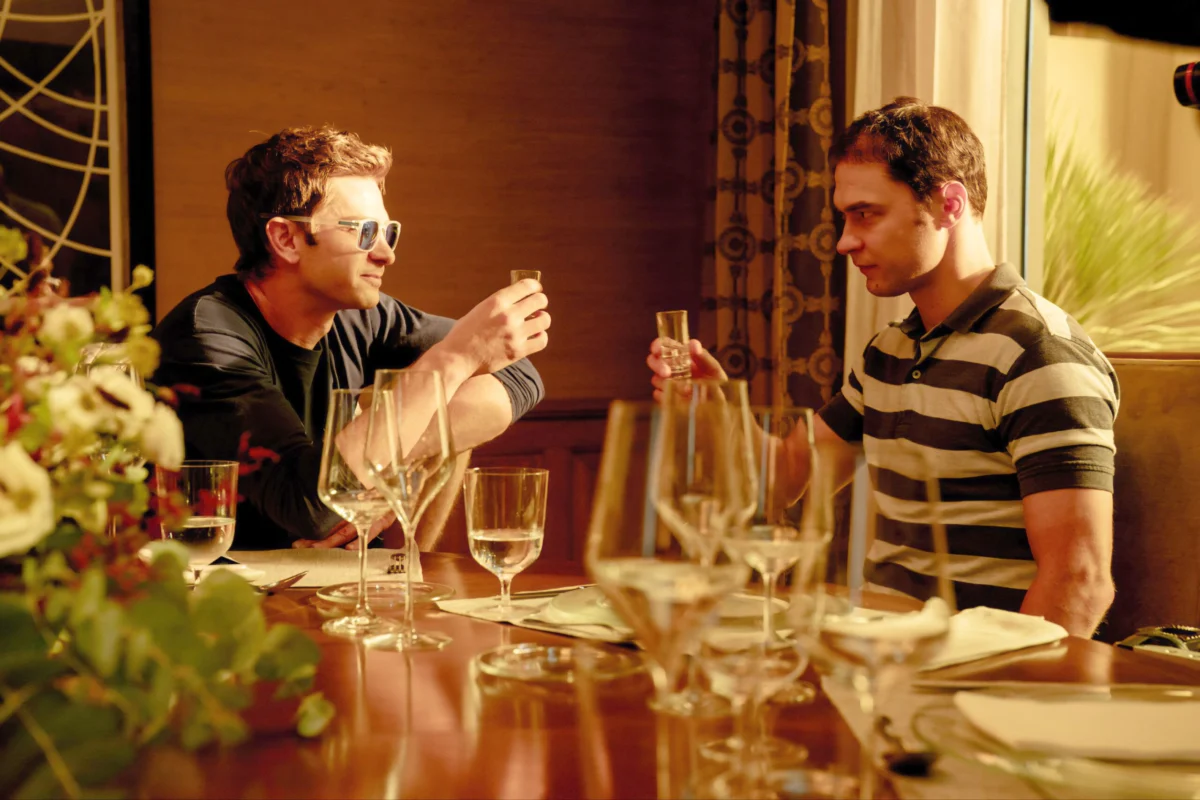
At the center of this storm is Andrew Garfield’s portrayal of OpenAI CEO Sam Altman. Garfield approaches the role with a terrifying, camp-inflected charisma, playing Altman as an "apocalyptic gay cross between Regina George and Agent Smith." It is a performance of immense, nihilistic depth. Garfield’s Altman is not merely a tech visionary; he is a man who seems to have transcended the need for human moral guardrails entirely.
The film’s most chilling sequence occurs when Altman is confronted by a skeptical board member regarding the potential for an AI model to incite self-harm among teenagers. Garfield’s delivery of the line, "I didn’t invent teen suicide," is a masterclass in detached, corporate sociopathy. It is a moment that captures the core thesis of the film: that the architects of our future are not necessarily "evil" in the traditional sense, but rather so deeply consumed by the mania of the technological arms race that they have lost the ability to empathize with the biological entities they are ostensibly trying to "improve."
Supporting Cast and the Architecture of the Film
While Garfield dominates the screen, the supporting cast provides the human friction against which the narrative grinds. Monica Barbaro, as CTO Mira Murati, provides the film’s only semblance of a moral compass, her character’s eyes acting as a repository for the guilt the others refuse to acknowledge. Conversely, Ike Barinholtz’s turn as Elon Musk is a highlight of the film’s biting satire; he portrays the mogul as an "alpha dweeb" struggling to fit into the skin of a world-conquering visionary.
However, the film is not without its narrative stumbles. The introduction of characters like those played by Zosia Mamet and Billie Lourd feels tacked on in the final act, serving more as archetypes than fully realized human beings. Furthermore, Jason Schwartzman’s brief, two-scene appearance as a prophet of doom feels somewhat jarring, pulling the audience out of the film’s otherwise grounded (if stylized) reality.

The Technical Aesthetic: A Sensory Dissonance
Guadagnino, known for the lush, tactile eroticism of Call Me by Your Name and Challengers, makes a surprising pivot toward the sterile and the cold. Working with cinematographer Malik Hassan Sayeed, Guadagnino utilizes bright 35mm film stock to capture the glossy, soulless aesthetic of Silicon Valley offices.
The score, composed by Albarn, acts as a bridge between the physical and the digital. It oscillates between the grand, sweeping "Interstellar-esque" swells that signify the hubris of the tech elite and the haunting, sung-through dirges that suggest a funeral for the human experience. It is a sonic landscape that perfectly complements the film’s visual language: the focus on physical details—a pancreas, a receding hairline, the tension in a bicep—is meant to emphasize how desperate the characters are to escape their biology, even as the camera refuses to let them.
Official Responses and Industry Implications
The film’s release comes at a time of unprecedented public scrutiny regarding the rapid integration of AI into daily life. While OpenAI has not issued an official comment on the film’s characterizations, the industry reaction at the New York Film Festival has been one of nervous laughter. Insiders have noted that while Artificial takes significant creative liberties with the timeline of board meetings and internal coups, it accurately captures the "delusional utopianism" that permeates the upper echelons of the AI research community.
The film serves as an unintended, yet potent, rebuttal to the real-world arguments made by figures like Altman, who have suggested that the public must accept "bad things" as a necessary trade-off for the technological benefits of AI. Guadagnino’s film offers a stark counter-narrative: that nothing modeled after the flawed, greedy, and fragile human mind could ever result in something "good" for humanity at large.
The Verdict: A Biblical Warning
Artificial is a messy, occasionally broad, but deeply necessary film. It succeeds in its goal of diagnosing the pathology of the current tech era, even if its screenplay sometimes simplifies the complexities of the subject matter. It is not as sharp or as propulsively intelligent as Sorkin’s work, but it is far more honest about the existential stakes.
By the time the final credits roll, it is clear that the "Artificial" of the title refers not just to the software, but to the people creating it. The film leaves the audience with the uncomfortable realization that the chaos being unleashed from within the "Pandora’s box" of modern computing is, in fact, just a hyper-accelerated version of our own worst impulses. As a piece of cinema, it is a haunting, often frustrating, but undeniably powerful indictment of a generation that would rather build a god than learn how to live with its own humanity.
Grade: B-
‘Artificial’ premiered at the 2026 New York Film Festival. NEON will release it in theaters nationwide on Christmas Day.
