The Convergence of Control: How Reallusion and Escape.AI Are Solving the Generative Video Crisis
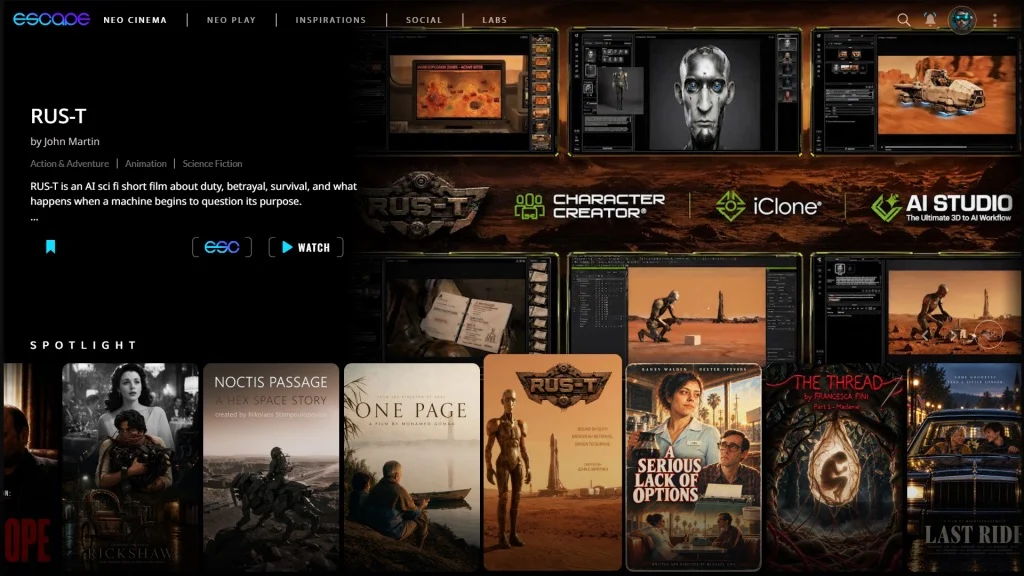
In the rapidly evolving landscape of digital media, generative AI has long promised a revolution in storytelling, yet it has frequently stumbled over the hurdles of technical inconsistency and legal ambiguity. Today, a landmark multi-year strategic alliance between Reallusion Inc., a powerhouse in 3D character and animation software, and Escape.AI Media Inc., the vanguard of "Neo Cinema" distribution, seeks to bridge the gap between volatile AI generation and professional-grade cinematic production. By connecting Reallusion’s robust 3D ecosystem to Escape.AI’s expansive Connected TV (CTV) infrastructure, the partnership aims to bring stable, high-fidelity AI-driven content to over 400 million households worldwide.
The Core Challenge: Why "Text-to-Video" Isn’t Enough
For the past two years, the industry has been obsessed with the potential of text-to-video models. However, filmmakers attempting to use these tools for long-form narrative projects have hit a "hard ceiling." The inherent nature of generative models—which predict pixels based on probabilistic data—often results in "hallucinations," where characters shift their appearance, lighting changes inconsistently between cuts, and spatial logic breaks down.
Beyond the aesthetic flaws, creators have faced an existential crisis regarding intellectual property. Because raw, text-generated content lacks human-authored "intent," its copyright eligibility remains under legal scrutiny in many jurisdictions.
The partnership between Reallusion and Escape.AI offers a definitive solution: 3D-as-the-Control-Layer. By using human-authored 3D spatial data—skeletons, rigged meshes, and camera coordinates—as the bedrock for AI generation, creators can finally dictate exactly what happens in a scene. This marriage of traditional 3D precision and generative speed ensures frame-to-frame continuity and provides a clear chain of custody for intellectual property, effectively solving the primary pain points that have kept professional filmmakers at arm’s length from AI.
Chronology of a Paradigm Shift
The collaboration did not happen in a vacuum. It follows a distinct trajectory in the evolution of digital production:
The Early Prototyping Phase: As generative AI tools like Midjourney and Sora gained traction, the industry saw an influx of "AI experiments." However, these were largely restricted to social media platforms, where algorithm-driven feeds prioritized short-term virality over narrative quality.
The Integration of Real-Time Engines: Reallusion, known for its iClone and Character Creator suites, began observing a trend among its user base: artists were using 3D rigs to "guide" AI tools. This informal workflow validated the need for a formal bridge.
The Birth of Neo Cinema: Simultaneously, John Gaeta—the visionary behind the iconic "Bullet Time" effects in The Matrix—launched Escape.AI. His goal was to move beyond the limitations of social media, creating a "gallery-quality" distribution platform specifically for AI-driven cinematic art.
The Strategic Alliance (2026): Recognizing that both companies were building complementary halves of the same solution, Reallusion and Escape.AI formalized their alliance. This partnership marks the transition of AI filmmaking from "novelty experiment" to "legitimate studio-grade production."
Supporting Data: The Scale of the Ecosystem
The partnership is supported by a massive infrastructure designed to scale:
The 3D Pipeline: Reallusion brings its full-circle software suite—Character Creator, iClone, ActorCore, and AI Studio—to the table. These tools allow for the creation of consistent characters, sophisticated rigging, and precise spatial lighting.
The Distribution Reach: Escape.AI operates as a premium content platform that bypasses the "black box" algorithms of social media. By leveraging native Connected TV (CTV) applications, the platform ensures that high-quality, long-form AI cinema reaches audiences on the largest screens in their homes, across a combined footprint of 400 million active devices.
Production Efficiency: By grounding generative video in 3D spatial data, creators significantly reduce "render-and-replace" costs. Instead of generating hundreds of iterations to get one consistent shot, filmmakers can iterate in real-time within the 3D environment, using AI only as the final "render" layer.
Official Perspectives: The Philosophy of "Neo Cinema"
The alliance is defined by a shared philosophy: that technology should serve the artist, not replace them.
Enoc Burgos, Director of Reallusion Inc., emphasized the necessity of control:
"Pure text-to-video generation has hit a hard ceiling when it comes to long-form narrative storytelling. Filmmakers cannot build persistent franchises when characters and animations morph from shot to shot. By pairing Reallusion’s 3D control layer with AI Studio, we give directors total camera, spatial, lighting, and motion command. More importantly, our alliance with Escape empowers creators by placing powerful 3D tools directly alongside a premier path to global distribution and monetization."
John Gaeta, Founder of Escape.AI Media Inc., framed the partnership as the maturation of a new medium:
"Neo Cinema is about blending human imagination, game engine control, and generative AI into a unified narrative force. Reallusion provides the precise 3D skeleton and camera guidance that generative models desperately need to achieve cinematic discipline. By combining Reallusion’s powerful toolset with Escape’s distribution network, this partnership empowers and expands a growing community of talented filmmakers, giving them the control to craft world-class, consistent stories and the global showcase to broadcast them to hundreds of millions of screens."
Implications for the Future of Filmmaking
The implications of this alliance extend far beyond simple technical integration.
1. The Professionalization of AI Content
For years, the stigma of "AI art" has been its low quality and lack of authorship. By requiring a 3D control layer, the Reallusion-Escape workflow essentially forces the creator to perform the work of a traditional director and cinematographer. This raises the barrier to entry, which—paradoxically—is a positive for the industry. It ensures that the content appearing on CTV screens meets professional standards of pacing, framing, and narrative structure.
2. Intellectual Property and Security
One of the most contentious issues in AI is copyright. Because the Reallusion-Escape workflow relies on human-authored 3D assets, the "bones" of the production are entirely human-made. This establishes a clear, undeniable trail of authorship. As legal frameworks around AI content evolve, this "human-in-the-loop" approach will likely become the gold standard for production studios seeking to protect their IP while leveraging AI’s creative efficiency.
3. A New Distribution Paradigm
By shifting the focus from social media feeds to the "living room experience" via CTV, the partnership is reclaiming the cinematic quality of film. Social media algorithms often compress video and favor short, high-stimulation content. By moving to a platform designed for "Neo Cinema," creators can produce longer, more contemplative, and narratively complex works, knowing they will be viewed on large, high-resolution screens.
4. Community and Education
Through the launch of Escape Labs, the partners are actively fostering a new generation of talent. The initiative will provide creators with access to the combined toolset, workshops, and direct feedback from industry veterans from companies like Pixar, Lucasfilm, and Epic Games. This mentorship model is critical for ensuring that the democratization of filmmaking technology results in a higher quality of storytelling, rather than a flood of low-effort content.
Conclusion: The Path Ahead
The alliance between Reallusion and Escape.AI represents a turning point in the timeline of generative technology. It is the moment when the "wild west" of early AI experimentation gives way to a structured, professional, and sustainable ecosystem.
By grounding AI in the discipline of 3D, and by providing a home for this work on the world’s most important screens, these two companies are not just providing tools—they are defining the standards of a new cinematic era. As the "Neo Cinema" movement gains momentum, the question for filmmakers is no longer whether they should use AI, but rather how they will use the control provided by this 3D-AI pipeline to bring their unique visions to the global stage.