
Stitching the Cosmos: How Costume Designer Cynthia Ann Summers Built the Visual World of HBO’s ‘Lanterns’
By Entertainment Desk
Published by IndieWire
Main Facts: The Anatomy of a Sci-Fi Mystery Wardrobe
While the ironclad non-disclosure agreements (NDAs) governing the DC Universe and HBO remain a force more formidable than the Green Lantern Corps itself, costume designer Cynthia Ann Summers is more than happy to talk about everything around the legendary power rings.
In HBO’s sprawling, neo-noir mystery series Lanterns, the visual storytelling relies less on CGI constructs and more on the fabric of everyday life. Set against the sun-baked, uneasy backdrop of Rushville, Nebraska, the series follows the reluctant partnership between veteran Green Lantern Hal Jordan (played with weathered cynicism by Kyle Chandler) and his meticulously sharp, potential replacement, John Stewart (Aaron Pierre).
Yet, as Summers discovered upon diving headfirst into the source material, Lanterns is not simply a sci-fi reskin of prestige dramas like Yellowstone or True Detective. Instead, it is a masterclass in contemporary costuming, where the true import of the characters’ psychological states hides entirely in plain sight. From the Hitchcockian uncanny valley inhabited by Laura Linney’s extraterrestrial emissary to the deliberate sartorial friction between Chandler and Pierre, every hem, button, and cowboy hat tells a story.
Chronology: From Concept Boards to Fitting Room Magic
The journey to defining the look of Lanterns began long before cameras rolled in Nebraska. For Summers, the creative process was an evolutionary timeline spanning comic book lore, spontaneous pre-fittings, and historical subversions.

The Mood Board Phase
When Summers first boarded the project, she immersed herself in DC’s comic catalog to understand the gravity of the Lantern mythology. However, she was determined to ground the rural setting of Rushville in a reality that felt tactile and lived-in.
For Hal Jordan, her primary reference point didn’t come from comic panels, but from real-world grit. Summers pinned a photograph of the late Anthony Bourdain sitting casually in a cantina—relaxed posture, arm draped over a chair, nursing a beer, wearing a simple yet distinctly stylish outfit. That effortless, world-weary demeanor with a hint of underlying tragedy became the blueprint for Hal’s 2016 hero look.
The Accidental Pre-Fitting
Costume designers rarely get extensive, uninterrupted time with their lead actors during early pre-production. However, fortune smiled on the Lanterns production when both Kyle Chandler and Aaron Pierre happened to be in Los Angeles simultaneously.
What was initially planned as a standard logistical meeting turned into an impromptu, magical pre-fitting. In that room, surrounded by racks of clothing, the complex love-hate dynamic between Hal and John crystallized. It was there that Summers, Chandler, and Pierre collaborated to lock down the exact visual identities of the two cosmic lawmen.
Spanning the Decades
The temporal breadth of the series—particularly showcased in pivotal flashbacks—required meticulous execution. Summers and her team leaned heavily into period-accurate styling for episodes tracking John Stewart’s intense upbringing, collaborating closely with actors like Jasmine Cephas Jones and Jay Alphonse to bring the 1980s texture of Rushville to life without leaning into cheap pastiche.

Supporting Data: Character Breakdowns and Sartorial Cues
Summers’ work on Lanterns succeeds because it establishes a visual language based on contrast, silhouettes, and subtle recurring motifs.
Hal Jordan vs. John Stewart
The generational and ideological clash between the two Lanterns is mapped directly onto their bodies:
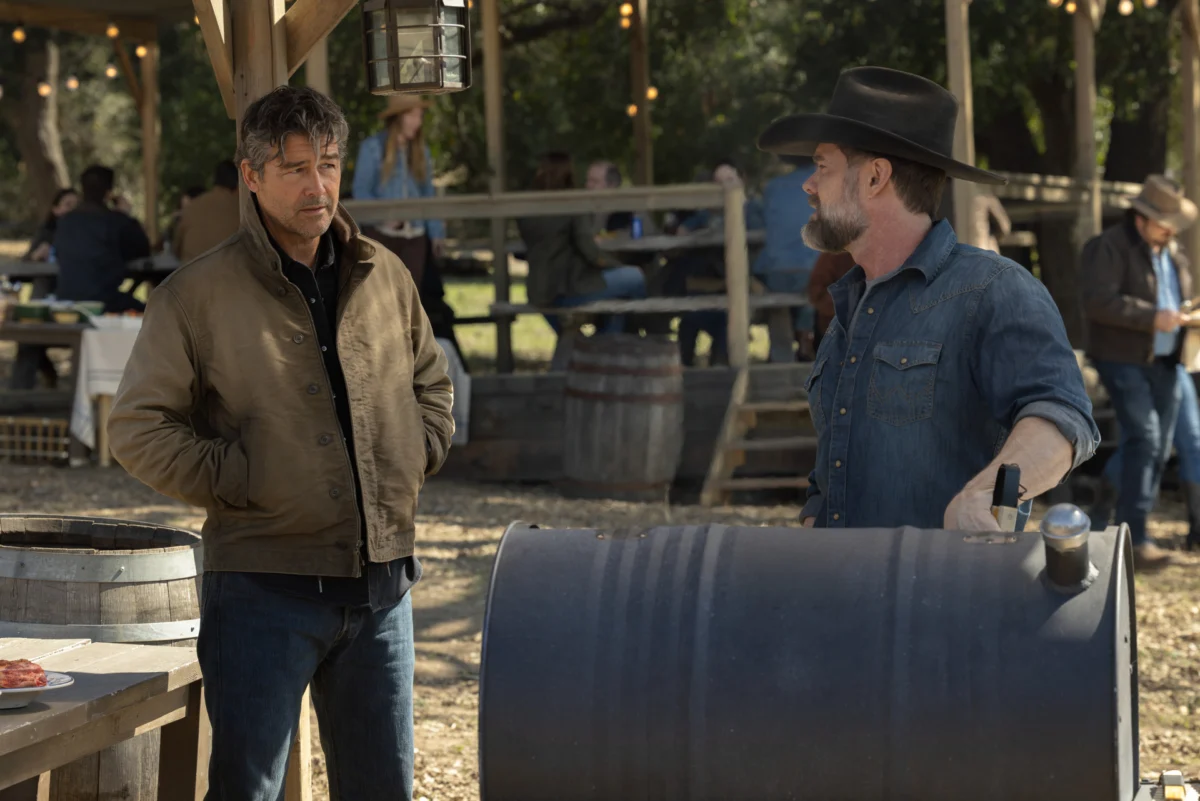
- Hal Jordan (Kyle Chandler): Characterized by a baggier, more relaxed silhouette. His clothes reflect a man who has carried the burden of the ring for too long, opting for comfort and a lived-in aesthetic that mirrors his cantankerous, world-weary personality.
- John Stewart (Aaron Pierre): Precision-cut and sharp. In contemporary settings, Pierre’s costumes are close-fitting and structured, reflecting a disciplined mindset and a readiness for the monumental responsibilities ahead of him.
Lianna’s Uncanny Hitchcockian Aesthetic
Laura Linney plays Lianna, a sublimely strange alien trying to blend into human society. However, her attempts to manifest an "Earthly woman’s look" are slightly out of sync with the modern era.
- The Inspiration: Summers drew heavily from Tippi Hedren in Alfred Hitchcock’s The Birds.
- The Look: Mid-century swing coats, immaculate pencil skirts, pristine gloves, and signature headscarves. As the series progresses—particularly in Episode 3, titled "OutKast"—Linney’s unwavering commitment to a 1950s aesthetic while interacting with modern characters makes her feel increasingly surreal and otherworldly.
- The Hidden Motif: Lianna is subtly tethered to John and his mother, Bernadette (Jasmine Cephas Jones). Every single outfit Linney wears features a hidden bird reference—whether integrated into a patterned dress or pinned to a scarf—symbolizing her obsessive, alien fixation on the Stewart family.
The Cowboy Hat Revolution
Rushville’s local power players, including rancher bigwig Mason (Garret Dillahunt) and skeptical Sheriff Kerry (Kelly Macdonald), were initially envisioned with a more standard, understated midwestern ballcap look.
Summers, eager to play into the western motifs, brought a few cowboy hats to the fittings just to experiment. Once Dillahunt (who naturally embodies western archetypes) and Macdonald (a Scottish actress who fully leaned into the aesthetic) tried them on, the decision was immediate. Photographs sent to the higher-ups were met with an instant green light. As Summers notes, a good cowboy hat expands an actor’s physical vocabulary, allowing for subtle performance choices like a slow tip or a sharp side-eye from beneath the brim.

Official Responses: Insights from the Design Team
Reflecting on the unique challenges of designing contemporary superhero television, Cynthia Ann Summers emphasized the sheer volume of micro-decisions required to make fantastical elements feel authentic.
"In contemporary [costume design], it’s really all in the small details," Summers explained to IndieWire. "You can’t imagine putting anything on Aaron that’s kinda casual and hip. It just would never work. He’s close cut, very precisely cut."
Discussing the unplanned synergy with her lead actors during the Los Angeles pre-fitting, Summers highlighted the emotional resonance discovered through clothing:
"It’s an incredible relationship that the two of them have, the love/hate thing, the sort of admiration for each other and the disdain for each other at the same time, and the camaraderie and the fear and the everything… And we found our pieces actually in that pre-fitting. That’s where we found [Hal’s] look. It was magic."
On the deliberate inclusion of avian motifs for Laura Linney’s character, Summers added:

"Every outfit she had on, somewhere in that outfit, whether it was in the scarf or a pin, there was a reference to a bird. The bird connects her with Bernadette and with John. That was intentional."
Implications: Elevating the Prestige Comic Book Adaptation Genre
The meticulous costume design of Lanterns carries significant implications for how comic book adaptations are approached on premium networks like HBO.
For years, superhero television struggled with either overly sterile tactical gear or overly cartoonish spandex that failed to translate to gritty, grounded narratives. By treating a cosmic sci-fi mystery with the same sartorial depth usually reserved for historical period dramas or prestige psychological thrillers, Lanterns bridges the gap between high-concept comic book lore and high-end television art direction.
Furthermore, Summers’ work proves that costume design in contemporary settings is not merely about making actors look good, but about weaponizing clothing as a narrative tool. Whether it is Anthony Bourdain’s ghost haunting Hal Jordan’s jacket, Tippi Hedren’s cinematic terror manifesting in an alien emissary, or the tactical shift from ballcaps to authoritative cowboy hats, the wardrobe acts as a silent narrator.
As Lanterns continues its run on HBO, viewers are left with a clear directive: keep a close eye on the actors’ clothes. In the shadowy, tension-filled world of Rushville, the biggest secrets are often stitched right into the sleeves.

Lanterns is now streaming on HBO.
