
A Reckoning at the Podium: Aamir Khan’s Emotional Journey Toward Balance and New Beginnings
Introduction: The Vulnerability of a Bollywood Icon
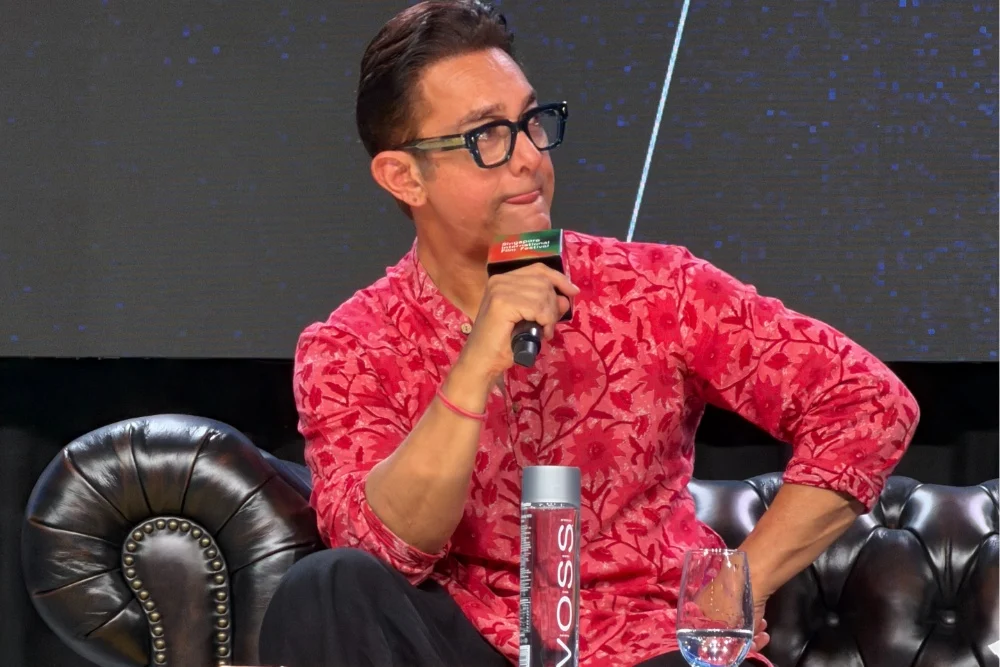
The glittering lights of the Grand Ballroom at Marina Bay Sands, Singapore, served as the backdrop for a moment of profound, raw humanity. Bollywood superstar Aamir Khan, a man synonymous with perfectionism and cinematic excellence, found himself overwhelmed during a candid "in-conversation" session at the Singapore International Film Festival. As he reflected on a career defined by three decades of relentless, high-octane professional output, the "Mr. Perfectionist" of Indian cinema lowered his guard, breaking down in tears as he confronted the personal cost of his singular focus.
The event, which saw Khan receive the prestigious Screen Icon Award from acclaimed Hong Kong filmmaker Peter Chan Ho-sun, transcended the typical boundaries of a festival interview. It became a public confession of a life lived in the fast lane, a realization of lost time, and a hopeful roadmap for the future.
The Turning Point: COVID-19 and the Price of Ambition
For the better part of thirty years, Aamir Khan operated under a philosophy of total immersion. He described himself as a lifelong workaholic whose identity was inextricably linked to his craft—eating, sleeping, and breathing cinema.
The epiphany, however, did not arrive on a film set or during a high-stakes production meeting; it came during the enforced stillness of the COVID-19 pandemic. Removed from the frantic pace of the industry, Khan was forced to confront the quiet spaces he had long avoided.
"When I was sitting in COVID and I was thinking, I said, you know, about 30 years have passed of my life," Khan told the audience, his voice thick with emotion. "It’s okay to work like a madman, completely obsessed with what you’re doing for one year, two years, five years. But if it goes on for 30 years, I mean, you’ve lost your relationships. Your kids have grown up, they’re adults now. So I felt a deep sense of loss."
The admission brought the room to a standstill. As the actor struggled to regain his composure, an audience member provided a box of tissues, a small gesture in a moment of large-scale realization. Khan, wiping away tears, offered an apology to the packed house, which responded with a thunderous, supportive ovation. He noted that this self-reflection at age 56 provided him a critical window of opportunity. "I’m so glad that this thought occurred to me when I was 56 and not when I was 86, when it would be really too late to do anything about it," he said.
Chronology of a Career: From Quicksand to Resilience
Khan’s path to this moment of clarity was paved with both meteoric highs and crushing lows. During the session, moderated by Singaporean comedian Rishi Budhrani, the actor traced his evolution from a naive debutant to a seasoned veteran.
The "One-Film Wonder" Crisis
Khan recalled the start of his career following the 1988 success of Qayamat Se Qayamat Tak. Fueled by the arrogance of youth and a miscalculation of his own capacity, he signed nine films within six months. He believed that if veteran stars could manage a dozen projects simultaneously, he could surely handle ten.
The reality was far bleaker. As the films began to roll out, they failed at the box office, one after another. Khan found himself trapped in what he described as "quicksand"—the harder he struggled to maintain his footing, the deeper he sank. He recounted how he would return home to his then-wife, Reena, and weep, fearing his career was over before it had truly begun.
The Defining Refusal
A pivotal moment of professional integrity saved him from a spiral of mediocrity. At the height of his "one-film wonder" stigma, the legendary filmmaker Mahesh Bhatt offered him a role. Despite the pressure to accept any work to stay afloat, Khan felt the script was not right. After a sleepless night, he chose to reject the offer—a decision he views as the most important of his career. "If I had compromised with that and I had been practical… I think my entire career would have been a series of compromises," he reflected. This principled stance eventually led to successful collaborations with Bhatt on Dil Hai Ke Manta Nahin and Hum Hain Rahi Pyar Ke.
Cinematic Future: Sequels and Creative Endeavors
While the conversation was marked by deep introspection, it also offered a glimmer of excitement for the future of Indian cinema. Khan addressed persistent rumors surrounding the potential sequels to two of his most iconic films: 3 Idiots and Andaz Apna Apna.
Regarding the long-awaited follow-up to the 2009 blockbuster 3 Idiots, directed by Rajkumar Hirani, Khan was cautiously optimistic. "Well, I’m not allowed to say a lot," he teased, before confirming that the project is in motion. "I think I can say this much, that yes, Raju is working on the script. In fact, hopefully once I’m back in the next couple of weeks, he’s going to narrate the final version to me. So, fingers crossed."
The actor also touched upon the cult classic Andaz Apna Apna, directed by Rajkumar Santoshi. While he confirmed that the director is "working on something," he remained guarded about the details, tempering expectations while keeping the door firmly ajar.
Supporting Data: The Global Reach of Indian Cinema
Khan’s influence extends far beyond the borders of India, a phenomenon he analyzed with characteristic pragmatism. His films, particularly 3 Idiots and Dangal, achieved staggering success in China and across East Asia.
When asked about this international resonance, Khan credited the "emotional key" shared between Indian and Chinese audiences. He famously noted that his popularity in China was, in part, an unintended consequence of the piracy market—a blunt, honest assessment that drew laughs from the audience. However, he emphasized that this was not an endorsement of piracy, but rather an observation of how the digital age facilitates cultural exchange. He recalled watching Dangal in a Chinese theater and being struck by how the audience’s reactions mirrored those of his fans back in India, proving that universal storytelling transcends language barriers.
Official Responses and Industry Philosophies
Beyond his personal narrative, Khan shared deep-seated insights into the mechanics of filmmaking:
- Test Screenings: Khan revealed that he is a rigorous proponent of feedback, conducting 50 to 60 test screenings—each with 25 people—to refine his work. He shared that the initial test screening for Taare Zameen Par was a "disaster," a stark reminder that even his most celebrated works underwent painful transformations.
- Financial Models: Demonstrating his commitment to the health of the film industry, Khan disclosed that for smaller projects that lack the budget for his standard fee, he frequently chooses to forgo his salary in favor of a "back-end" deal. This ensures that the production remains viable and the producer is protected against financial loss.
- The AI Debate: When asked about the rise of Artificial Intelligence in cinema, Khan positioned it as a neutral tool, comparable to the transition to VFX. While he acknowledged the utility of AI in building complex sets that would have once required hundreds of workers, he expressed a realistic, somewhat sobering view: "My common sense is telling me that in the short term, for sure, people are going to lose jobs."
Implications: A New Chapter for the Screen Icon
The lasting takeaway from Khan’s appearance at the Singapore International Film Festival is one of significant change. The actor has taken tangible steps to rectify the imbalance of his past. For the last four years, he has deliberately carved out dedicated time for his family and close friends, moving away from the "madman" persona that once consumed him.
He has even gone so far as to disconnect from the digital noise, revealing that he has shut off his phone and deleted all apps. He found that the act of aimless scrolling could steal three hours of his life in a single sitting—time he now prefers to spend in real-world interactions.
As he prepares for the 25th-anniversary screening of Lagaan—the film that solidified his transition from actor to producer—Aamir Khan stands at a crossroads. He is a man who has conquered the box office, faced the abyss of career failure, and emerged with the wisdom to prioritize the life that exists outside the lens. His message to the industry and his fans is clear: success is hollow if it comes at the expense of the people who matter most.
As the Singapore event drew to a close, it was evident that the "Screen Icon" has found a new, more sustainable way to navigate the industry—not by working harder, but by living more intentionally.
