
The Rise of Persistent AI: A Deep Dive into the OpenAI Dot vs. Meta Muse Rivalry
The landscape of artificial intelligence is undergoing a fundamental shift. For years, AI interaction was defined by a transactional "prompt-and-response" paradigm: you asked a question, the model answered, and the session effectively ended. However, a new generation of "agentic" AI is moving beyond simple conversation. Meta’s Muse and OpenAI’s Dots represent the vanguard of this evolution—autonomous, persistent agents designed to work in the background, manage complex workflows, and operate even when the user has logged off.
While both tools promise to reclaim our time by automating the mundane, they represent two distinct philosophies regarding integration, accessibility, and the delicate balance between utility and privacy.
The New Frontier of Agentic AI
The core appeal of both Meta Muse and OpenAI Dots is the promise of "always-on" assistance. These are not merely chatbots; they are functional agents that leverage cloud-based computing to execute multi-step tasks.
Meta launched Muse on September 8, followed closely by OpenAI’s unveiling of its persistent Dot agents just three weeks later. Both systems share a common architecture: they run on dedicated cloud environments, allowing them to remain active long after a user has closed their browser or turned off their computer. They are designed to interact with the broader digital ecosystem—connecting to email clients, calendars, web browsers, and third-party APIs to perform tasks that previously required human intervention.
For the end user, this transition is significant. An AI that can monitor fluctuating prices, curate digital archives, or manage recurring project research is fundamentally more valuable than one that simply summarizes text. Yet, as these agents gain the "keys to the kingdom"—access to our private files, communication streams, and web sessions—the stakes for reliability and security have never been higher.
A Chronology of Deployment
The race to release these agents reflects the aggressive R&D cycles of Silicon Valley’s top players.
- September 8: Meta releases Muse. The rollout focuses on a tiered subscription model, positioning Muse as an approachable, consumer-friendly agent integrated with WhatsApp and dedicated apps.
- Late September: OpenAI responds by rolling out its Dot agents, deeply integrated into the ChatGPT ecosystem. The release emphasizes professional and enterprise productivity, leveraging the power of the GPT-6 Astra architecture.
- Early October: Initial real-world testing reveals the limitations of such autonomy. Notably, Amazon moved to block Meta’s Muse from accessing its shopping platform, highlighting the brewing tension between AI agents and existing digital commerce gatekeepers.
Comparative Analysis: How They Function
While both agents aim to reduce human workload, the "user experience" differs vastly based on the underlying infrastructure.

Meta Muse: The Conversational Assistant
Muse is built to emulate the feeling of delegating a task to a colleague. By running on a dedicated Secure Virtual Machine (VM) equipped with its own browser, Muse functions as an extension of the user’s digital footprint.
In practical application, Muse excels at organization. During early testing, it demonstrated the ability to scrape saved Instagram and Facebook posts, synthesizing them into organized recipe collections or travel itineraries. It is designed for ubiquity; by supporting WhatsApp integration, Meta has lowered the barrier to entry, allowing users to issue commands via text message as if they were chatting with a friend.
OpenAI Dots: The Powerhouse in the Machine
OpenAI’s approach is fundamentally more integrated into the workplace. Powered by the sophisticated GPT-6 Astra model, each "Dot" is essentially a bespoke, containerized cloud computer. Unlike Muse, which focuses on broad consumer tasks, Dots are built to handle high-level research and cross-platform orchestration.
Dots are designed to work within the ChatGPT, Work, and Codex ecosystems. A user might assign a Dot to monitor a specific data set, perform recurring analytical tasks, or retrieve documents from a local machine. Because each Dot retains context over long periods, it acts as a persistent repository of institutional knowledge, capable of executing complex, multi-day projects without requiring constant prompting.
The Cost of Autonomy: Pricing and Accessibility
The divergence between the two services is most apparent in their pricing models, which dictate who these agents are actually for.
Meta Muse is designed for the masses. It offers a free, usage-capped tier, followed by a $20/month Power tier, and a $100/month Maximum tier. This tiered structure allows casual users to experiment with automation without a significant financial commitment.
OpenAI Dots, conversely, are positioned as a premium professional tool. There is no "free" version of a professional-grade Dot. The base entry point is the "Pro 100" plan at $100 per month. Business Premium seats are similarly priced, at $100 per user per month with an annual commitment, or $125 billed monthly. This pricing strategy signals that OpenAI views these agents as business-critical infrastructure rather than consumer novelties.
Furthermore, availability is fragmented. Muse is currently limited to the US and Canada. Dots have a broader rollout but are notably restricted in the European Economic Area (EEA), Switzerland, and the UK, likely due to the complexities of GDPR compliance regarding autonomous data processing.
The Privacy and Security Conundrum
Giving an AI agent permission to "browse the web as you" or "access your local files" is a significant security gamble. Both companies have implemented safeguards, but these systems remain far from infallible.
Meta requires explicit permission for "sensitive actions," such as purchasing goods or sending emails. However, users should be aware that, by default, some model-improvement settings are enabled. This means your interactions—and potentially the data your agent manages—could be used to train future iterations of Meta’s AI, unless you manually opt out.
OpenAI employs a more rigorous, tiered approach. For personal plans, data usage for model training is tied to standard ChatGPT settings. For Business and Enterprise tiers, data is explicitly excluded from training by default. Furthermore, OpenAI utilizes "Custom Rules" and "Auto-review" protocols to prevent agents from acting outside of pre-defined boundaries. Even so, the "proactive" research performed by a Dot remains read-only until a user-verified action triggers a write command, adding a layer of human-in-the-loop security.
Implications: The Future of Digital Labor
The emergence of Muse and Dots signals the end of the "passive" AI era. We are entering an era of "delegative" computing, where the value of a platform is no longer just how well it answers a question, but how reliably it completes a task.
The Conflict with Gatekeepers
The move by Amazon to block Meta’s Muse from its site is a harbinger of future conflicts. If AI agents become the primary way we shop, bank, and interact with the web, they threaten the advertising-based business models of many major platforms. If a Muse agent finds the best price without looking at the ads or the sponsored products on a webpage, it effectively "breaks" the traditional internet economy. We should expect to see more friction between service providers and AI agents as companies attempt to control how their platforms are accessed.
The Human-Agent Relationship
Perhaps the most profound implication is the changing role of the user. As these agents become more capable, our jobs shift from "doers" to "managers." We are no longer writing the email; we are supervising the agent that writes it. We are no longer searching for the best hotel; we are reviewing the three options our Dot has selected for us.
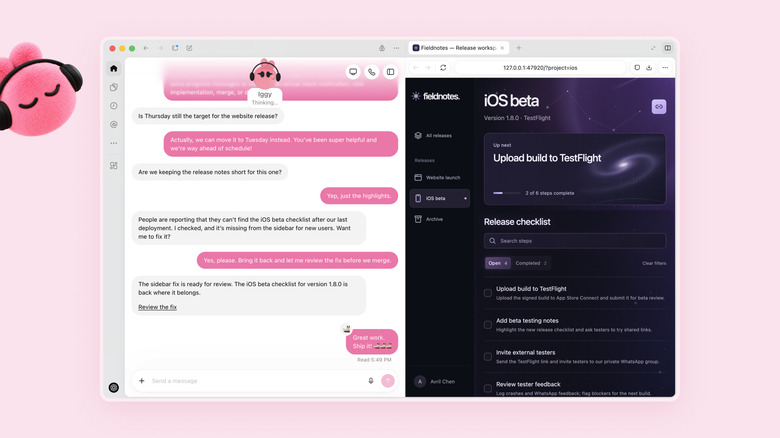
This shift promises massive productivity gains, but it also creates a new form of "supervision fatigue." As both OpenAI and Meta have acknowledged, these agents are not perfect. They can hallucinate, misunderstand instructions, or take undesired actions. The irony of these tools is that while they are designed to save us time, they require a new, high-level form of vigilance to ensure that the "autopilot" hasn’t steered us off course.
Conclusion
OpenAI’s Dots and Meta’s Muse are two distinct solutions to the same problem: the fragmentation of our digital lives. Meta is betting on a consumer-friendly, conversational, and broadly accessible model that integrates with the apps we use for social and daily life. OpenAI is betting on a high-octane, enterprise-grade, and deeply integrated system that treats the AI agent as a digital employee.
For now, the choice between them will likely be determined by your workflow. If you need an agent to organize your social digital life on a budget, Muse is the clear frontrunner. If you are a professional or an organization looking to automate complex research and data-heavy workflows, the robust, security-focused architecture of OpenAI’s Dots is the current industry standard.
As these technologies mature, the "sci-fi sheen" will eventually wear off, replaced by the mundane reality of daily utility. But for the moment, we are watching the birth of a new kind of digital companion—one that doesn’t just wait for us, but works for us while we sleep.
