
Industry Staple on Discount: Sennheiser EW 112P G4 Wireless System Sees Significant $280 Price Drop
By Matthew Allard ACS
Published: October 26, 2026
Main Facts
Videographers, broadcast journalists, and content creators looking to bolster their audio gear lockers have been handed a notable hardware discount. The industry-standard Sennheiser EW 112P G4 Camera-Mount Wireless Omni Lavalier Microphone System has experienced a substantial markdown, currently retailing for $419 USD.
This price point represents a massive $280 USD discount off its standard market value. For budget-conscious independent filmmakers or media production houses looking to scale up their multi-camera setups without breaking the bank, the promotion offers a rare opportunity to acquire professional-grade radio frequency (RF) audio hardware at a mid-tier price point.
The promotion applies to two distinct frequency band versions:
- A1 Band: 470 to 516 MHz
- G Band: 566 to 608 MHz
While the Evolution Wireless (EW) G4 platform is now entering its eighth year on the market since its initial rollout, its enduring build quality, seamless legacy compatibility, and dependable RF transmission continue to make it a heavily utilized tool across professional sets worldwide. Industry analysts view the current price cut as a strategic retail move to clear out remaining inventory, yet the underlying hardware remains fully capable of handling modern broadcast demands.
Chronology: The Evolution of Sennheiser’s Flagship Wireless Series
To understand the weight of this hardware discount, it is helpful to look back at how Sennheiser’s Evolution Wireless line cemented its dominance in the production landscape over two decades.
Early Generations: Laying the Foundation (G1 to G3)
When Sennheiser first introduced the Evolution Wireless series (starting with the G1 and rapidly iterating through the G2 and G3 platforms), the company fundamentally changed how indie filmmakers and ENG (Electronic News Gathering) crews captured field audio. Before these systems became ubiquitous, reliable wireless audio typically required bulky, expensive rack-mounted units ill-suited for run-and-gun documentary work. The introduction of robust, metal-chassis bodypack transmitters and camera-mountable receivers brought multi-channel UHF reliability to DSLR video shooters and broadcast journalists alike.
The G4 Launch and Industry Adoption
In 2018, Sennheiser raised the bar once more with the release of the G4 generation. Building upon the tried-and-true architecture of the G3, the G4 series introduced faster setup times, increased RF output power, a higher channel count, and improved OLED displays for enhanced visibility under harsh outdoor sunlight. It quickly became the default rental house item and a permanent fixture in production bags globally, trusted to capture audio in high-interference environments ranging from bustling convention centers to windy outdoor sporting events.
The Modern Era and the Current Discount
Fast forward to the current market landscape. While digital 2.4GHz systems and newer proprietary digital wireless setups have flooded the entry-level creator market, traditional analog UHF systems like the Sennheiser EW 112P G4 remain prized for their long-range stability, resistance to dropouts in crowded spectrums, and zero-latency performance. The announcement of the $419 USD price tag on October 26, 2026, marks one of the deepest direct retail discounts the G4 camera-mount kit has seen, positioning it as a direct competitor to much cheaper, yet less durable, entry-level plastic wireless sets.
Supporting Data and Technical Specifications
At its core, the Sennheiser EW 112P G4 system is designed to solve real-world audio challenges on fast-moving sets. A closer look at the technical specifications reveals why this system has sustained its reputation over nearly a decade of production use.
System Components and Build Quality
The package centers around the robust SK 100 G4 bodypack transmitter and the EK 100 G4 camera-mount receiver, both housed in rugged, all-metal enclosures designed to withstand the physical abuses of field production. Unlike many consumer-grade plastic alternatives, the metal chassis provides natural shielding against electromagnetic interference (EMI) while ensuring longevity through years of travel, drops, and weather exposure.
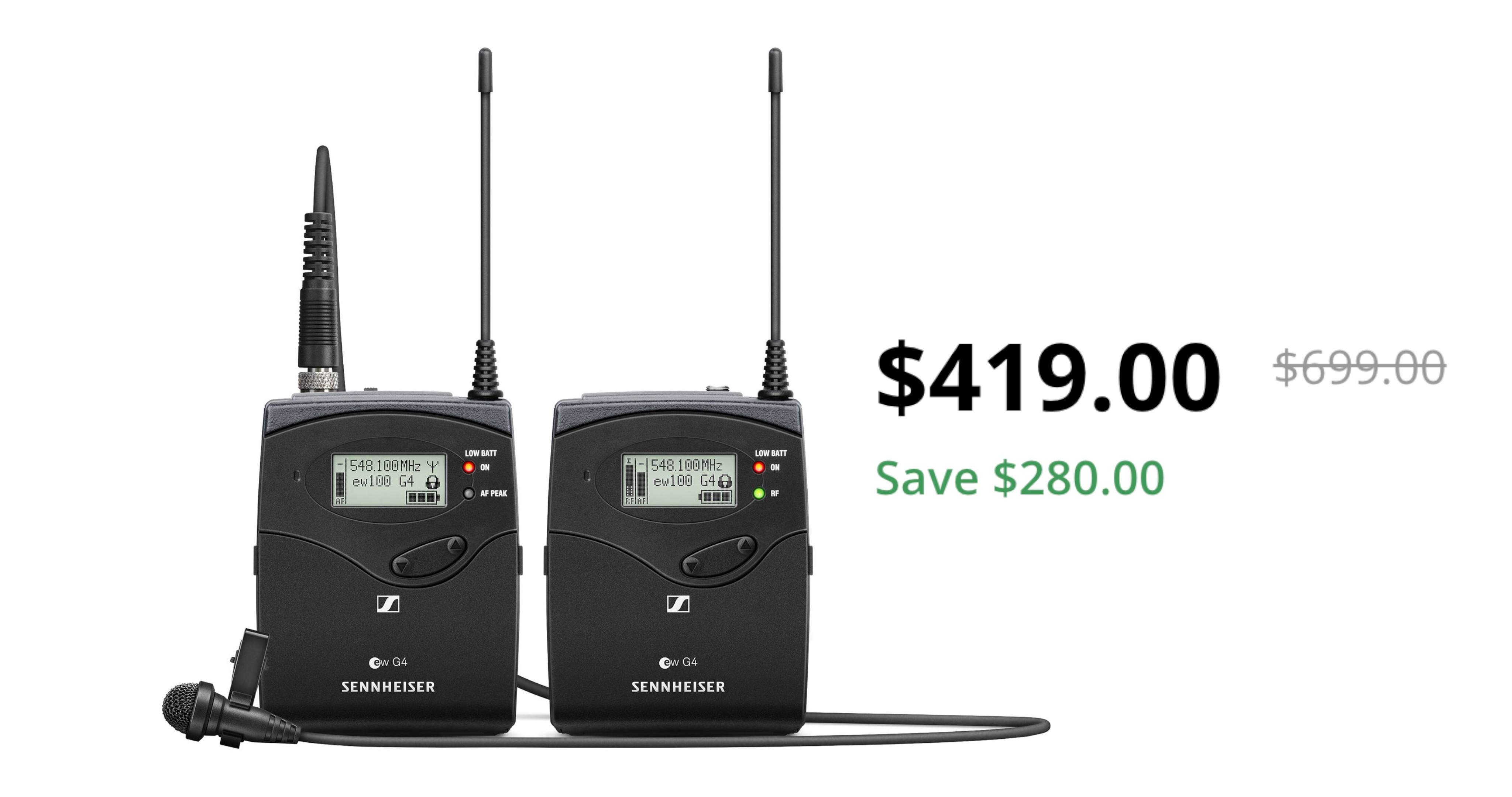
Included in the kit is the ME 2-II omnidirectional lavalier microphone, an upgraded iteration over the original G3 ME 2 capsule. The ME 2-II features a sleeker, moisture-resistant design and delivers a clean, intelligible frequency response optimized for human speech. Whether hidden beneath heavy winter clothing or clipped neatly to a lapel, the mic delivers crisp broadcast audio.
Key Technical Performance Metrics
- Switching Bandwidth: Up to 42 MHz with 1680 selectable frequencies, fully tunable in a stable UHF range.
- Frequency Management: Enhanced frequency bank system with up to 12 compatible channels per frequency bank, drastically reducing setup times in complex RF environments.
- Auto-Scan Feature: The receiver’s built-in frequency scan function automatically searches for unoccupied, clean frequencies in the immediate local area, bypassing manual trial-and-error.
- Transmitter Sensitivity: Adjustable input sensitivity accommodates a massive dynamic range, seamlessly handling everything from whispers to booming theatrical voices, as well as line-level audio feeds.
- Power and Range: Operates with a transmission range of up to 100 meters (330 feet)—line of sight—and runs on standard AA batteries or optional rechargeable accupack batteries, delivering up to 8 hours of continuous operation.
Backward Compatibility: A Major Cost-Saver
One of the most praised aspects of the Sennheiser Evolution Wireless ecosystem is its backward compatibility. The G4 series is fully compatible with previous generations (G3, G2, and G1), as well as the higher-tier EW 500 systems.
For production companies and independent operators who already own older Sennheiser gear, this compatibility means that purchasing a G4 kit at the discounted $419 rate does not render existing inventory obsolete. Receivers and transmitters can be freely mixed and matched, allowing crews to scale their audio kits modularly without buying an entirely new ecosystem.
Official Responses and Industry Perspective
While manufacturers rarely issue formal press releases for routine retail markdowns executed via major distributors like B&H Photo, industry reaction from field recordists, sound mixers, and gear reviewers has been overwhelmingly vocal.
Audio professionals across forums and creator networks have weighed in on the longevity of the G4 platform. Industry consensus generally splits into two schools of thought:
- The Purist / Reliability Argument: Seasoned sound engineers frequently point out that while digital audio transmission has made massive strides, analog UHF systems like the EW 112P G4 remain unmatched in predictability. An experienced location sound recordist noted in a recent gear forum discussion: "Digital systems can sound pristine, but when you run into heavy Wi-Fi congestion in a downtown corporate venue, 2.4GHz can fail catastrophically. A good UHF analog system with a solid scan feature will punch through obstacles and keep rolling."
- The Budget Value Proposition: For indie filmmakers working on tight documentary, wedding, or corporate video budgets, purchasing a broadcast-standard wireless system for just $419 represents a paradigm shift. Rather than investing in unproven budget brands that sacrifice build quality and dynamic range, creators can now access professional Sennheiser hardware for roughly the same price as consumer-grade gear.
Sennheiser’s ongoing support for the EW series—providing firmware updates, easy availability of replacement accessories (such as antennas, belt clips, and replacement lavalier elements), and robust customer service—further underpins buyer confidence even as the system matures.
Implications for Videographers, Creators, and the Audio Market
The timing and depth of this price drop carry several significant implications for the broader video production and pro-audio landscape.
1. The Death Spiral of Consumer vs. Pro Price Points
For years, the sub-$500 wireless microphone market was dominated by entry-level brands offering basic digital transmission. By dropping the EW 112P G4 to $419, Sennheiser directly pressures these companies. Creators who might have previously settled for plastic, non-upgradeable consumer microphones can now buy into a legendary broadcast ecosystem for a comparable financial investment.
2. A Smart Play for Backup and Expansion Gear
Even for production houses that have transitioned to multi-channel digital systems or 32-bit float internal recorders, having a reliable analog backup system in the bag is non-negotiable. At $419, purchasing an EW 112P G4 kit as an emergency backup or to handle overflow talent on large corporate shoots is a low-risk, high-return capital expenditure.
3. Navigating Frequency Regulations
Buyers must remain mindful of regional frequency allocations. The current discounted models are available in the A1 (470–516 MHz) and G (566–608 MHz) bands. With governments globally auctioning off portions of the UHF spectrum for cellular data (such as the FCC spectrum repack in the United States), buyers must ensure that the frequency band they purchase remains legal and free from interference in their specific operational territories. Fortunately, both the A1 and G bands sit comfortably within usable, regulated spectrum windows for professional wireless microphones in many major markets.
Final Verdict
The Sennheiser EW 112P G4 may be eight years old, but engineering excellence ages gracefully. For any videographer, journalist, or content creator looking to upgrade their audio fidelity without paying top-dollar retail prices, the $419 USD sale price transforms this legacy industry workhorse from a luxury investment into an essential, must-buy tool.
