
Animating Outside the Lines: The Enduring Rebellion and Masterclass in Independence of Bill Plympton
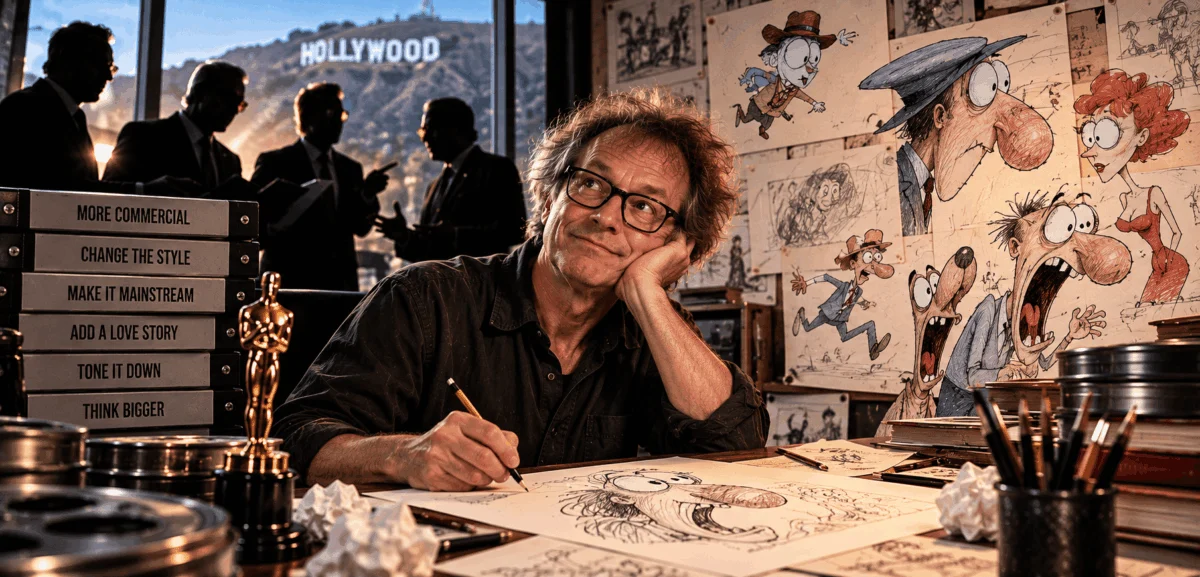
Main Facts: The Blueprint of an Independent Icon
In the modern landscape of corporate media conglomerates, algorithmic content generation, and billion-dollar computer-generated animation pipelines, true creative independence is a vanishing rarity. Yet, for over four decades, two-time Academy Award-nominated animator Bill Plympton has maintained a singular, uncompromising voice in the industry. Known for his wildly surreal, hand-drawn aesthetic, subversive adult humor, and distinctive pencil-and-paper technique, Plympton stands as a towering figure in independent animation.
This deep dive examines Plympton’s storied career, his evolutionary leap from commercial illustrator to autonomous auteur, his historic forays into mainstream institutions like The Simpsons, and his pioneering use of crowdfunding and direct-to-fan distribution models. His journey offers a masterclass for contemporary creators navigating an increasingly consolidated entertainment marketplace, proving that artistic integrity—though fraught with financial peril—remains a viable, enduring path.
Chronology: From Disney Dreams to Direct-to-Fan Autonomy
The Early Influences and the NYC Illustration Years
Bill Plympton’s infatuation with the medium began in his childhood, inspired by the timeless theatrical shorts of Walt Disney, Bob Clampett, and Chuck Jones. Like legions of aspiring artists of his generation, he dreamed of stepping directly into the studio system. However, upon graduating from college around 1968, he encountered a bleak commercial reality: the traditional studio animation pipeline was contracting, and entry-level opportunities were scarce.
Undeterred, Plympton relocated to New York City and forged a viable career as a commercial illustrator and political cartoonist. For roughly fifteen years, he honed his draftsmanship, structural design, and sharp comedic timing. This extended detour away from animation inadvertently built the foundational visual sensibilities that would later define his signature cinematic style.
The Catalyst: The Power of Self-Permission
The trajectory of Plympton’s life changed in 1983 when an outside producer hired him to direct and animate a short project. Although he did not write or originate the concept, sitting at the drawing board and bringing an entire narrative to life through his own labor was an epiphany. He realized a fundamental truth that many independent creators fail to grasp: the greatest impediment to artistic production is often the psychological barrier of waiting for institutional permission.
Energized by this realization, Plympton produced his landmark independent short, Your Face (1987). The film—featuring a man singing a melancholic tune while his facial features grotesquely stretch, morph, and contort—was a critical triumph, earning an Academy Award nomination for Best Animated Short Film. The success validated his gamble, prompting him to abandon commercial illustration entirely and dedicate himself wholly to independent filmmaking.
The Mainstream Interlude: The Simpsons and Mass Visibility
Despite his fiercely independent stance, Plympton’s artistic reputation eventually crossed paths with mainstream pop culture via Matt Groening’s iconic animated series, The Simpsons. Bound by shared Oregon roots and years of casual encounters within the international animation festival circuit, Groening eventually invited Plympton to conceive and animate a custom "couch gag" for the show.
The collaboration proved fruitful, resulting in three distinct, highly memorable opening sequences. Reflecting on the experience, Plympton has often noted a stark industry paradox: those brief television segments were viewed by more people in a matter of seconds than had collectively consumed his entire lifetime portfolio of independent features. This exposure highlighted the profound divide between niche artistic recognition and mass-market saturation, providing him with a broader cultural footprint without compromising his creative autonomy.
Collaborative Auteurs: Bringing Revengeance to Life
As Plympton continued to produce feature-length works, his collaborative instincts led him to writer and animator Jim Lujan. Discovering Lujan’s idiosyncratic shorts through the film festival circuit, Plympton found a kindred spirit whose satirical, pulp-inflected worldview mirrored his own.
The resulting feature, Revengeance (2016), explored the sleazy underbelly of Los Angeles, populating its frame with corrupt politicians, outlaw biker gangs, washed-up wrestlers, and religious zealots. While Lujan authored the screenplay, composed the musical score, and voiced primary roles, Plympton spearheaded the animation and direction. The partnership showcased how independent artists could pool distinct skill sets to bypass the homogenization inherent in large corporate writer’s rooms.
Supporting Data: The Economics of Hand-Drawn Independence
Financing an entirely hand-drawn animated feature film is an extraordinary fiscal and logistical challenge. Every second of screen time requires thousands of individual pencil drawings, often followed by painstaking digital or physical coloring processes.
Personal Financial Stakes
Plympton’s dedication to his craft has routinely extended beyond sweat equity into direct personal financial exposure. During the production of features like Revengeance and Cheatin’ (2013)—the latter of which required an intricate digital watercolor aesthetic that significantly inflated labor costs—Plympton personally invested between $50,000 and $100,000 per project from his own savings. As he succinctly summarizes the stakes of his career: "I bet my career on these films."
Crowdfunding as a Democratic Lifeline
When traditional venture capital, state grants, and studio funding dried up, Plympton turned to digital patronage platforms, most notably Kickstarter. His campaigns consistently demonstrated the viability of direct-to-consumer fundraising:
- The Flying House Restoration: Used crowdfunding to clean, digitally restore, and score deteriorated historical animation by silent-era pioneer Winsor McCay.
- Cheatin’: Surpassed its initial fundraising goal of $75,000, ultimately pulling in over $100,000 to cover mounting labor and coloring expenses.
Crucially, Plympton’s crowdfunding model avoided transactional sterility. Instead of asking for unreciprocated handouts, he offered imaginative, personalized incentives that bridged the gap between creator and patron. Supporters could purchase original animation cels, custom scripts, or—most notably—have their own caricatures drawn directly into the background of a feature film like Revengeance. This strategy transformed backers from passive financiers into active participants in the creative canvas.
Official Responses: Navigating the Hollywood Rejection Loop
The traditional studio apparatus—dominated by major Hollywood players—has historically marginalized work that falls outside predictable commercial demographics. When Plympton pitched his portfolios, storyboards, and concepts to studio executives, the responses were uniformly polite yet dismissive.
Corporate gatekeepers cited several structural incompatibilities:
- Medium: The studio system heavily favored computer-generated imagery (CGI) over traditional, analog, hand-drawn paper animation.
- Target Audience: Plympton’s films were explicitly crafted for adult sensibilities, featuring dark humor, surrealism, and mature themes, whereas studio capital was tightly tethered to four-quadrant, family-friendly marketing models.
- Scale and Control: Plympton’s insistence on maintaining total creative control clashed with the producer-driven oversight models typical of corporate animation houses.
Rather than compromising his artistic vision to appease studio notes departments, Plympton embraced a deliberate pivot away from traditional gatekeepers. He realized that the institutional structures controlling Hollywood’s capital were fundamentally unsuited for avant-garde artistry. Instead, he chose to cultivate a decentralized, loyal global fan base that understood and valued his uncompromising aesthetic.
Implications: A New Paradigm for Independent Creators
Plympton’s career serves as a vital blueprint and cautionary tale for the next generation of independent animators and filmmakers. His philosophy dismantles several pervasive myths about modern cinematic success:
1. The Myth of the Studio Gateway
Aspiring creators are frequently conditioned to believe that a career must begin with an internship, a studio contract, or corporate validation. Plympton demonstrates that an artist can construct a sustainable, internationally recognized career by bypassing the studio infrastructure entirely—building a portfolio through commercial illustration, mastering small-scale production workflows, and cultivating direct relationships with audiences.
2. The Weight of Creative Sovereignty
Independence is not a romanticized ideal free from stress; it is a rigorous trade-off. By retaining absolute control over his intellectual property, Plympton inherited every administrative, financial, and logistical burden. Managing small studio payrolls, funding production overruns, handling festival distribution logistics, and navigating uncertain revenue streams require immense resilience. Creative freedom demands absolute accountability.
3. Rethinking Distribution and Revenue Retention
The evolution of digital distribution has further validated Plympton’s decentralized philosophy. Following the festival and theatrical runs of films like Cheatin’, Plympton experimented with platforms like Vimeo On Demand. By favoring direct-to-consumer digital distribution models over legacy middlemen, independent filmmakers can secure more favorable revenue-sharing agreements, ensuring that capital returns directly to the creators rather than bleeding out through layers of distribution overhead.
The Ultimate Lesson
In an era dominated by algorithmic optimization and risk-averse studio slates, Bill Plympton’s body of work stands as a defiant monument to individual imagination. His journey proves that when Hollywood boardrooms deem an artistic vision "too strange" or "commercially unviable," those very criticisms often signal the presence of true originality. For creators willing to bet everything on their own pen strokes, the audience is out there—waiting for someone brave enough to make the movie only they can create.
