Redefining Virtual Production: Inside Framestore’s Groundbreaking Collaboration with Greig Fraser on Project Hail Mary
Main Facts
When legendary cinematographer GreigFraser was handed a physical mixing deck equipped with tactile dials and trackballs that allowed him to literally move the sun, it wasn’t just a gimmick—it was the linchpin of a massive technological undertaking. For the cinematic adaptation of Andy Weir’s bestselling sci-fi novel ProjectHailMary, directed by Phil Lord and Christopher Miller, Framestore Pre-production Services (FPS) spent roughly a year at Shepperton Studios bridging the gap between physical set construction and a fully realized digital environment.
Starring Ryan Gosling as middle-school science teacher turned astronaut Ryland Grace on a desperate mission to save Earth, the film demanded an unprecedented level of spatial coordination, optical engineering, and virtual cinematography. Collaborating closely with production designer Charlie Wood and the art department, Realtime Supervisor Michael Zaman and Virtual Production Supervisor Connor Ling led an FPS team that fundamentally transformed how filmmakers block, light, and capture a complex, zero-gravity sci-fi epic.
Across 65 intense days inside the motion-capture volume, Fraser captured 1,096 virtual-camera shots. These weren’t mere pre-visualization placeholders; they were deliberate, fully lit choices concerning movement, framing, and light, recorded with granular metadata that flowed seamlessly downstream into visual effects (VFX) and the editing suite.
Chronology: A Year-Long Pipeline from Art Department to Post-Production
The monumental technical roadmap of Project Hail Mary unfolded through distinct, highly collaborative phases over the course of production:
Phase 1: Pre-Production and Virtual Exploration
The collaboration began deep within the art department. Because the spacecraft interiors were constructed as isolated physical sets, the filmmakers needed to understand how these modules fit together long before anyone could physically walk between them. FPS constructed a comprehensive virtual version of the spacecraft.
Using Virtual Reality (VR), Fraser and the art department could explore Grace’s multi-module journey, assess interior scale, and evaluate how shifting gravity vectors would affect audience comprehension. More importantly, this phase served a practical engineering purpose: testing focal lengths, identifying structural obstructions, and flagging panels that needed to be removable for physical cameras. Discovering that a structural wall blocked a critical shot while it was still a digital design decision saved weeks of expensive physical rebuilds later on.
Phase 2: Motion-Capture Volume and Custom Controls
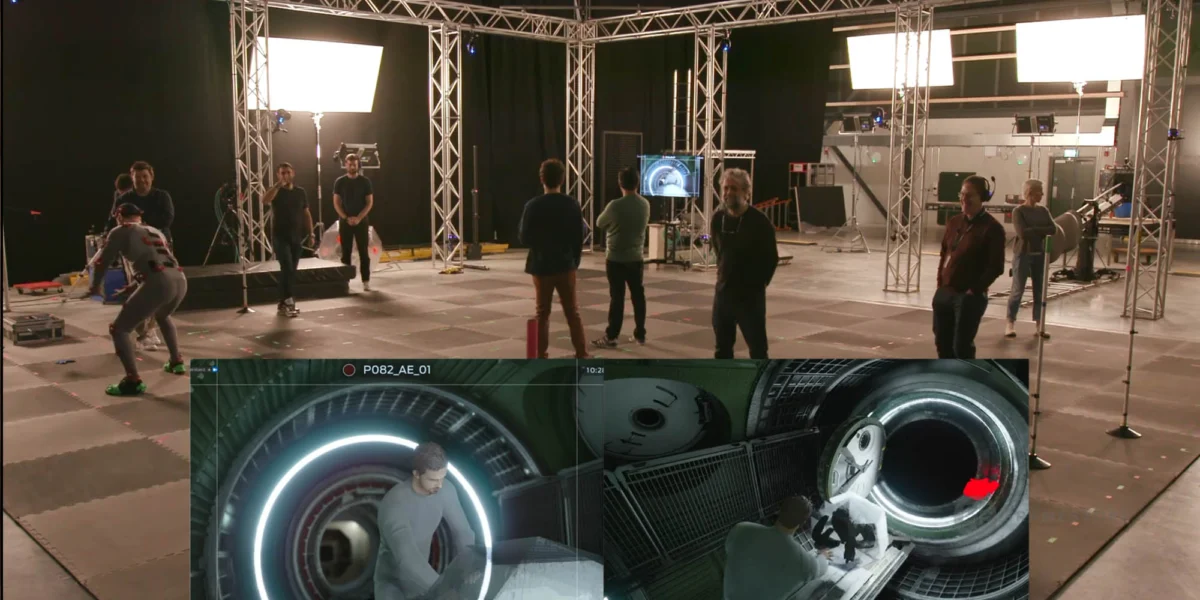
Transitioning from the art department to the motion-capture volume, the team blocked action with performer Josh Wichard before refining it through virtual cameras. To keep Fraser in his element, FPS bypassed generic computer mice and standard digital interfaces, developing a bespoke physical mixing deck.
This hardware gave Fraser tactile control over exposure, focus, iris, zoom, and even orbital lighting via familiar physical gestures. Operating a shoulder-mounted virtual camera, he maneuvered through scenes using joysticks while adjusting the virtual sun along individual axes.
Phase 3: Principal Photography and Live Simulcam
Once principal photography commenced on the physical stages at Shepperton, FPS deployed an Amazon MGM Studios Simulcam system. Utilizing RedSpy camera tracking sensors and stage-wide LiDAR point-cloud scans loaded into Unreal Engine, the system generated real-time composites of the photographed physical sets blended seamlessly with their digital extensions.
Camera operators could pivot from a planned mechanical jib shot to a handheld configuration on short notice, and the virtual background system would update within milliseconds to match the new perspective.
Phase 4: Post-Production and Postvis Continuity
The digital workflow did not end on set. FPS provided continuous support through editorial and post-visualization, notably helping to refine the alien character Rocky’s performance inside his specialized traveling sphere. Furthermore, all camera animations, lens choices, and lighting setups were directly imported into final VFX pipelines, ensuring that the digital shots faithfully reproduced the exact cinematic choices Fraser made months prior.
Supporting Data & Technical Complexities
The technical hurdles faced by Framestore Pre-production Services went far beyond standard virtual production workflows. The sheer volume of data, coupled with unorthodox optical choices, required custom engineering at every turn.
Volume Output: Across 65 days of shooting inside the motion-capture volume, Greig Fraser captured 1,096 distinct virtual-camera shots.
Daily Turnarounds: FPS routinely delivered rushes twice daily—handing over the morning session during the crew break and the afternoon session immediately following wrap.
Data Footprint: The virtual shoot generated approximately 2,000 individual video files totaling roughly 60 hours of raw footage. Early virtual cuts remained in the master edit well into post-production, guiding pacing and narrative structure while final visual effects were still being rendered.
The Anamorphic Challenge: The production utilized an ARRI ALEXA 65 camera package paired with vertically oriented anamorphic lenses for space sequences. This configuration produced a striking, towering IMAX frame with unique optical distortions. However, standard virtual camera packages could not natively account for the vertical de-squeeze. FPS engineers had to rewrite virtual filmback calculations to match the specific optics.
Tracking and Calibration: RedSpy sensors combined with stage markers established precise positional tracking, while LiDAR scanned physical sets to align real-world geometry with Unreal Engine environments. When automated tracking solutions failed due to the extreme properties of the vertical anamorphic lenses, recorded metadata from FarSight Studio—which preserved asset versions, lighting changes, and lens properties per take—provided a trusted reference for downstream VFX artists.
Official Responses and Industry Insights
The success of the virtual production pipeline on Project Hail Mary hinged on breaking down traditional silos between departments. Rather than treating virtual production as an isolated visual effects exercise, the filmmakers integrated FPS into the core creative decisions of the film.
Michael Zaman, Realtime Supervisor for Framestore Pre-production Services, highlighted the foundational philosophy governing their technological restraint:
"Digital can do anything, that doesn’t mean it should… The goal was to render what he shot, not to change it at all."
Zaman emphasized that while digital environments offer infinite possibilities, the true triumph of the system was its ability to respect and replicate the natural instincts of a seasoned cinematographer. Rather than letting software dictate the look, the technology was engineered to bend entirely to Fraser’s established vocabulary of lumens, ISO, and apertures.
Echoing this sentiment, Virtual Production Supervisor Connor Ling noted the careful balance required when sharing virtual environments in real-time:
"The work was always as information, never to tie them into a direction."
Ling explained that to prevent the motion sickness often associated with wide, restless headset monitor feeds, the team attached a virtual cinematic camera with controlled filmback and lens settings directly to the VR headset, stabilizing the output. This allowed directors Phil Lord and Christopher Miller, along with department heads, to observe a readable, cinematic view of the decisions being made without restricting the exploratory freedom of the operator inside the headset.
Implications for the Future of Filmmaking
The collaboration between Framestore, Phil Lord, Christopher Miller, and Greig Fraser on Project Hail Mary establishes a new benchmark for what modern virtual production can achieve when driven by creative intent rather than technical novelty.
By treating virtual assets, lighting tools, and camera packages as direct extensions of traditional filmmaking gear, the production successfully bridged the gap between pre-visualization and principal photography. The data collected on set—ranging from precise lens metadata to lighting configurations—ensured that the aesthetic integrity established by the cinematographer in a virtual volume survived the grueling journey through post-production and final visual effects rendering.
Ultimately, Project Hail Mary proves that the most successful technological advancements in cinema are those that empower filmmakers to work more intuitively. By giving a master cinematographer a dial to move the sun, Framestore didn’t just build a digital playground; they expanded the physical boundaries of the medium, proving that with the right tools and collaborative relationships, the camera can go anywhere—even to the edge of the universe.