
The Dual Legacies of Under the Skin: Why Michel Faber’s Sci-Fi Masterpiece Still Deserves a Faithful Screen Adaptation

In 2013, director Jonathan Glazer released Under the Skin, a haunting, minimalist science-fiction film starring Scarlett Johansson as an enigmatic alien entity hunting men in the Scottish Highlands. Distributed by A24, the film was hailed by critics as a landmark of modern cinema—an unsettling, atmospheric meditation on empathy, gender dynamics, and human connection. Yet, despite its critical acclaim, the film represents only one possible interpretation of its source material: Michel Faber’s brilliant, deeply disturbing 2000 debut novel of the same name.
While Glazer’s adaptation achieved cinematic masterpiece status, it did so by stripping away almost the entire narrative architecture of Faber’s book. The novel’s overt critiques of industrial agriculture, corporate exploitation, and class division were largely discarded in favor of abstract, tone-driven existentialism. Decades after the book’s publication, and over ten years since the film’s release, the landscape of speculative fiction is riper than ever for a project that has yet to be realized: a faithful, narratively complete adaptation of Michel Faber’s original vision.
1. Main Facts: The Divergent Paths of Page and Screen
To understand why a second adaptation is warranted, one must first examine how fundamentally the 2013 film departed from the 2000 novel. Though both works share a geographic setting—the mist-shrouded roads of Northern Scotland—and a premise involving an alien disguised as a human woman preying on male hitchhikers, their thematic priorities, world-building, and narrative arcs are entirely distinct.
+-------------------+-----------------------------------------+-----------------------------------------+
| Feature           | Michel Faber's Novel (2000)             | Jonathan Glazer's Film (2013)           |
+-------------------+-----------------------------------------+-----------------------------------------+
| Protagonist       | Isserley (Painfully surgically altered) | "The Female" / Laura (Sleek, ambiguous) |
| Core Conflict     | Class struggle, factory farming guilt   | Discovery of human empathy & identity   |
| Alien Motive      | Harvesting "voddissin" (human meat)     | Mysterious, abstract consumption        |
| Tone & Style      | Satirical, grotesque, deeply internal   | Minimalist, avant-garde, sensory        |
+-------------------+-----------------------------------------+-----------------------------------------+
The Novel: A Grotesque Allegory of Industrial Exploitation
In Faber’s novel, the protagonist is named Isserley. She is not a sleek, effortlessly seductive phantom, but a deeply traumatized, lower-class citizen of an unnamed alien world. To survive and secure employment, she has undergone agonizing, highly invasive surgeries to warp her quadrupedal, fur-covered body into a bipedal human form. Her breasts are painful silicone implants, her spine has been brutally elongated, and her tail has been amputated.
Isserley works for a corporate conglomerate called Vess. Her job is to drive a modified Toyota Corolla around the A9 road in Scotland, picking up muscular male hitchhikers (referred to by her species as "vodsel"). Once deemed of sufficient quality, the men are drugged and transported to an underground processing facility hidden beneath a farm called Ablach. There, they are castrated, fattened up, chemically silenced, and eventually slaughtered to be shipped back to her home planet as a luxury meat delicacy known as voddissin.
The Film: An Abstract Study in Human Empathy
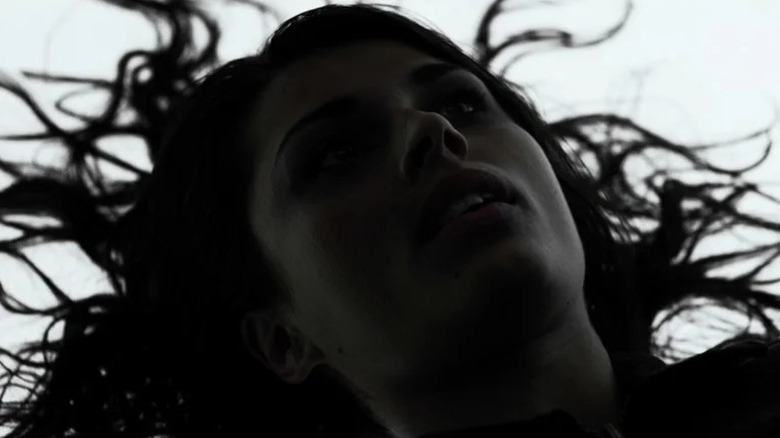
Jonathan Glazer’s film discards the corporate backstory, the alien home world, the physical agony of the protagonist, and the culinary destination of her victims. Johansson’s character—unnamed in the film but often referred to as "The Female" or Laura—lures men not to a hidden farm, but to a surreal, extradimensional black liquid pool where they are seamlessly dissolved.
Glazer focuses almost entirely on the alien’s internal awakening. Through her encounters with humanity—most notably a gentle man with neurofibromatosis—she begins to experience self-awareness, vulnerability, and the terrifying realities of human sexuality and violence. Where Faber’s novel uses science fiction to examine how we treat "the other," Glazer’s film uses it to examine how "the other" learns to see us.
2. Chronology: From Highland Solitude to Cinematic Landmark
The journey of Under the Skin from a lonely Scottish highway to the heights of international cinema spans over two decades of creative evolution and painstaking development.

1993–1999: The Genesis of Isserley
The roots of the novel lie in Michel Faber’s personal history. Having moved from a bustling Australian metropolis to a remote, isolated cottage in the Scottish Highlands, Faber experienced profound geographical and social alienation. The vast, empty landscapes and the psychological weight of isolation became the bedrock of Under the Skin. Writing the novel throughout the late 1990s, Faber sought to capture the vulnerability of marginalized individuals while interrogating the moral blindness of industrial society.
2000: Publication and Critical Breakthrough
Under the Skin was published in 2000 by Canongate Books. It was an immediate critical success, shortlisted for the Whitbread First Novel Award. Critics praised its unique blend of body horror, dark humor, and genuine emotional pathos.
2004–2013: Glazer’s Decade-Long Developmental Hell
Shortly after the book’s release, film producers began pursuing the rights. Director Jonathan Glazer, hot off the success of Sexy Beast (2000) and Birth (2004), signed on to direct. However, translating the book proved exceptionally difficult.
Early drafts of the screenplay were highly faithful, featuring elaborate CGI alien worlds and a secondary alien character (at one point, Brad Pitt was in negotiations to co-star as Isserley’s partner). Over a grueling nine-year development process, Glazer and co-writer Walter Campbell systematically stripped away these conventional sci-fi tropes. They decided that showing the alien world on screen would cheapen the mystery, choosing instead to anchor the perspective entirely on Earth.
[1993-1999: Faber moves to Scotland; writes novel]
       │
[2000: "Under the Skin" published to critical acclaim]
       │
[2004: Jonathan Glazer begins development on film adaptation]
       │
[2004-2011: Multiple drafts discarded (including conventional sci-fi versions)]
       │
[2011-2012: Guerilla filming in Glasgow with hidden cameras]
       │
[2013: Film premieres at Telluride & Venice; released by A24]
       │
[2020: Faber reflects on the novel's 20th anniversary in The Guardian]
2012: Guerilla Production in Glasgow
Filming took place under immense secrecy. Glazer utilized hidden cameras installed inside a modified van driven by Scarlett Johansson. The actress interacted with real, unsuspecting members of the public, improvising conversations to lure them into the vehicle. This hybrid of documentary realism and surrealist sci-fi gave the film its signature, deeply unsettling texture.
3. Supporting Data: Thematic and Narrative Distinctions
A closer analysis of the narrative mechanics of both versions reveals why Glazer’s film, while brilliant, left the most compelling elements of Faber’s book untouched.
The Morality of the Meat Industry vs. Existential Awakening
Faber’s novel is one of the most powerful anti-factory-farming allegories in modern literature. Isserley’s species does not view humans as sentient equals because humans walk on two legs, speak a language they do not understand, and lack the "spiritual" sophistication of her kind.
The novel details the horrific industrialization of human slaughter:

- The "Sinks": Underground holding pens where captured humans are kept in darkness to keep their meat tender.
- Ablach Farm: A facade of rural Scottish domesticity that masks a highly efficient, corporate-run slaughterhouse.
- The Class Divide: Isserley’s masters, the "Elites," live in luxury on their home planet, entirely insulated from the environmental devastation of their world and the moral cost of the meat they consume.
In contrast, Glazer’s film bypasses the meat industry allegory entirely. The men captured by Johansson’s character are not processed for consumption in a corporate sense; instead, their bodies are harvested in an abstract, dreamlike void. The film shifts the thematic focus from collective corporate guilt to individual sensory experience.
Characterization: Isserley’s Agony vs. Laura’s Cold Curiosity
The physical reality of the protagonist differs wildly between the two mediums:
- Isserley (Book): Lives in constant, agonizing physical pain due to her forced orthopedic surgeries. She is a tragic, exploited worker who must take massive doses of painkillers just to sit upright in her car. Her sexuality is a tool of forced labor, and she harbors a deep resentment toward the elite male bosses who mutilated her body for corporate profit.
- The Female (Movie): Appears as an idealized, unblemished human female. She does not experience physical pain until the film’s climax. Her journey is defined by a slow, observational curiosity. When she looks in a mirror, she is not mourning her lost alien body; she is trying to understand the human skin she inhabits.
Cinematic Style: The Power of Mica Levi’s Score and Hidden Cameras
While Glazer abandoned Faber’s narrative, he constructed a masterpiece of sensory cinema. The film’s impact relies heavily on:
- Mica Levi’s Score: A microtonal, scratching string soundtrack that evokes a sense of alien dread and tragic beauty.
- Naturalistic Acting: By casting non-professional actors who did not know they were being filmed until after the scenes were shot, Glazer captured genuine human warmth, awkwardness, and vulnerability—elements that contrast sharply with the coldness of the alien’s mission.
4. Official Responses: Authors, Directors, and Critics
The relationship between a novelist and the filmmaker who adapts their work can often be contentious, but the creative history of Under the Skin is marked by mutual respect and artistic clarity.
Michel Faber’s Perspective
Rather than feeling betrayed by Glazer’s radical departures, Michel Faber has consistently championed the 2013 film. In a 2014 interview with critic Gabriel Valdez, Faber expressed relief that Glazer did not attempt a literal, low-budget translation of his book:
"A mediocre or weak adaptation that tried to be faithful would have upset me. A strong adaptation that took wild liberties made me very happy. I’ve been lucky so far."
Faber went on to compare Glazer’s film to Francis Ford Coppola’s Apocalypse Now—a loose adaptation of Joseph Conrad’s Heart of Darkness that was "ruthlessly unfaithful and yet true to the essence."
However, Faber has also remained protective of the book’s distinct identity. Writing for The Guardian in 2020 on the 20th anniversary of the novel’s publication, Faber clarified that his story was not a simple tract on vegetarianism, but a broader exploration of moral evasion:
"Under the Skin is not about the evils of eating meat, but about the evils of evading moral responsibility for the decisions we make… [It is about] the vulnerability of the lost and unloved people pushed to the peripheries of our herd."
Jonathan Glazer’s Directorial Philosophy
Glazer has been open about his need to find his own connection to the material, even if it meant discarding Faber’s intricate plotting. For Glazer, the core of the film was the gaze: seeing our world through eyes that find the ordinary to be utterly extraordinary. He wanted to strip away the "pulpier" science-fiction elements of the novel—such as the corporate alien hierarchy and the physical description of the alien home world—to prevent the film from becoming a conventional B-movie.
Critical and Commercial Reception
Upon its release, the film was a critical darling but a commercial disappointment. It grossed just $7.2 million worldwide against a production budget of $13.3 million. However, its cultural footprint has grown exponentially. It routinely appears on lists of the greatest science-fiction films of the 21st century, celebrated for its bold aesthetic choices.
5. Implications: Why the 2020s Demand a Faithful Adaptation
The success of Jonathan Glazer’s 2013 film does not close the book on Under the Skin; rather, it leaves half of the story completely untold. The themes that Michel Faber explored in his 2000 novel have only grown more urgent, prescient, and culturally relevant in the decades since its publication. A new, faithful adaptation—perhaps as a high-budget prestige television miniseries—could offer a profound exploration of modern anxieties.
The Rise of Eco-Horror and Anti-Capitalist Sci-Fi
The 2020s have seen a massive resurgence in speculative fiction that tackles systemic exploitation, climate collapse, and corporate greed. Faber’s depiction of the Vess corporation—which ravages Earth’s resources and exploits its own lower-class citizens (like Isserley) to provide luxury goods for an insulated elite—is a perfect mirror for contemporary anxieties surrounding late-stage capitalism and environmental degradation.
The Ethics of Consumption and Animal Rights
Public discourse around factory farming, veganism, and the ethical treatment of animals has shifted dramatically since 2000. What was once considered a niche philosophical debate is now a mainstream cultural conversation. A faithful adaptation that forces audiences to confront the physical reality of the "sinks" and the industrial processing of humans as "voddissin" would serve as a powerful, provocative exploration of speciesism.
                    [Contemporary Cultural Anxieties]
                                   │
         ┌─────────────────────────┼─────────────────────────┐
         ▼                         ▼                         ▼
 [Factory Farming]         [Late Capitalism]         [Class Exploitation]
  Humanity cast as          The Vess Corp's           Isserley's painful
  slaughterhouse prey      resource extraction       body-modification labor
The Visual Potential of Faber’s Alien World
With advancements in prosthetic makeup, practical effects, and CGI, a modern adaptation could fully realize the tragic, grotesque beauty of Isserley’s true form. Showing the physical toll of her surgeries and the vast difference between her natural quadrupedal movement and her forced bipedal gait would provide a powerful visual metaphor for bodily autonomy, disability, and transhumanist labor exploitation.
Ultimately, Under the Skin is a rare property that contains two entirely different, equally brilliant masterpieces within its premise. Jonathan Glazer gave the world a cinematic triumph of empathy and sensory dread. Now, the time is right for a storyteller to return to the Highlands, pick up Michel Faber’s original blueprint, and confront audiences with the terrifying, deeply moral, and radically anti-systemic vision of the book that started it all.
