
Unearthing the Genesis of a Master: A Deep Dive into Criterion’s The Complete Kubrick
Main Facts: The Ultimate Retrospective and Early Work Revival
In celebration of the monumental release of Criterion’s The Complete Kubrick, film enthusiasts and critics are being treated to a comprehensive, era-by-era, disc-by-disc re-examination of one of cinema’s most exacting auteurs. While Stanley Kubrick’s later masterpieces—such as 2001: A Space Odyssey, The Shining, and Barry Lyndon—are universally recognized as towering achievements in visual storytelling, this expansive box set forces a reassessment of where the legend truly began.
The first leg of this retrospective ventures far beyond the polished, climate-controlled London soundstages of his mid-career epics, transporting viewers back to the gritty, asphalt-paved streets of 1950s New York and the sun-bleached badlands of the American Southwest. Comprising a trio of early documentary shorts (Day of the Fight, Flying Padre, and The Seafarers) alongside his notoriously troubled narrative features (Fear and Desire and Killer’s Kiss), this foundational block of work shatters the myth of the overnight cinematic prodigy. Instead, it reveals a fiercely ambitious, formally daring, and frequently stumbling young artist carving out a cinematic vocabulary from the ground up.
Chronology: From Photojournalist to Experimental Auteur
To understand Stanley Kubrick’s directorial debut, one must first trace his trajectory through the world of still photography. At just seventeen years old, Kubrick’s sharp eye landed him a staff position at Look magazine. This formative period instilled in him a quiet, confident mastery of expressive angles, dynamic shot composition, and the uncanny ability to evoke an entire human milieu within a single frame.
1. The Apprenticeship of Reality: Early Documentary Shorts (1951–1953)
Kubrick’s transition from photojournalism to motion pictures began in earnest with his trio of early short subjects:
- Day of the Fight (1951): Filmed on location in his native Manhattan, this 16-minute short follows twin middleweight boxing brothers Walter and Vincent Cartier—both World War II veterans—as they prepare for a high-stakes bout. Kubrick exercised complete authorial intervention, staging scenes and incorporating props to amplify the narrative. Notably, he included a sequence of the brothers receiving holy communion in a cathedral shot with imposing Gothic awe, alongside staging his own pet dog in a scene to make a fighter appear gentler. The stylistic seeds of his future narrative works, particularly Killer’s Kiss, were sown right here in the boxing ring.
- Flying Padre (1951): Shot against the blazing skies and sun-bleached horizons of rural New Mexico, this short chronicles a Catholic priest who uses a light aircraft to traverse his sprawling, topographically challenging parish. Serving as Kubrick’s first onscreen engagement with religious iconography, the film also offers a fascinating glimpse into how he might have approached the Western genre, featuring evocative wide shots of mule riders and expressionistic close-ups of weathered wooden crosses in small settlement graveyards.
- The Seafarers (1953): Commissioned by the Seafarers’ International Union, this 30-minute industrial film is primarily an educational showcase of union facilities and member benefits. While its heavy narration can test the patience of modern viewers, the film is a masterclass in color composition. Kubrick uses pale-blue and beige-clad workers dwarfed by stark, commanding technological structures—at sea and inside industrial command centers—while revealing his early penchant for pop-culture subversion by lingering on bawdy pin-up posters.
2. The Misstep: Fear and Desire (1952)
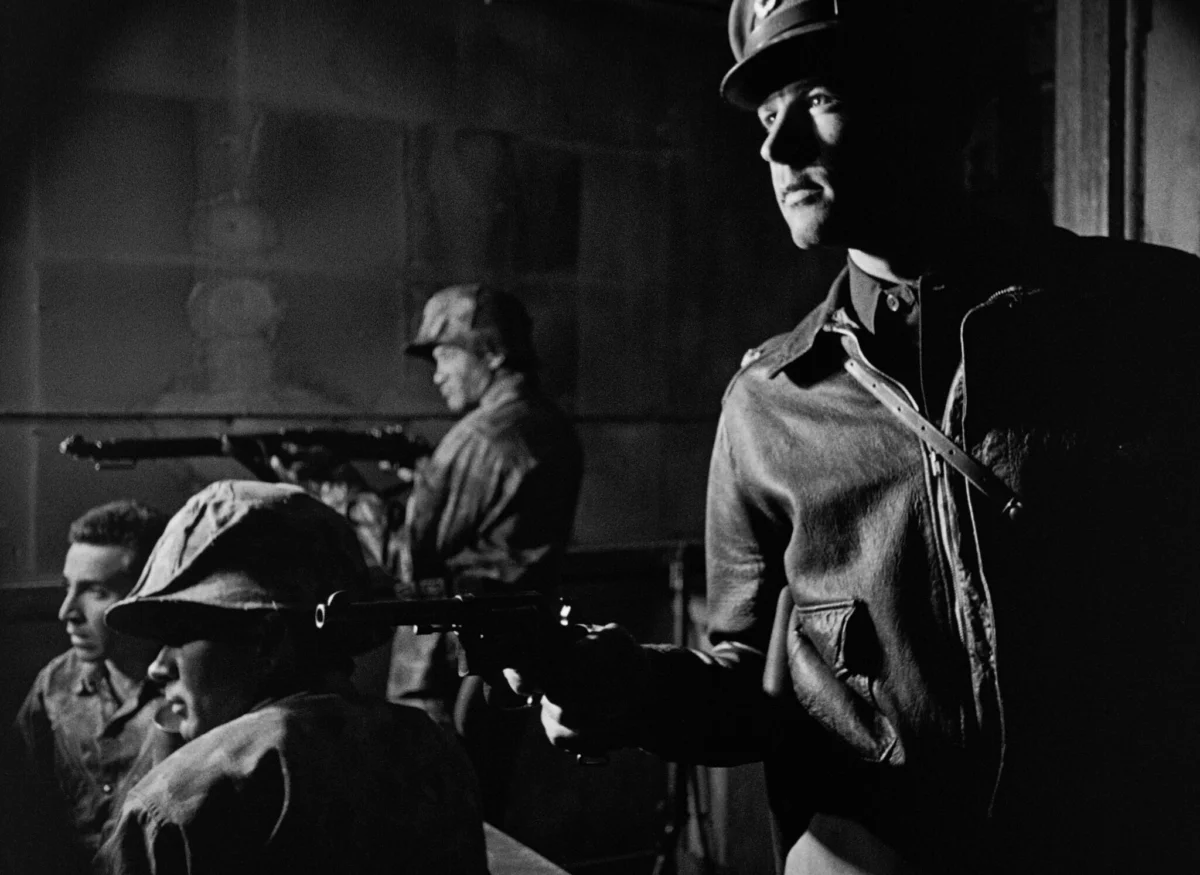
Moving from documentary to fiction, a 23-year-old Kubrick pooled funds from family—most notably his pharmacist uncle Martin Perveler—to direct his first feature-length narrative, Fear and Desire. Set during an unspecified wartime conflict, the film follows four soldiers stranded behind enemy lines.
The result was an amateurish exercise that even an older, wiser Kubrick would famously dismiss as "boring and pretentious." Driven by a deep embarrassment, Kubrick spent decades attempting to purge the film from circulation, tracking down and destroying existing prints while forbidding his wife, Christiane, from ever viewing it.

3. The Noir Transition: Killer’s Kiss (1955)
Kubrick’s second narrative feature, Killer’s Kiss, marked his first official step into legitimate commercial filmmaking, albeit through an independent, bootstrapped production. Co-written by Howard Sackler, the film follows a down-on-his-luck boxer (Jamie Smith) who falls for a local gangster’s girlfriend (Irene Kane) amidst the shadowy canyons of midcentury New York City. Though still encumbered by clunky dialogue and an abrupt, hokey conclusion, the film served as a vital visual bridge between his documentary roots and his future cinematic heights.
Supporting Data: Technical Evolution and Visual Motifs
A comparative analysis of Kubrick’s earliest works reveals a fascinating paradox: while his technical proficiency as a visual stylist was apparent almost immediately, his mastery of written dialogue and narrative pacing took years to catch up.
| Film Title | Release Year | Primary Medium / Genre | Defining Visual Motifs | Critical Verdict in Retrospect |
|---|---|---|---|---|
| Day of the Fight | 1951 | Documentary Short / Boxing | High-contrast Manhattan streetscapes, Gothic church framing, staged human-interest elements. | A confident display of photojournalistic instincts adapted to motion. |
| Flying Padre | 1951 | Documentary Short / Travelogue | Sun-drenched wide shots, expressive close-ups, religious architectural framing. | A tantalizing preview of a potential Kubrickian Western. |
| The Seafarers | 1953 | Industrial / Educational | Stark color blocks, industrial geometry, early inclusion of pin-up iconography. | A stylized, if dry, time capsule of mid-century union labor. |
| Fear and Desire | 1952 | Narrative Feature / War Allegory | Abstract sets, heavy shadows, metaphorical framing of internal psychological conflict. | An over-ambitious undergraduate exercise; Kubrick’s most famous misfire. |
| Killer’s Kiss | 1955 | Narrative Feature / Film Noir | Art Deco architecture, gritty street photography, high-contrast chiaroscuro lighting. | A narrative misfire elevated by breathtaking location cinematography. |
As highlighted in the data above, Kubrick’s earliest cinematic DNA relied heavily on spatial juxtaposition. Whether contrasting the clean, angular Art Deco architecture of Manhattan with the dirty, chaotic urban underbelly in Killer’s Kiss, or abstracting war completely from historical flags and ideologies in Fear and Desire, the director was consistently drawn to dualism. The "real war," as Kubrick conceptualized it from his very first feature, was never about external geopolitics; it was an internal struggle against base human nature—a theme memorably literalized in Fear and Desire when soldiers play both opposing armies, and shockingly underscored by a captive assault sequence.
Official Responses and Archival Revelations
The curation of The Complete Kubrick by Criterion has prompted widespread discussions among film historians, archivists, and estate representatives regarding the treatment of marginalized early works.
For decades, Fear and Desire existed primarily as a cinematic ghost, circulated only via illicit, low-quality bootlegs among cinephiles. The inclusion of a newly restored version within Criterion’s box set represents a major shift in how film preservationists view an artist’s complete output. Michael Chaiken, who spearheaded the assemblage of The Complete Kubrick, noted in interviews surrounding the release that the preservation of Kubrick’s early shorts and debut feature is essential for tracing the evolution of his uncompromising artistic vision.
While Kubrick himself spent a lifetime trying to bury Fear and Desire, contemporary critics argue that his efforts were misguided. Far from tarnishing his legacy, the film’s glaring flaws humanize the legendary filmmaker, proving that even masters must stumble before they can learn to walk.

Implications: Reshaping the Kubrick Mythos
The arrival of The Complete Kubrick carries profound implications for film studies and the mythos surrounding auteur theory.
For generations, film culture has leaned heavily into the archetype of the "boy genius"—the infallible artist whose every creative output springs forth fully formed and dripping with perfection. Kubrick’s early work, preserved and presented in pristine quality by Criterion, dismantles this romanticized notion. It demonstrates that greatness is often forged through trial and error, cheap budgets, clunky dialogue, and embarrassing miscalculations.
Furthermore, these early films establish the foundational grammar that Kubrick would refine across a five-decade career. The nonverbal storytelling experiments witnessed in the shadows and alleys of Killer’s Kiss directly foreshadow the cinematic abstraction he would perfect in 2001: A Space Odyssey. The deep-seated fascination with institutional control, psychological duality, and the fragility of human civilization can be traced in a direct, unbroken line from an industrial union hall in 1953 all the way to the corridors of the Overlook Hotel and the saloons of Barry Lyndon.
Ultimately, Criterion’s retrospective does not diminish Stanley Kubrick’s towering status in cinema history; rather, it grounds him. By dragging his earliest, roughest experiments out of the shadows, The Complete Kubrick reminds audiences that cinematic titans are not born overnight—they are built through relentless drive, self-criticism, and the courage to confront, and learn from, their most spectacular failures.
